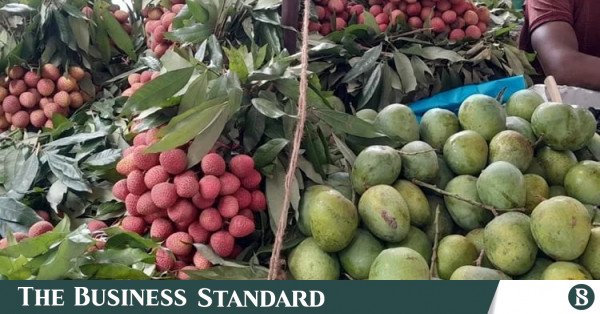
The country earned $123.02 million from fruit exports between July and May of FY26, surpassing the total $67.51 million recorded in the whole of FY25. The figure marks an increase of more than 82% and the highest earnings from fruit exports in recent years
Seasonal fruits at a fruit stall. File Photo: BSS
“>

Seasonal fruits at a fruit stall. File Photo: BSS
Highlights:
- Iran conflict disrupting trade routes, increasing global food costs
- Rising energy prices driving higher food production expenses
- Millions more face hunger in Somalia, Afghanistan, Sri Lanka
- Up to 45 million additional people risk food insecurity
- Vulnerable low-income families hardest hit by rising prices
- WFP seeks more donor support amid funding shortages
The country’s fruit exports have reached a record high in the first 11 months of fiscal year 2025-26, driven by rising demand from expatriate Bangladeshis for mangoes, guavas, jackfruits and other tropical fruits, according to Export Promotion Bureau (EPB) data.
The country earned $123.02 million from fruit exports between July and May of FY26, surpassing the total $67.51 million recorded in the whole of FY25. The figure marks an increase of more than 82% and the highest earnings from fruit exports in recent years.

The sector has recorded rapid growth over the past three fiscal years, with earnings of $29.24 million in FY24 and just $1.06 million in FY23.
Abdul Wahed, president of the Chapainawabganj Chamber of Commerce and Industry, said Bangladeshi fruits are currently exported mainly to the Middle East and European countries with large Bangladeshi expatriate populations.
Infograph: TBS
“>

Infograph: TBS
“Most of our exports cater to expatriate communities. We have yet to penetrate the mainstream international fruit market because our compliance standards, packaging and branding are still not at the level required by global buyers,” he said.
Industry stakeholders also attributed the growth to improved compliance with international food safety standards, expansion of export-oriented cultivation, and wider access to overseas markets.
EPB data show that exports under the category “other nuts, fresh or dried” accounted for the bulk of earnings, bringing in $122.18 million during the July-May period, compared to $66.05 million in FY25.
Exports of frozen fruits and nuts also rose to $439,821, while fresh fruit shipments contributed to overall growth.
Exporters said mangoes remain the country’s main fruit export during the summer season, particularly in markets among expatriate communities in the United Arab Emirates, Saudi Arabia, Qatar, Oman, Kuwait, the United Kingdom and parts of Europe.
Fresh guavas and jackfruits have also gained popularity due to improved quality and competitive pricing. Demand for pineapples, litchis, bananas and other seasonal fruits has steadily increased.
Bangladeshi fruits are currently exported to destinations including the UAE, Saudi Arabia, Qatar, Oman, Kuwait, Malaysia, Singapore, the United Kingdom and several European Union countries.
EPB Director Kumkum Sultana said fruit cultivation in Bangladesh, particularly in the hill districts, has undergone a significant transformation.
“A fruit revolution is taking place in the hill regions. The scale of cultivation of fruits such as dragon fruit, cashew nuts and coffee is impressive,” she said.
She added that targeted infrastructure support could further boost exports.
“If packing sheds, post-harvest treatment facilities and other basic infrastructure are expanded, exporters will be able to take greater advantage of international markets,” she said.
EPB Vice Chairman Mohammad Hasan Arif said fruit exports generate high economic value as they rely largely on local raw materials.
“Unlike many other sectors, fruit production does not depend heavily on imported inputs,” he said, adding that the EPB is working to encourage more farmers and entrepreneurs to enter export markets.
Industry stakeholders said investments in cold-chain systems, modern packaging facilities and improved post-harvest handling have strengthened product quality and shelf life.
They also pointed to the growing role of private agro-processing firms and contract farming in ensuring a steady supply of export-grade produce.
Logistics remains a challenge
The adoption of vapour heat treatment, pesticide residue monitoring and traceability systems has also improved buyer confidence in strict international markets.
However, exporters said logistics remain a key constraint. High air freight costs, limited cargo space during peak seasons, inadequate refrigerated transport and slow customs clearance continue to hinder growth.
Abdul Wahed said the district exported around 10,000 tonnes of mangoes last year and expects higher volumes this season, but rising freight costs remain a concern.
“Most export-related services, including quarantine certification and packaging facilities, are concentrated in Dhaka. If such facilities were available at the divisional level, it would make exports much easier and more cost-effective,” he said.
He added that if freight costs can be reduced and export procedures simplified, fruit exports could grow substantially,
Industry participants expect export earnings to rise further before the end of the fiscal year as the peak mango export season continues.
About The Author