Documents show political, civic and cultural life before displacement
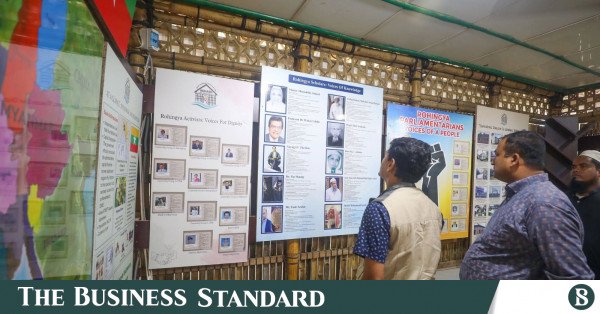
Visitors look over displays on Rohingya parliamentarians, scholars and activists inside the Rohang Heritage Center at Kutupalong Camp 6 in Ukhiya. The centre preserves more than 200 documents, photographs and records tracing the community’s political, civic and cultural history. The photo was taken recently. Photo: Mohammad Minhaj Uddin
“>

Visitors look over displays on Rohingya parliamentarians, scholars and activists inside the Rohang Heritage Center at Kutupalong Camp 6 in Ukhiya. The centre preserves more than 200 documents, photographs and records tracing the community’s political, civic and cultural history. The photo was taken recently. Photo: Mohammad Minhaj Uddin
Long before refugee camps came to define the Rohingya experience, members of the community sat in Burma’s parliament, held government-issued identity papers and heard their language on national radio.
Those fragments of political, civic and cultural history now line the bamboo walls of the Rohang Heritage Center in Camp 6 of the Kutupalong refugee settlement in Ukhiya.
Established with Bangladesh government funding in February, the centre displays more than 200 documents, photographs, maps, newspaper clippings, books and other records.

The initiative also seeks to introduce younger Rohingya to a past increasingly distant from camp life. More than 2,16,000 Rohingya children have been born in Bangladesh over the past nine years, while about 52% of the roughly 1.2 million refugees are under 18.
“More than 200 items are currently on display at the heritage centre,” Refugee Relief and Repatriation Commissioner Mohammed Mizanur Rahman told TBS.
“Many came from documents that Rohingya families managed to carry with them when they fled to Bangladesh,” he said.
The bamboo-built Rohang Heritage Centre in Kutupalong Camp 6, Ukhiya, showcases documents, photographs, maps and language records that trace Rohingya political, civic and cultural history for younger generations growing up in exile. The photo was taken recently. Photo: Mohammad Minhaj Uddin
“>

The bamboo-built Rohang Heritage Centre in Kutupalong Camp 6, Ukhiya, showcases documents, photographs, maps and language records that trace Rohingya political, civic and cultural history for younger generations growing up in exile. The photo was taken recently. Photo: Mohammad Minhaj Uddin
A political past
One section focuses on a period when Rohingya politicians were represented in Burma’s legislature.
Sultan Ahmed and MA Gaffar were elected to Burma’s Constituent Assembly in 1947. In the first post-independence parliamentary election in 1951-52, Zura Begum, also known as Daw Aye Nyunt, won the Maungdaw South constituency and became one of only two women elected in that poll.
The centre also features Sultan Mahmud, who was elected from Buthidaung and later served as health minister under prime minister U Nu.
Later political participation is also documented. Four candidates from the National Democratic Party for Human Rights won parliamentary seats in the 1990 election, although the military did not transfer power nationally and the party was later banned.
For Mohammed Ansar, a young Rohingya volunteer, the records show a history sharply different from the community’s present statelessness.
“The presence of members of parliament and people who represented the government shows the political position the Rohingya once had,” he told TBS.
From civil documents to temporary cards
A board titled “Civil Documents of Rohingya in Myanmar” displays identity cards, birth and marriage certificates, family census lists, land records and voting documents.
Rohingya families were among those issued National Registration Cards under Burma’s post-independence registration system in the 1950s. Their legal position changed sharply after the 1982 Citizenship Law and the citizenship scrutiny system that followed.
The Rohingya were later omitted from Myanmar’s official list of 135 recognised “national races”. When old registration documents were replaced with Citizenship Scrutiny Cards from 1989, many Rohingya were denied the new cards.
Temporary Registration Cards, commonly known as white cards, were later issued widely to Rohingya. These were cancelled in 2015 and followed by the National Verification Card process, which many Rohingya rejected because they said it treated them as foreigners.
The centre also displays photographs of 25 mosques that it says date to before 1823, as well as records of Rohingya-language programming on Burma Broadcasting Service in the early 1960s.
Keeping memory alive
The Rohang Heritage Centre was developed under the initiative of Camp 6 Camp-in-Charge Gazi Shariful Hasan, with support from Rohingya volunteers.
Hasan, a deputy secretary, said many refugees readily recall farming, fishing, livestock and business, but their political past is fading from memory.
“The centre was created to preserve that history and introduce children and young people to their political heritage,” he said.
A separate Rohingya Centre in Camp 10 at Balukhali preserves another side of that memory through paintings of village life, football, traditional wrestling, university life, Eid fairs, theatre and cinema.
Supported by the Danish Refugee Council, it also hosts indoor games, music, reading sessions, film screenings and skills-development programmes.
Camp 10 Camp-in-Charge Muhammad Arafatul Alam said the activities are intended to remind young people that “this congested camp life is not the whole of their identity”.
For Refugee Relief and Repatriation Commissioner Mizanur Rahman, that is the broader purpose of both initiatives.
“The refugee life they see here is not their entire history,” he said. “They had their own heritage and culture. We want the younger generation to understand that history and preserve that connection.”
Repatriation attempts have repeatedly stalled, while Myanmar’s 2021 military coup and renewed fighting in Rakhine since late 2023 have made prospects for return more uncertain.
For now, the records remain inside bamboo buildings in Cox’s Bazar, preserving a past that many of the children studying them have never seen themselves.
About The Author