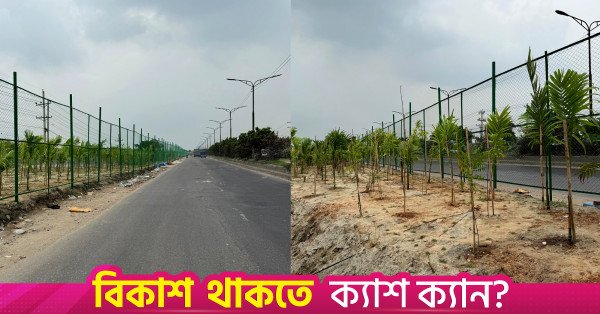
The Tk1cr project aims to turn a roadside dumping ground into a landscaped stretch.
A 1.5-kilometre stretch of the Dhaka-Aricha highway has been going through modification to implement an initiative to promote renewable energy by using two wind turbines to power more than 600 lights across it. Photo: TBS
“>

A 1.5-kilometre stretch of the Dhaka-Aricha highway has been going through modification to implement an initiative to promote renewable energy by using two wind turbines to power more than 600 lights across it. Photo: TBS
The Savar Upazila Administration has taken up an initiative to promote renewable energy by using two wind turbines to power more than 600 lights along a 1.5-kilometre stretch of the Dhaka-Aricha highway.
Once used as a dumping ground, the roadside stretch has recently been cleared of accumulated waste, fenced, and planted with trees to stop further dumping.
Savar Upazila Nirbahi Officer and municipal Administrator Md Saiful Islam said each of the two turbines will have a capacity of one kilowatt and will generate electricity to power more than 600 lights along that stretch.

The administration plans to extend the fencing and tree-planting work to five kilometres of the highway, from the Baliaarpur Bhanga Bridge area towards Aricha. The first 1.5 kilometres will have the lighting system.
Saiful also said the lighting was needed not only to improve the look of the stretch but also to make the fencing visible at night and help prevent accidents.
He continued, “Since we have fenced about 1.5 kilometres of the road to stop people from dumping waste again, lighting is also necessary to make the boundary visible to prevent accidents.
“Using electricity from the national grid for lighting under the current circumstances would be nothing but a luxury. That is why we have taken the initiative to install two one-kilowatt wind turbines. The electricity generated by these turbines will be used for the lighting.”
Why wind, not solar?
The administration chose wind turbines over solar panels partly because it wanted to draw public attention to a less familiar source of renewable energy.
“People are already quite familiar with solar power. Besides, solar panels beside a road may not attract much attention. We chose the comparatively less familiar wind turbines so that they can easily attract people’s attention,” he added.
He also said the area has sufficient wind flow throughout the year.
The administration expects to plant around 7,000 saplings of areca palm, neem, and palmyra along the five-kilometre stretch.
The entire project is estimated to cost around Tk1 crore, which will come from the upazila parishad fund. The two wind turbines alone are expected to cost Tk12 lakh.
From dumping ground to garden
The stretch around Baliaarpur Bhanga Bridge was once a dumping ground where the stench was so strong that passing through the area was difficult even inside a vehicle.
During a visit to the site this morning (21 August), this correspondent saw rows of areca palm, neem, and palmyra saplings along one side of the Dhaka-Aricha highway.
Several female workers were tending the plants, while male workers painted the steel fencing and worked on the garden’s boundaries. Fencing and tree planting have already been completed along about 1.5 kilometres of the road, with workers painting the steel fence green.
The choice of trees was also made with the highway environment in mind, Saiful said.
Areca palms were chosen because they would not create dense bushes along the road. Larger trees could have branches broken by storms and create obstacles on the highway, while dense vegetation could provide cover for criminals, he added.
Neem trees, meanwhile, were chosen mainly for their ability to help purify the air.
The administration also plans to build a maintenance room at the site and keep two people there around the clock to look after the trees and the area.
“We are not just planting trees or putting up fencing for temporary praise,” Saiful said.
He also said Bangladesh remained relatively behind other countries in moving away from fossil fuels and towards renewable energy.
Despite government incentives, public interest and awareness about generating and using electricity from solar and other renewable sources remain low, he said.
“If our initiative can encourage even some people, then it will have been worthwhile,” Saiful added.
About The Author