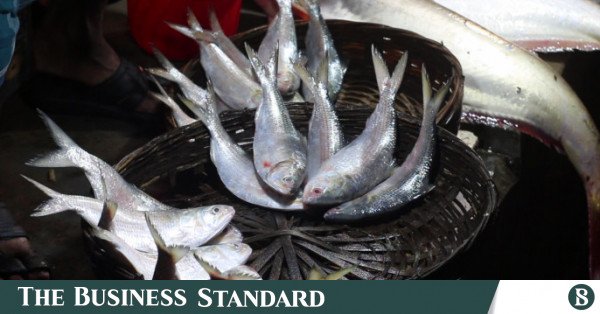
A hilsa that costs around Tk500 a kilogram after reaching Bangladesh is being sold for up to Tk1,800 as “Padma hilsa” in Jashore and elsewhere, leaving buyers to discover the deception only after taking the fish home.
The fish are legally imported from India, but buyers and traders allege that some businesses are passing off Indian and Myanmar hilsa as Bangladeshi fish, exploiting the much higher demand and price for local hilsa.
Data from customs and the Fisheries Quarantine Office show that 3,52,787kg of hilsa entered Bangladesh through Benapole land port in the first two months of the 2026-27 fiscal year.

Of the total, 29,440kg arrived in July and 3,23,346kg in August. The consignments were valued at Tk6.92 crore, with 22 importers bringing in the fish.
A lucrative price gap
Hilsa imported from India via letters of credit is priced at approximately Tk252 per kilogram. After government duties of about Tk162, truck fares, LC charges and other expenses of around Tk100, the total cost comes to roughly Tk514 per kilogram.
Yet the fish is selling for Tk1,400-1,800 per kilogram in Jashore, Benapole and other markets.
By comparison, locally sourced hilsa weighing 1.2 kg to 1.3 kg is currently selling for Tk3,300-3,400 per kilogram, according to traders.
The substantial price difference is drawing many buyers towards the imported fish. Local hilsa traders say the influx of cheaper, larger fish has also reduced their sales.
The imported fish reportedly look almost identical to local hilsa and are often larger in size, making it difficult for ordinary consumers to distinguish between them.
Some traders and buyers said imported fish are being sold under labels such as “Padma hilsa”, “Chandpur hilsa”, “Barishal hilsa” and “Chattogram hilsa”.
‘No taste, no smell’
Buyers in Jashore said they often realise that the fish is not local hilsa only after cooking it.
“I bought a fish thinking it was local hilsa. After eating it, I realised that it did not have the taste or smell of local hilsa,” said Imrul Hasan of Barandipara in Jashore while buying hilsa at Jashore Boro Bazar.
Another buyer, Imkoran Hossain, alleged that some traders sell imported hilsa under the names of different districts while charging high prices.
“We want the administration to take action against fish traders involved in such deception according to law. This kind of fraud must be stopped immediately,” he said.
What officials say
Ashwadul Alam, inspector at the Fisheries Quarantine Office at Benapole land port, said the authorities had recorded imports of 3,52,787kg of hilsa in the first two months of the current fiscal year.
“A total of 22 importers brought in the fish. We are issuing quarantine certificates only after properly examining the fish,” he said.
According to Fisheries Quarantine officials, the hilsa entering through Benapole is Indian. Myanmar hilsa enters Bangladesh through Chattogram port.
There are also allegations of illegal imports. On 22 July, Benapole Customs seized 12 cartons containing around 360 kg of Indian hilsa that had allegedly been imported through the land port by declaring them as “white fish”.
Importers: We sell it as Indian hilsa.
Several importers, speaking on condition of anonymity, said they had legally imported the fish from India through letters of credit after paying the required government duties.
“We have legally imported hilsa from India through LCs after paying government duties. We sell it to wholesalers, who then sell the fish in the market. How market traders choose to sell it is their concern. We import it from India, and everyone knows that,” they said.
Fish traders said the imported hilsa is entering Bangladesh from different Indian states and Myanmar via India. However, Fisheries Quarantine officials said Myanmar hilsa enters through Chattogram, not Benapole.
Local traders fear losing the market.
Jashore and Benapole traders said the arrival of large quantities of cheaper imported hilsa was hurting sellers of local fish.
Jashore and Benapole traders, including Utsab Mondal, Babu, Mahbub, Mostafizur and Paritosh Biswas, said buyers were increasingly choosing imported hilsa because of the significant price difference.
They expressed concerns that marketing imported hilsa as local fish adversely affects both consumers and authentic local hilsa traders. Consumers are misled, while local traders suffer a loss of market share.
At Benapole land port, acting director Ruhul Amin said 29,440kg of Indian hilsa arrived in July and 3,23,346kg in August through the port.
“Twenty-two importers brought in the fish. We released the consignments after customs clearance and collection of port duties. The importers transported the fish to different parts of the country in Bangladeshi trucks,” he said.
The figures show that the issue is no longer limited to a few isolated consignments. With more than 3.5 lakh kilograms of imported hilsa entering through Benapole in just two months, the growing challenge for consumers is not finding hilsa but knowing where it actually came from.
About The Author