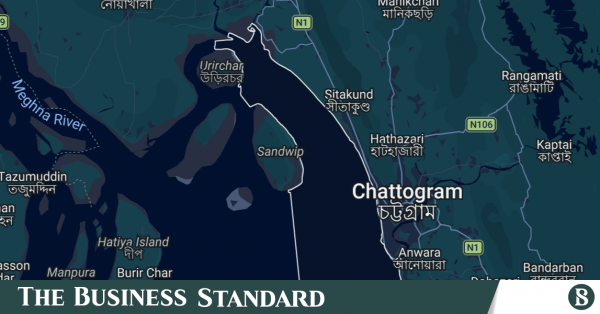
Ferry services on the Chattogram-Sandwip route were disrupted again on Wednesday (2 September), the first day of operations after a four-day suspension due to weather warnings, as the ferry “Kopotakkho” became stranded in the Sandwip Channel because of poor navigability.
The ferry got stuck on a shoal just minutes after leaving Guptachhara Ghat for Bashbaria in Sitakunda around 7:10pm.
Around 300 passengers, two passenger buses, seven trucks and several private vehicles were on board, according to passengers. Children, elderly people and sick passengers were also among those stranded.

After travelling a short distance from the ghat, the ferry became stuck in silt in the channel. As it remained stranded for hours, concern grew among passengers. Food and drinking water shortages also emerged after supplies at the ferry’s canteen ran out.
“We are suffering greatly after being stranded on the ferry for such a long time. The condition of sick patients is getting worse,” said Md Imrul, a stranded driver.
He said local representatives and political party activists were providing food and other essential supplies to the stranded passengers.
Passengers complained that the ferry’s canteen did not have enough food in stock. Although items such as tea, bread and biscuits were available, they alleged that passengers were being charged high prices.
Ferry master Saiful Islam said the vessel became stuck because of shallow water at the mouth of Guptachhara Channel.
“The ferry will float once the water level rises with the tide,” he said, expressing hope that it would be able to resume its journey around 3am when the tide rises.
However, Bangladesh Inland Water Transport Authority (BIWTA) Deputy Director (port) Nayan Shil blamed the ferry master for failing to maintain the appropriate schedule.
“Ferry schedules on coastal waterways have to be determined by taking the tides into account. Kopotakkho left the ghat about half an hour late and reached the shoal as the tide was receding,” he told The Business Standard.
Nayan further said the ferry was expected to float during the next high tide. “Police were ensuring the safety of stranded passengers with assistance from local members of parliament,” he added.
People familiar with the route said around 300 metres of the channel towards the mainland had been dredged and a pontoon installed. However, the area is not dredged regularly, causing silt to accumulate and reducing water depth.
As a result, ferries face a risk of becoming stranded unless they operate during high tide.
The Kopotakkho had previously become stranded at the same location due to poor navigability.
On 14 October 2025, the ferry got stuck at the spot and authorities initially said it would be able to float during the night tide. However, it was eventually refloated around 25 hours later, at 9am on 15 October, with the help of three tugboats.
About The Author