In addition to the Tk7 lakh from the yard, the deputy commissioner handed over Tk25,000 from the Relief and Disaster Management Fund to five families from Chattogram.
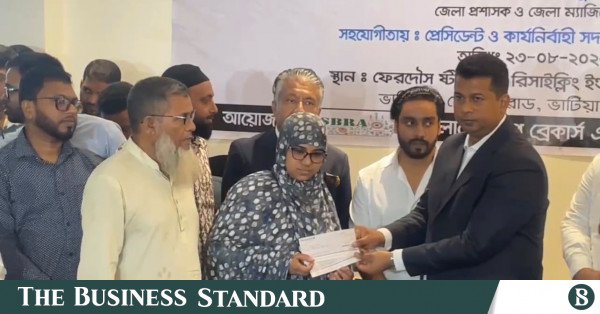
Ferdous Steel Ship Recycling Industry authorities hand over compensation cheques of Tk7 lakh each to the families of 10 workers who died after being exposed to toxic gas at the shipbreaking yard in Sitakunda, Chattogram, on 23 August 2026. Photo: TBS
“>

Ferdous Steel Ship Recycling Industry authorities hand over compensation cheques of Tk7 lakh each to the families of 10 workers who died after being exposed to toxic gas at the shipbreaking yard in Sitakunda, Chattogram, on 23 August 2026. Photo: TBS
Families of the 10 workers who died after being exposed to toxic gas at Ferdous Steel Ship Recycling Industry in Sitakunda, Chattogram, have received Tk7 lakh each from the yard authorities.
The compensation was handed over at a ceremony at the shipbreaking yard today (23 August), attended by Chattogram Deputy Commissioner Jahedul Islam Miah.
In addition to the Tk7 lakh from the yard, the deputy commissioner handed over Tk25,000 from the Relief and Disaster Management Fund to five families from Chattogram. The remaining five families will receive the same amount from the administrations of their respective districts, he said.

The yard authority had earlier paid Tk1 lakh to each family immediately after the accident and deposited Tk2 lakh for each deceased worker with the Labour Court in line with labour regulations.
The authority has also pledged to provide further assistance to the families when necessary.
“We know that no compensation can replace a life. But the government and the industry are standing beside the families, and we will try to provide further support as opportunities arise,” Jahedul Islam said.
Govt targets zero deaths in shipbreaking
The deputy commissioner said Bangladesh’s shipbreaking industry had established itself as an important economic sector, but worker safety needed greater attention.
“We want to bring casualties in this sector down to zero,” he said, stressing the need for better technology, training and safety practices.
He acknowledged that local authorities lacked the technological capacity to immediately detect and neutralise the high concentration of hydrogen sulphide inside the vessel involved in the accident.
Following the incident, an expert team was brought in, and relevant government agencies were consulted on removing the toxic gas and making the vessel safe.
“We need to advance in technology, knowledge and expertise,” the DC said.
He also called for greater scrutiny of vessels carrying LNG, gas and other hazardous materials before they are purchased and brought to Bangladesh for recycling.
Several government agencies have formed investigation committees to determine how hydrogen sulphide accumulated inside the vessel and why it remained undetected despite the vessel reportedly having a gas-free certificate.
The authorities will take action if negligence is found, the DC said.
BSBRA points to previous ship owner
Bangladesh Ship Breakers and Recyclers Association (BSBRA) President Mohammad Mohsin Chowdhury said responsibility for the accident should not automatically be placed solely on the local shipbreaking yard.
He said the previous owner of a vessel also has a responsibility to properly clean it and make it safe before selling it for recycling.
“Before buying a ship, there is another owner. That owner also has a responsibility to clean the vessel properly,” he said.
According to him, documents from the inspection process indicated that the vessel had been cleaned before being sold. However, hazardous gas was later found inside the vessel.
The association is trying to establish contact with the parties involved before the vessel was sold to Bangladesh to determine how the gas remained inside and prevent similar vessels from being sent for recycling, he said.
Mohsin also pledged continued support for the victims’ families.
“We will always stand beside the families. Not only the workers, but their children too,” he said.
Yard owner apologises to families
Ferdous Steel Managing Director and CEO Ferdous Wahid apologised to the families of the deceased workers and said the company had sought to maintain high safety standards.
He said his father, Alhaj Mohammad Lokman Haji, entered the shipbreaking business in 1995 and that he took over the company after his father died in 2021.
Two of the deceased, foreman Mansur and senior cutter Nasir, had worked at the yard for around 18 years, he said.
“They were my colleagues. We respected each other. I never had a dispute with them. I do not know what cruel fate brought us to this day,” Ferdous said.
He said the company had been trying to develop environmentally responsible ship recycling facilities and currently had two green shipyards.
“If we made any mistake, the Ferdous Steel family apologises to you,” he said.
Ferdous said the company would review its safety procedures and take additional measures to prevent future accidents.
“We were not prepared for an incident of this nature. But in the future, we will consider many more things and try to create a safer workplace,” he said.
Toxic gas raises fresh safety questions
The accident occurred on 14 August when workers entered a scrap vessel after a gas leak was detected.
Subsequent testing by the Department of Explosives found 10.8 parts per million (ppm) of hydrogen sulphide inside the vessel several hours after the incident. Officials suspected the concentration had exceeded 100 ppm when the accident occurred.
The toxic gas exposure killed workers who entered the vessel to inspect the leak, as well as some who went in to rescue their colleagues.
The incident has since triggered multiple investigations and renewed scrutiny of safety practices at Sitakunda’s shipbreaking yards, particularly gas-free certification, the handling of hazardous vessels and the capacity to detect and neutralise toxic gases before workers enter confined spaces.
For the families receiving the compensation, however, the financial assistance offers only limited relief after the loss of their primary earners.
About The Author