Highlights:
- Extreme heat cost Bangladesh $1.3–$1.8 billion in productivity losses in 2024
- 23 million Bangladeshi children could face an additional month of heat stress yearly
- Dhaka loses around 3% of annual working hours to heat stress
- Heat-related deaths in Bangladesh roughly doubled between 2000 and 2023
- Apparel exporters could lose billions if heat stress remains unaddressed
- Bangladesh needs stronger heat protections for workers and vulnerable communities
Over the past two months, as Europe endured one of its hottest summers on record, a succession of reports sounded an increasingly familiar alarm: extreme heat is no longer simply a weather hazard; it is becoming a growing threat to lives, productivity, incomes and economies.
Western Europe this July experienced heatwaves disrupting economic activity, straining health systems, killing people and fuelling wildfires in some places. If wealthy countries with relatively strong infrastructure and social protection systems can be caught off guard, the consequences for low-income, hotter countries could be far more severe.

Bangladesh has repeatedly appeared at the centre of these warnings aired in global studies.
A July study by Berlin-based research firm adelphi global estimated the financial risks arising from lost productivity and higher healthcare costs from extreme heat in eight countries, including Bangladesh. Around the same time, the World Bank estimated that extreme heat cost Bangladesh between $1.3 billion and $1.8 billion in productivity losses in 2024 alone – equivalent to 0.3-0.4% of GDP.
A Lancet Planetary Health study published in July warned of the potentially severe consequences of rising temperatures for people aged over 60 in Asian countries, including Bangladesh, under a 3°C global-warming scenario. The latest warning has come from research by a Brussels-based university, which projects how severely children in South Asia are exposed to heat stress. Under a 1.5°C warming scenario, 23 million Bangladeshi children are projected to experience at least one additional month of heat stress each year, according to new research led by Vrije Universiteit Brussel (VUB) and published in Science Advances on 27 August.
These are not isolated warnings. Heatwaves have been identified for years as a threat to productivity and public health. Yet the economic and health consequences of extreme heat have still not gained the prominence they deserve in Bangladesh’s policy agenda.
The economic cost is already mounting
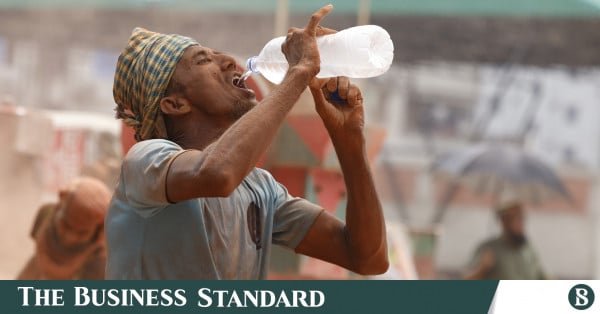
Bangladesh is particularly vulnerable because it is already hot, humid and densely populated, while millions of people work outdoors or in poorly ventilated workplaces. Rising temperatures are adding another layer of pressure to an economy heavily dependent on labour-intensive sectors.
The adelphi global study found that workers in agriculture and construction in Bangladesh, India, Indonesia and Nigeria are already losing the equivalent of around 20 working days or more each year because of heat stress. The loss is particularly damaging to low-income families, for whom every day’s income matters.
Bangladesh, India and Nigeria face the greatest compound risks, according to the study, as high working-hour losses, heavy out-of-pocket healthcare costs and weak social protection systems reinforce one another. Falling incomes combined with rising medical expenses could push significant numbers of people below the poverty line.
The World Bank’s findings paint an equally worrying picture. Its report, A Livable Future: Protecting Jobs and Growth from Extreme Heat in South Asia’s Cities, released on 31 July, says the productivity losses rise sharply when daytime temperatures exceed 37°C. In Dhaka alone, heat stress already makes around 3% of annual working hours theoretically unworkable – the equivalent of about 465,000 full-time jobs.
The consequences extend to Bangladesh’s biggest export industry. Citing a joint analysis by the ILO, IFC, and Cornell University’s Global Labor Institute, the World Bank said the apparel industries of Bangladesh, Pakistan, Vietnam and Cambodia could lose up to $65.8 billion in export earnings by 2030 if heat stress is not addressed.
This is, therefore, no longer simply a climate issue. It is a competitiveness issue. The effects can begin even before a child grows up to become part of the workforce. Extreme heat exposure during the first 1,000 days of life significantly increases the risk of childhood stunting, the World Bank said.
But little has been discussed in Bangladesh so far about the economic cost of extreme heat and the safeguards needed to contain its impact.
“What more can Bangladesh do beyond navigating the situation and mitigating its effects?” economist Dr Fahmida Khatun asks.
She suggests several interventions, including adjusting working hours, alerting workers to the health risks of heat exposure, sensitising employers to covering treatment costs for heat-related illnesses, and accelerating mechanisation in agriculture and other labour-intensive activities.
“First of all, steps need to be taken to formalise the informal sector and bring employers under the purview of labour laws,” Fahmida says. This, she argues, would help improve workplace conditions and reduce workers’ exposure to heat-related shocks.
Bangladesh has already warmed by 1.28°C since pre-industrial times, the second-fastest rate among six South Asian countries, according to the World Bank report. Heat-related deaths roughly doubled between 2000 and 2023, based on Global Burden of Disease estimates cited in the report.
The health bill is harder to see
The economic cost of heat can be measured in lost working hours and output. The health cost is much less visible – but potentially more enduring.
Prolonged exposure to extreme heat and humidity can cause conditions ranging from heat cramps and exhaustion to potentially fatal heatstroke. The World Health Organization describes heat stress as a “silent killer” and has urged countries to develop heat-health action plans to protect lives, labour productivity and ecosystems.
For Bangladesh, the challenge is especially acute because heat exposure cannot simply be eliminated. Millions of people earn their livelihoods in agriculture, construction, transport, street vending, and other informal activities where staying indoors is not an option.
Health economist Dr Shafiun Nahin Shimul says there has been little research in Bangladesh quantifying the monetary consequences of heat-related health impacts. He says heat stress clearly affects the health of people who work under the sun, but the country still lacks adequate evidence on the resulting financial burden on individuals and households.
Some industries are already adapting
There are signs that adaptation is possible when financing and policy support come together.
The World Bank points to Bangladesh’s Green Transformation Fund, launched in 2016 to help manufacturers invest in energy- and water-efficient equipment and improve working environments. What began with a limited number of factories has developed into a broader transition across the manufacturing sector.
IFC support through the Partnership for Cleaner Textile and sustainability-linked lending has reinforced that progress. By the end of 2025, Bangladesh had more than 270 LEED-certified apparel factories, with more in the pipeline – a transformation achieved in a little more than a decade.
The experience offers an important lesson: adaptation is possible when there is financing, institutional support and a clear business case.
But factory-level improvements alone cannot protect the millions who work outside formal workplaces.
Adelphi global recommends strengthening public health and social protection systems, including compensation for lost working time, state-supported health insurance and extending labour protections to informal workers. It also calls for greater mobilisation of international adaptation finance for health and worker protection.
For Bangladesh, however, the challenge is deciding how to turn these recommendations into workable policy.
FBCCI’s new administrator Md Fazlul Hoque, also a leading apparel exporter, has acknowledged that heat management might become a requirement for factory production system in future. Some RMG factories, especially those green certified, have some sort of mechanisms that keep factory floors cooler than outside. But these green factories are not enough; factories need to have an overall heat management strategy in practice to ensure comfort for workers and reduce the scope of productivity loss from heat stress.
“You can’t reduce temperature outside. What you can do is manage the heat inside at least for 15/20 days a year when temperature turns unbearably extreme,” he said in TBS Zero-sum Game talk show on Thursday, suggesting evening work shift and compensation for workers for lost work hours.
Health insurance for informal workers remains difficult. Dr Shimul points to the failure of an earlier pilot universal health insurance scheme for low-income people and questions the feasibility of providing broad insurance coverage to workers exposed to heat.
That makes prevention even more important.
Bangladesh cannot stop temperatures from rising on its own. But it can reduce the economic and human cost of rising heat.
That means treating heat not merely as a seasonal inconvenience or an environmental problem, but as a public-health, labour-market and economic-policy issue.
The warning from Europe should make the urgency clear. Rich countries are discovering that conventional systems can be overwhelmed by extreme heat. For Bangladesh, where millions already work in heat-exposed conditions and social protection remains limited, waiting until the impacts become catastrophic would be far more expensive.
About The Author