The Japanese masterpiece known popularly as the “Great Wave” has long been celebrated as a pioneering cultural work.
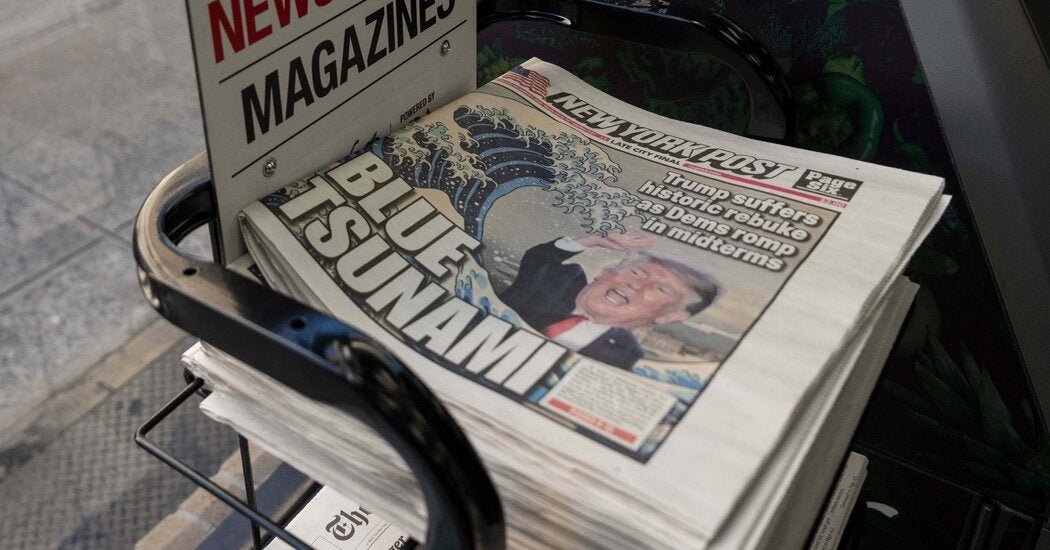
But on Wednesday, the print, created around 1831 by the artist Katsushika Hokusai, appeared in an unlikely place: the cover of The New York Post. The “Great Wave” had been repurposed to depict Democrats’ landslide victory in midterm elections, with President Trump shown being menaced by a breaker. “BLUE TSUNAMI,” blared the headline.
The rendering came as a surprise to the staff of the Sumida Hokusai Museum in Tokyo on Thursday, which displays the artist’s woodblock prints, paintings, sketches and artifacts.
The Sumida Hokusai Museum said through a spokesman, “That’s not really how these pieces were intended to be enjoyed.”
“Hokusai depicted a powerful, dynamic wave, so to see that transformed into a parody — a kind of ironic subversion — is something we cannot view favorably,” the spokesman said. “Ideally, we would prefer that his art not be used as a form of satire intended to disparage others.”
A spokeswoman for The Post did not immediately respond to a request for comment.
After Tuesday’s election, pundits and politicians around the world are talking about the “blue tsunami.” But in Japan, which has a long history of natural disasters, the word tsunami, and its imagery, are complicated, evoking destruction and despair.
Japanese news outlets have delicately translated the term — often favoring “wave.” Some commentators have expressed concern about what they see as insensitive uses of the word, especially after a 2011 earthquake and tsunami that devastated the northeastern coast of Japan. Others noted that World Tsunami Awareness Day falls on Thursday.
“People are calling the Democrats’ big win a ‘Blue Tsunami,’ but somehow, that just doesn’t sit right with me,” the Japanese novelist Keiichiro Hirano wrote on X on Thursday. “There are no positive impressions associated with tsunamis. For as widely as all that footage spread around the world, did the tragedy of so many people dying really not get across?”
The “Great Wave,” whose actual name is the “Under the Wave Off Kanagawa,” is part of Hokusai’s most famous series, “Thirty-Six Views of Mount Fuji.” It shows a wave, not a tsunami, and features boats and a snow-capped Mount Fuji in the distance. The Post superimposed an image of a flailing Mr. Trump instead.
While the cover raised some eyebrows in Japan, some fans of Hokusai said they were pleased to see the cultural interplay.
Aya Yasuhira, 30, who was visiting the Sumida Hokusai Museum on Thursday, said she could see how some people might find the use of the “Great Wave” to portray American politics a “bit off-putting.”
But Ms. Yasuhira, who works at a nursing home, said she found The Post’s rendering “quite clever.”
“This kind of approach is quite engaging,” she said.
Mayumi Matsuo, 43, who was also visiting the museum, said it was “quite interesting — perhaps even a bit surprising — to see such a quintessentially Japanese image being used in that way in America.”
“At the same time,” she said, “it feels like a rather sophisticated form of satire.”
In the run-up to midterms, the “Great Wave” was featured on mugs, T-shirts and political signs — a symbol of Democrats’ hopes to retake Congress.
The print has inspired other forms of satire over the years, including a 2018 cartoon by the American cartoonist Lalo Alcaraz, which circulated on social media again after Tuesday’s election.
The cartoon was originally published after the 2018 midterm elections, in which Democrats made significant gains. It depicts a drenched Mr. Trump standing amid the waves and saying, “Momentum is on our side!” In the upper left corner, above Mr. Alcaraz’s name, he included a note: “Apologies to Hokusai.”
In an interview, Mr. Alcaraz said he chose to use the “Great Wave” because it was “incredibly detailed” and “instantly recognizable.”
“It is a symbol of our powerlessness against nature and against forces,” he said. “It also represents the power of humans — of people voting and speaking their minds.”
About The Author