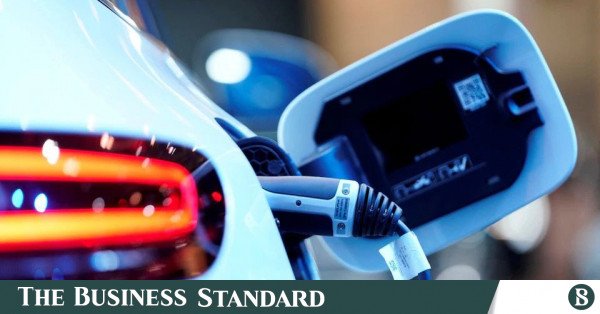
EV sales started gaining momentum in 2025, although vehicle registration started in September 2022, according to officials at the Bangladesh Road Transport Authority (BRTA)
Representational image. Photo: Reuters
“>

Representational image. Photo: Reuters
Highlights:
- EV sales are rising rapidly, driven by lower running costs and environmental awareness.
- Limited charging infrastructure and high investment costs hinder wider adoption.
- Charging stations remain underused, delaying profitability and network expansion.
- Shortages of trained technicians and expensive spare parts weaken after-sales support.
- Bangladesh lacks a comprehensive system for recycling end-of-life EV batteries.
- Automakers are exploring local manufacturing, but mass adoption requires stronger infrastructure and policy support.
Electric vehicle (EV) demand is rising in Bangladesh, but limited charging infrastructure, high investment costs and gaps in after-sales services and battery recycling are holding back wider adoption.
EV sales started gaining momentum in 2025, although vehicle registration started in September 2022, according to officials at the Bangladesh Road Transport Authority (BRTA).

BYD Bangladesh, a major player in the country’s new-energy vehicle (NEV) market, has delivered more than 1,400 vehicles, including electric and plug-in hybrid models, and operates seven flagship showrooms.
The company sold around 500 NEVs in 2025, averaging about 42 units a month, while average monthly sales rose to around 160 in 2026, nearly four times the previous year’s rate, according to Amid Sakif Khan, managing director of BYD Bangladesh.
Sakif said demand has expanded beyond early adopters to families, businesses and corporate customers, driven by lower operating costs and environmental awareness.
Infograph: TBS
“>

Infograph: TBS
Mohammad Saiful Islam Tushar, marketing lead at DHS Autos, the exclusive distributor of Changan Automobile’s Deepal electric and plug-in hybrid vehicles, said customer enquiries have shifted from basic questions about charging, battery performance and driving outside Dhaka to concerns about running costs, warranties, after-sales service and resale value.
Deepal does not disclose sales figures, but Tushar said enquiries, test drives and customer acceptance are increasing. “Consumer confidence remains the biggest barrier, alongside vehicle prices, financing, taxation, charging access, battery life and resale prospects.”
Apartment dwellers can face restrictions on installing chargers and difficulties securing electrical connections, while motorists travelling on highways need reliable charging facilities along their routes, he said.
Investment remains risky
Bangladesh’s charging network is expanding, but the relatively small EV fleet is making it difficult for operators to generate enough business to justify the high upfront investment.
Sakif said around 30 public charging stations equipped to charge BYD vehicles have been established across the country.
CrackPlatoon Charging Solutions operates 32 public charging units, 241 private units and 335 residential installations, mainly in Dhaka and Chattogram, with additional coverage in Cumilla, Narayanganj and Gazipur.
The company recorded 1,972 charging sessions, consuming 33.73 megawatt-hours of electricity, in 2026, compared with 461 sessions and 11.88 megawatt-hours in 2025. Average daily sessions increased to three for direct-current (DC) chargers and 0.57 for alternating-current (AC) chargers, from 0.8 and 0.23, respectively.
Despite the increase, utilisation remains low. A 120kW DC charger in Cumilla recorded a usage ratio of 1.203% in 2026, up from 0.300% in 2025.
Engr Abu Mosaeb Khan, head of operations at CrackPlatoon, said a typical 120kW public charging station costs around Tk70 lakh, with commercial payback generally taking five to seven years or longer.
The payback period could fall below two years if utilisation reached 30%-50%, he said.
Around 70% of a station’s investment may go towards substations, grid connections, cabling and other electrical infrastructure, he added. Demand charges and regulatory clearances further increase costs, making operators cautious about expanding before demand grows sufficiently.
Ekhon Charge’s Tejgaon station served three to four vehicles a day in 2026, compared with four to five a week in 2025, according to Safi Ar Rahman, the company’s EV activation executive.
Most users are plug-in hybrid vehicles, including the BYD Sealion 6, Chery Tiggo 8 Pro and Omoda C9, as well as BMW and Mercedes models.
Ekhon Charge operates four charging points in Tejgaon, Cumilla, Chattogram and Cox’s Bazar. Safi said the government’s 0% tax policy on imported EV chargers should help reduce equipment costs.
The company plans to extend its network to Panchagarh, Khulna and Sylhet and aims to achieve nationwide coverage within 1.5 to two years using chargers rated at 120kW to 180kW.
After-sales services struggle to keep pace
The expansion of charging infrastructure is only one part of the challenge, as EV owners also need technicians trained to handle high-voltage systems, battery management and software-driven components.
Sakif said BYD had five service centres and two spare-parts dealer partners. The company plans to add more service points and roadside technicians while expanding training in high-voltage systems, diagnostics and batteries, alongside nationwide spare-parts distribution.
Deepal is also building its technical capacity. Tushar said technicians need expertise in high-voltage systems, battery management, charging, electronics, software diagnostics and safety. The company is continuing training and developing its spare-parts and diagnostic capabilities.
Abu Sufiyan Arnab, a BYD Atto 3 owner, said spare parts are readily available through the official distributor and he had not experienced major mechanical problems.
However, he is concerned about access to servicing in district towns, while EV spare parts are more expensive than those for conventional vehicles.
Battery recycling remains a major gap
Battery durability and disposal are expected to become increasingly important as the country’s EV fleet ages.
Sakif said BYD provides an eight-year battery warranty and estimates battery life at 12-14 years. Its battery management system monitors performance, while authorised service centres can assess battery health.
Deepal also offers an eight-year battery warranty. Tushar said its modular battery design allows individual sections to be diagnosed and, where appropriate, repaired or replaced without replacing the entire battery pack.
However, Bangladesh has no comprehensive system for collecting, reusing and recycling end-of-life EV batteries.
Sakif said developing such a system will require cooperation among manufacturers, distributors, recyclers and government agencies. No specific investment or timeline has been announced.
Arnab said the potential cost of battery replacement after eight to 10 years, alongside the shortage of public charging facilities, remained among his biggest concerns.
Automakers eye localisation and long-term growth
Despite the infrastructure gaps, companies are preparing for a larger market.
Sakif said BYD is discussing plans for an assembly and manufacturing plant in Bangladesh, although no timeline has been announced. The company aims to become the market leader within three to five years, offering vehicles across affordable and luxury segments and expanding its after-sales network nationwide.
Deepal is also interested in localising production, but Tushar said investment would depend on market size, government policy, taxation, infrastructure, foreign exchange conditions and the availability of a reliable local supplier base.
Both companies say wider adoption will require more than vehicle sales. Tushar identified home and highway charging, trained technicians, after-sales services, financing, insurance, consumer education and long-term policy support as key requirements.
Sakif called for policies covering public charging, electricity supply to charging stations, battery recycling, smart-city development and greater use of electrified vehicles in commercial and public transport.
Lower running costs offer a strong incentive
For existing owners, lower running costs provide a major incentive to switch to electric vehicles.
Arnab, who drives around 50km a day, said he spends about Tk1,400 on electricity to run his EV for seven days, compared with around Tk900 a day when he used a fuel-powered vehicle.
However, public charging facilities remain extremely limited outside Dhaka, creating anxiety about long-distance journeys.
With demand for electric and plug-in hybrid vehicles rising, Bangladesh remains in the early stages of building the infrastructure and support services needed for mass adoption. Charging utilisation remains low, while much of the ecosystem is concentrated in major cities.
As Tushar noted, wider EV adoption depends not simply on bringing more vehicles into the country, but on developing the entire ownership ecosystem alongside them
About The Author