A key route at the Satghar corridor has been effectively blocked for nearly two months as a 900-metre section of the Chattogram-Cox’s Bazar highway is widened to four lanes, preventing elephants from crossing between forest habitats on either side.
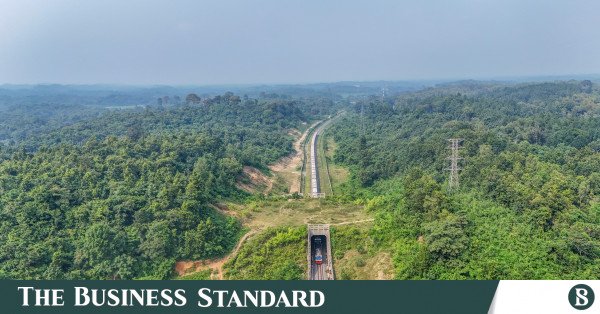
An aerial view shows the Chattogram-Cox’s Bazar railway running through Chunati Wildlife Sanctuary in Lohagara. Elephant movement through traditional corridors in the area has been disrupted by road expansion and other infrastructure works. The photo was taken at Jangalia in Chunati, Lohagara, Chattogram, on Sunday. Photo: Mohammad Minhaj Uddin
“>

An aerial view shows the Chattogram-Cox’s Bazar railway running through Chunati Wildlife Sanctuary in Lohagara. Elephant movement through traditional corridors in the area has been disrupted by road expansion and other infrastructure works. The photo was taken at Jangalia in Chunati, Lohagara, Chattogram, on Sunday. Photo: Mohammad Minhaj Uddin
Road expansion, lighting and railway infrastructure are increasingly disrupting elephant movement through Chunati Wildlife Sanctuary in Lohagara, raising concerns over access to traditional corridors and the risk of elephant-train collisions.
A key route at the Satghar corridor has been effectively blocked for nearly two months as a 900-metre section of the Chattogram-Cox’s Bazar highway is widened to four lanes, preventing elephants from crossing between forest habitats on either side.
“Due to road expansion work, elephants have been unable to move from the eastern side, including the Bandarban hills, to the reserved forests in the west for the past two months, with herds reaching both sides of the corridor but unable to cross,” said Nur Jahan, wildlife and biodiversity conservation officer in Chattogram.

The disruption has reduced access to an overpass and two underpasses built along the Dohazari-Cox’s Bazar railway, 27km of which passes through reserved forests. Unable to cross in search of food, elephants are now entering villages, damaging houses, and moving into paddy fields, she said.
The Forest Department has urged the Roads and Highways Department to complete the work quickly and demanded a flyover if the highway is eventually widened to six lanes.
However, Asif Imran, an environmental safeguards consultant for the Asian Development Bank (ADB), which funded the railway project, claimed that the longer-running disruption was caused by the Forest Department’s Satghar Beat Office boundary and lighting.
He also claimed that elephants had stopped using the corridor for nearly eight months, with eastern herds obstructed while elephants on the western side continued using the overpass and underpass.
Key elephant habitat under pressure
Chunati, Fasiakhali and Medhakachhapia are among the main habitats of Bangladesh’s remaining Asian elephants. Around 40-50 elephants move through the forests of Lohagara, Banshkhali and Chakaria, with Chunati Wildlife Sanctuary alone covering 19,185 acres.
The government released 276 acres from the three protected areas for railway construction in 2016, involving the cutting of an estimated 240,000 trees and alteration of 26 hills.
A 2016 International Union for Conservation of Nature (IUCN) study identified 16 elephant corridors along the 27km railway section. Yet an ADB baseline biodiversity assessment in 2018 recommended only one overpass and two underpasses.
HM Raihan Sarkar, an elephant expert and lead researcher of the IUCN study, told TBS that reducing crossing points could significantly increase the risk of elephant-train collisions and pose a severe threat to Bangladesh’s Asian elephant population.
Monitoring disrupted as cameras vandalised
Elephants can take five to 10 years to adapt to underpasses, overpasses and culverts, making regular monitoring essential. But CCTV cameras installed to track their movement have repeatedly been damaged by criminals, apparently to avoid being caught on camera, according to Asif Imran.
Seven cameras were destroyed in one night in August 2025, while two cameras at an underpass were broken over the past three months. Cameras at the overpass were also damaged seven months ago.
Imran said 8km of reinforced concrete fencing had been installed along both sides of the railway to prevent elephants from reaching the tracks and guide them towards designated crossings. He said elephants that initially pushed against the fencing were gradually adapting by following it to find crossing points.
Despite the disruption, elephants are using one underpass extensively and three of five oversized culverts. Wild boars, barking deer, porcupines, fishing cats, jungle cats and civets have also been recorded using the structures.
AI collision system remains on the drawing board
Elephant-train collisions have already occurred since services began on the route on 1 December 2023.
On 13 October 2024, a baby elephant was struck and killed near the northern end of the Chunati overpass. The maximum train speed through the forest was subsequently set at 20km per hour.
On 22 July last year, a herd came onto the tracks but the locomotive driver spotted it and stopped the train. One elephant later struck the last carriage after repeated whistling, but no major damage occurred.
Four pairs of trains now operate on the Cox’s Bazar route, while Bangladesh Railway plans to increase this to 10-15 pairs.
The railway had planned six robotic and sensor-based cameras with AI-powered signalling at a cost of Tk40 crore. The system would detect elephants on the tracks and trigger visual alerts and red warning lights, allowing drivers to spot them from 500-700 metres away and brake from around 220 metres.
But the system was not installed before the Tk11,000 crore railway project was completed last year.
A revised development project proposal is now being prepared to add the AI system to an ADB-funded project to convert the Chattogram-Dohazari metre-gauge railway into dual gauge.
Project Director Md Asadul Haque told TBS that discussions with ADB were underway and the AI component could be included after assessing its market price and effectiveness.
Meanwhile, railway authorities plan to deploy 20 waymen along the 27km section as an interim measure. They would carry sound-making devices to drive elephants away and red flags or signalling equipment to stop trains, but recruitment has yet to begin.
About The Author