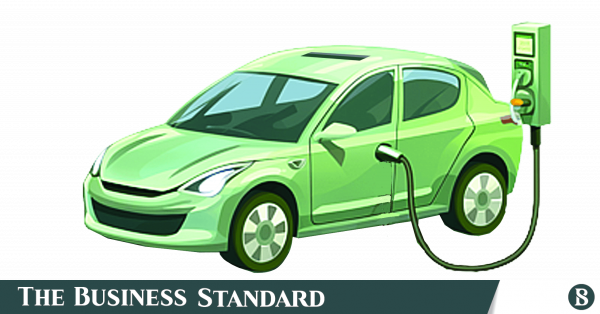
Under Bangladesh Bank directives issued in May, banks can lend up to Tk80 lakh to buyers of electric, hybrid and domestically assembled cars, covering up to 80% of the vehicle’s purchase price with a maximum repayment period of eight years.
Infograph: TBS
“>

Infograph: TBS
Easier car financing is driving a sharp rise in car-loan applications in Bangladesh, but the boom is increasingly favouring hybrid and electric vehicles over conventional and reconditioned cars.
Under Bangladesh Bank directives issued in May, banks can lend up to Tk80 lakh to buyers of electric, hybrid and domestically assembled cars, covering up to 80% of the vehicle’s purchase price with a maximum repayment period of eight years.
For conventional octane-run cars, the borrowing limit remains Tk60 lakh.
The change has quickly boosted demand for auto loans, bankers say. City Bank has seen auto-loan applications rise by 30% over the past two months, bringing monthly applications to around 600 from roughly 450 before the increase.

“The increase has been driven predominantly by applications for hybrid and electric cars, with demand for these vehicles significantly outpacing non-hybrids,” said Arup Haider, deputy managing director at City Bank.
The bank’s average monthly auto-loan disbursement volume rose by nearly 35% during the period, while the number of loans disbursed increased by around 20%. The average loan size also grew by about 12%.
Arup said it is too early to attribute the entire increase to the revised Bangladesh Bank rules, but the timing suggests that the enhanced financing framework has contributed to higher customer interest and application volumes.
Mutual Trust Bank (MTB) has also recorded a significant rise in applications. Total auto-loan file submissions rose 84% to 335 during May-August 2026, from 182 in January-April. Average monthly intake rose from around 46 to 84 applications, while the underwriting approval ratio improved from 73% to 75%.
BRAC Bank has also seen strong growth. Its auto-loan disbursements have more than doubled year-on-year, while the bank also recorded a 32% surge in disbursements since the Bangladesh Bank directive. Non-performing loans in its auto-loan portfolio remain below 2%.
“Customers are increasingly considering auto loans as a financing option,” said Md Mahiul Islam, deputy managing director and head of retail banking at BRAC Bank.
Customers currently borrow an average of Tk30 lakh to Tk40 lakh to buy cars, while the bank offers loans of up to Tk80 lakh. The bank has also expanded its lending capacity and partnerships with car dealers, he said.
An MTB official said the growth reflects both the new 80:20 debt-equity facility and rising domestic fuel prices, which are encouraging consumers to shift away from fuel-inefficient vehicles.
Hybrid and plug-in hybrid electric vehicles (PHEVs) now account for the lion’s share of MTB’s applications, while EVs maintain a small but steady share because of limited charging infrastructure and model availability.
Hybrids emerge as early winner
Hybrids appear to be benefiting most immediately from the financing changes.
They already have an established market and offer lower running costs without depending on the still-limited public charging infrastructure needed by fully electric vehicles.
Arif Khan, managing director of Motors Bay, a Japanese car importer, said the revised financing rules have helped hybrid vehicles by allowing customers to access significantly higher amounts of financing.
The combination of an established market, lower operating costs and greater convenience gives hybrids an advantage over fully electric vehicles, which remain at an earlier stage of adoption.
EVs gain interest, but adoption remains slow
Electric vehicles have also received a financing boost. Buyers can now access loans of up to Tk80 lakh, with banks financing as much as 80% of the purchase price.
Amid Sakif Khan, director of Runner Automobiles and the BYD Bangladesh wing, said the higher loan limit and financing ratio have increased customer interest and financing enquiries.
But he said it was too early to assess the full impact on sales because buying a vehicle involves a longer consideration cycle.
While Runner Automobiles and BYD Bangladesh did not provide specific sales figures, automotive digital publishing network Auto Rebellion said there are currently more than 1,600 BYD vehicles on Bangladesh’s roads, up from around 1,000 in June this year.
The higher financing ratio reduces the upfront cost for buyers, but financing is only one factor in an EV purchase, Sakif said. Consumers also consider driving range, charging availability, after-sales service, reliability and overall ownership costs.
Runner is working to expand the wider EV ecosystem, including charging facilities, servicing capacity and customer awareness, Sakif said.
Reconditioned cars face tougher competition
The shift towards new hybrids and EVs is putting pressure on the reconditioned-car market.
Abdul Haque, president of the Bangladesh Reconditioned Vehicles Importers and Dealers Association (BARVIDA), said easier financing was helping overall car sales but that the benefits were being felt more strongly by new-vehicle buyers, particularly those purchasing hybrids and EVs.
New cars are also benefiting from fiscal incentives, creating a growing competitive disadvantage for reconditioned vehicles, he said. “This is more biased towards new cars.”
Bangladesh imported 19,968 reconditioned vehicles in FY26, down from 21,337 in FY25 and 21,519 in FY24.
Industry estimates suggest about 80% of imported reconditioned vehicles are eventually sold, implying sales of roughly 16,000 units from last fiscal year’s imports.
Haque said the combination of more favourable financing and tax treatment for new locally assembled and electric vehicles had created an uneven competitive environment.
About The Author