Driven by high fuel prices, rising urban living costs, traffic congestion and growing demand for cleaner transport, e-bikes are increasingly becoming a practical choice for commuters and a serious business opportunity for manufacturers
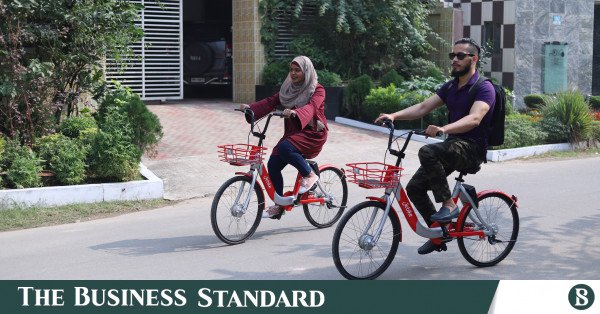
Young bikers ride on rented bicycles provided by the startup Jobike. Photo: Courtesy
“>

Young bikers ride on rented bicycles provided by the startup Jobike. Photo: Courtesy
Highlights:
- Bangladesh e-bike market booming with Tk2,000 crore investments
- Major conglomerates entering, expanding production and nationwide showroom networks
- Sales surged from hundreds to thousands monthly within years
- Lower costs, fuel savings driving rapid consumer adoption
- Heavy import reliance persists despite growing local assembly capacity
- Charging infrastructure, registration barriers slowing wider EV adoption
A quiet but fast-moving shift is underway on Bangladesh’s roads as electric bikes and e-scooters emerge as a new growth industry, drawing over Tk2,000 crore in fresh investments and rapidly rising consumer demand.
What began as a niche market just a few years ago is now drawing significant investment from some of the country’s largest conglomerates, including Nasir Group, Walton, PRAN-RFL Group, Runner Automobiles and Akij Group.

Driven by high fuel prices, rising urban living costs, traffic congestion and growing demand for cleaner transport, e-bikes are increasingly becoming a practical choice for commuters and a serious business opportunity for manufacturers.
Industry insiders estimate that at least five major companies made fresh investments in the sector over the past year alone, with ongoing commitments exceeding Tk2,000 crore.
At the same time, imports have surged sharply, highlighting how rapidly consumer demand is building. Just three years ago, monthly e-bike sales in Bangladesh were negligible, hovering around 100 units. Today, monthly sales have climbed into the thousands.
Infograph: TBS
“>

Infograph: TBS
National Board of Revenue data show imports of e-bikes quadrupled within three years. Imports rose from 2,446 units in FY23 to 10,053 units in FY25. However, industry players say the actual market is significantly larger.
Subail bin Alam, chief operating officer of Nasir Syntax Motors Ltd, said NBR import data do not fully capture the market because a large volume of CKD kits entered Bangladesh in 2025 and many of those shipments are not reflected in the headline numbers.
“If those are added, the actual figure would be several times higher, with hundreds of e-bikes now being sold every day,” he added.
He said the market received a major boost after the government reduced taxes on imported electric two-wheelers and parts in 2024. Currently, completely built-up unit imports face 98.87% tax, while CKD imports are taxed at around 37%, making local assembly increasingly attractive. For fuel-based motorcycles, the rates are 125% and 90%, respectively.
This shift has encouraged multiple firms to enter the market or expand operations.
Subail added that while fuel-based motorcycles cost around Tk3-4 per kilometre to operate, e-bikes cost only 30-40 paisa per kilometre, making them highly cost-effective for daily users.
“A battery costing Tk30,000-35,000 can last around three years. Over the same period, maintenance costs for petrol bikes are much higher. That is why consumers are turning to e-bikes as an alternative.”
Major players scale up investments
Among the newest major entrants is Nasir Group, which has already invested Tk300 crore in the sector.
The company launched five models in November 2025, two with graphene batteries and three with lithium batteries, and has already built showrooms in 40 districts as part of an aggressive expansion strategy.
Subail said Nasir Syntax Motors initially began producing around 70 bikes per day, but has built a factory with the capacity to scale several times higher depending on demand.
“Our target is to invest Tk500 crore in EVs,” he said.
PRAN-RFL Group has also entered the race with its RYDO e-scooter brand. The company has invested around Tk200 crore, with production beginning in January this year at its Habiganj facility.
The plant currently produces around 500 units per month, with plans to scale up to 3,000 units monthly at full capacity.
RN Paul, managing director of RFL Group, said current duty structures remain a challenge because they raise retail prices.
He said the company is engaging with policymakers and aims to bring e-scooters to market at around Tk50,000 by 2027, subject to stronger policy support.
Walton, one of Bangladesh’s largest electronics manufacturers, has already established an early lead. The company launched the country’s first locally produced e-bike under the Takyon brand in 2022 and currently commands around 18% market share.
Its manufacturing ecosystem already includes assembly lines, plastic moulding, PCB SMT production for digital systems and battery management systems, as well as battery manufacturing facilities.
Touhidur Rahman Rad, chief business officer of Walton Digi-Tech Industries Ltd, said Walton plans a dedicated 1,20,000-square-foot e-bike factory with an annual production capacity of 20,000 units.
The project is expected to generate more than 1,500 jobs with an investment running into several hundred crore taka.
He said e-bikes can reduce household transport fuel costs by as much as 80%, allowing families to recover the cost of ownership within a relatively short period.
Runner, Akij intensify competition
Runner Automobiles, a long-established player in Bangladesh’s motorcycle market, has also accelerated its EV strategy.
After entering motorcycle manufacturing in 2012 with over Tk500 crore in phased investment, Runner began assembling e-scooters in 2025 in partnership with China’s Yadea.
It had already launched e-bikes under the eWave brand several years earlier.
Priced between Tk70,000 and Tk100,000, Runner’s e-bikes have gained a strong foothold.
Runner Automobiles Chairman Hafizur Rahman said the company plans to move from assembly to full manufacturing at its Bhaluka factory in Mymensingh.
Meanwhile, Akij Motors entered the e-bike segment between 2020 and 2022 and now assembles seven models at its Gazipur facility.
The company is focusing on the premium segment, with most models priced above Tk1,00,000.
An Akij official said customer preferences are shifting towards better performance, durability and higher-quality vehicles.
Why consumers are switching
A petrol-powered motorcycle typically costs Tk2-3 per kilometre in fuel. An e-bike costs only Tk0.30-0.40 per kilometre.
There is no engine oil, lower servicing costs, and monthly charging expenses can be as low as Tk300-500.
Nawshad Alam, an HR official at BRAC Bank, recently bought a Jiho A8 SE electric scooter for Tk2,20,000.
The lithium-powered scooter can travel 105–110 kilometres on a full charge.
“I bought an e-bike to avoid the hassle of fuel,” he said.
“I no longer need to stand in petrol pump queues. I charge it at home. There is almost no fuel or servicing cost, and the company gave a three-year warranty.”
He added that premium models are expensive, but entry-level bikes begin at around Tk50,000.
Md Mahmudur Rahman, general manager of RFL E-bike, said young professionals, especially women, are increasingly adopting e-bikes.
Their controlled speed makes them appear safer to many families, helping transform them from transport tools into lifestyle products.
He said countries such as India, China and Vietnam demonstrate the long-term potential of electric mobility.
Even families that already own cars or motorcycles are buying e-scooters for short urban trips because of their affordability and convenience, he added.
Md Matiur Rahman of Transsion Holdings said rising fuel prices and worsening congestion are steadily pushing consumers away from conventional motorcycles.
Import dependency
Despite growing local assembly, Bangladesh remains heavily reliant on imports.
Most units arrive fully built from China, while another 20-30% come in as SKD or CKD kits for local assembly. Foreign brands still dominate parts of the market.
Revoo, imported by Transsion Holdings since 2022, controls around 20% market share, offering high-performance models with ranges of up to 80 kilometres, swappable lithium batteries and NFC smart unlocking.
Chinese brands such as TailG, Salida, AIMA and Exploit also maintain strong positions.
Charging, registration still major barriers
Industry leaders say the sector’s biggest growth constraints are inadequate charging infrastructure and cumbersome registration processes.
Bangladesh currently has only 112 public charging stations, concentrated in Dhaka and Chattogram, creating severe range anxiety outside major cities.
Subail of Nasir Syntax Motors said a rider who leaves home with a partial charge has few options if the battery runs out mid-journey.
“Fuel stations exist everywhere, but charging stations do not. The government still has no clear policy framework. This is a major barrier for EV adoption,” he said.
Walton’s Touhidur Rahman said demand is currently stronger in Khulna and Chattogram than in Dhaka in some cases, partly due to road-use patterns and infrastructure realities.
He said rapid expansion of fast-charging and battery-swapping stations would dramatically accelerate growth.
Md Moshiuzzan, director of corporate affairs at Nasir Syntax Motors, said e-bike registration costs range from Tk8,000 to Tk12,000.
He added that no dedicated BRTA desk exists for e-bike registration, forcing many buyers into lengthy procedures and leaving many vehicles unregistered.
Bangladesh’s motorcycle market is now worth an estimated Tk7,000-8,000 crore, expanding at 16-17% annually.
Nearly 99% of motorcycles sold locally are now manufactured or assembled in Bangladesh, a transformation driven by supportive industrial policies.
If registration systems are simplified, charging infrastructure expanded and tax policies remain supportive, Bangladesh’s e-bike market may soon become the next major success story in domestic manufacturing and urban mobility, stakeholders say.
About The Author