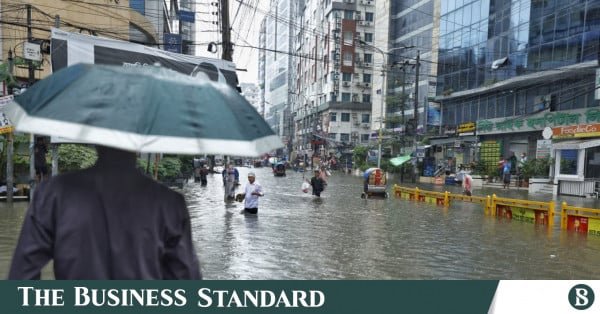
Dhaka had a physical risk score of 60, the highest among the 72 major cities assessed in the index
A man stands on a lifted up sidewalk as he watches people struggle in waist-deep water in Green Road, Dhaka, on 12 July 2026 as incessant downpour has caused waterlogging in some parts of the capital. Photo: Rajib Dhar/TBS
“>

A man stands on a lifted up sidewalk as he watches people struggle in waist-deep water in Green Road, Dhaka, on 12 July 2026 as incessant downpour has caused waterlogging in some parts of the capital. Photo: Rajib Dhar/TBS
Highlights:
- Dhaka has the highest physical climate risk among 72 cities
- Adaptation reduced Dhaka’s climate risk by 24 points
- Dhaka remains among the six least resilient major cities
- Chattogram has lower physical and residual climate risks
- South Asian cities dominate the least resilient rankings
- Climate risks could increase Bangladesh’s financial and infrastructure pressures
Bangladesh faces major climate risks, with the country’s capital Dhaka carrying one of the highest levels of physical climate risk among major cities worldwide, according to the Climate Risk & Resilience Index (CRRI).
According to a report published by AlphaGeo, Dhaka had a physical risk score of 60, the highest among the 72 major cities assessed in the index. The score measures the city’s exposure to climate-related hazards before taking adaptation efforts into account.

Dhaka has also made significant progress in reducing these risks through adaptation measures. Its adaptation efforts reduced its risk by 24 points, giving it an adaptation rate of 40%.
However, the city’s very high level of physical exposure means its Resilience-Adjusted Risk (RAJ) score remains at 36. This puts Dhaka among the six least resilient major cities in the 72-city index.
Heat exposure adds to pressure
The South Asian cities in the index face particularly high climate risks, with extreme heat a major factor. The six least resilient major cities in the global analysis are all in South Asia.
Ahmedabad in India and Hyderabad in Pakistan had the highest RAJ scores at 41, followed by Multan at 38. Dhaka ranked next with a score of 36. Kolkata and Lahore both had scores of 35.
Despite Dhaka’s high overall risk, its adaptation efforts are stronger than those of several regional peers. Its 24-point reduction was the largest among the South Asian cities listed in the analysis.
The report describes adaptation performance across South Asia as moderate, with adaptation rates remaining relatively low compared with the scale of physical risks faced by the region.
Chattogram has lower residual risk
Bangladesh’s second major city, Chattogram, has a lower level of physical risk than Dhaka and a lower residual risk after adaptation.
Chattogram had a physical risk score of 46 and reduced its risk by 16 points through adaptation measures. Its adaptation rate was 34.8%, compared with 40% for Dhaka.
Despite Dhaka having a higher adaptation rate and a larger absolute reduction in risk, Chattogram had a lower RAJ score of 30. This reflects its lower starting level of physical exposure.
Chattogram ranked ahead of several major South Asian cities, including Karachi, Faisalabad, Kolkata and Lahore, which had RAJ scores of 32, 34, 35 and 35 respectively.
Climate risks create financial pressures
The high climate risks facing Dhaka could also create financial pressures for Bangladesh, particularly through future spending on disaster response, infrastructure repairs and the relocation of people affected by climate-related events.
The report warns that Bangladesh has limited capacity to close its adaptation gap as quickly as its physical climate risks are increasing. This could create contingent liabilities for the government and increase risks for sovereign and municipal bond investors.
For real estate and infrastructure investors, the risks include falling property values, shorter infrastructure lifespans and disruptions to business operations.
The report identifies Bangladesh as a potential priority for adaptation finance because of the large gap between its physical climate risks and current adaptation efforts. Concessional financing and development funding could help reduce some of these risks.
South Asia lags other major Asian cities
The comparison with major East Asian cities highlights the role of investment and adaptation in reducing climate risks.
Tokyo, for example, has a RAJ score of 20 despite facing high levels of heat risk. Chinese cities such as Beijing and Shanghai have adaptation rates of between 46% and 50%, according to the index.
Within South Asia, Mumbai was the most resilient city in the index, with a RAJ score of 18, followed by Delhi at 23 and Colombo at 24.
Chattogram ranked at 30, while Karachi scored 32, Faisalabad 34, Kolkata and Lahore 35, Dhaka 36, Multan 38, and Hyderabad and Ahmedabad 41.
The figures show that adaptation can reduce climate risks, but cities with very high levels of physical exposure may still face significant residual risks even after making substantial investments in resilience.
About The Author