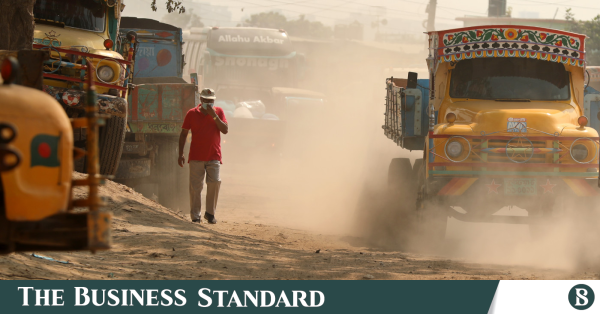
The AQI in Dhaka today (2 November) was around 164 to 165 (US AQI scale), which falls into the “unhealthy” category.
The AQI in Dhaka today (2 November) was around 164 to 165 (US AQI scale), which falls into the “unhealthy” category. Photo: Collected
“>

The AQI in Dhaka today (2 November) was around 164 to 165 (US AQI scale), which falls into the “unhealthy” category. Photo: Collected
Air quality across Bangladesh has deteriorated sharply following the retreat of the monsoon, with fine particulate matter (PM) levels in the capital rising to unhealthy thresholds, environmental monitoring data shows.
The rapid spike in ambient toxicity has triggered fresh warnings as the country enters its high-risk dry season.
According to the latest daily Air Quality Index (AQI) report published on the Department of Environment (DoE) website on 26 October, residents of major cities, including Dhaka, Chattogram, Barishal, Mymensingh and Rangpur, are breathing toxic air as air quality has sharply deteriorated in these areas.

Dhaka’s AQI was 163 on 26 October, meaning the capital’s air quality was unhealthy. Chattogram recorded an AQI score of 163, Gazipur 160, Narayanganj 176, Mymensingh 184, Rajshahi 132, Barishal 157, Cox’s Bazar 160, Feni 154, Tongi 163, Bogura 167, Rangpur 150 and Tangail 156.
Data from the IQAir Real-Time City Ranking also indicated that Dhaka’s average monthly concentration of fine particulate matter (PM2.5) frequently pushes the capital’s Air Quality Index (AQI) well into the “unhealthy” bracket.
The AQI in Dhaka today (2 November) was around 164 to 165 (US AQI scale), which falls into the “unhealthy” category.
According to the IQAir Global Air Quality Database, Dhaka ranks fourth to fifth among the world’s most polluted cities, with historical annual particulate averages measuring more than 13 times the World Health Organization’s (WHO) annual safety guideline of 5 micrograms per cubic metre.
The DoE measures the AQI based on five criteria pollutants: particulate matter (PM10 and PM2.5), nitrogen dioxide (NO2), carbon monoxide (CO), sulphur dioxide (SO2) and ozone (O3).
According to the air quality standards set by the DoE, an AQI score ranging from 0 to 50 is considered ‘Good’, while 51 to 100 is ‘Moderate’, 101 to 150 is ‘Unhealthy for Sensitive Groups’, 151 to 200 is ‘Unhealthy’, 201 to 300 is ‘Very Unhealthy’ and a score above 301 is ‘Hazardous’.
Talking to BSS, DoE Deputy Director (Air Quality) Dr Mohammad Abdul Motalib said air quality deteriorates in Bangladesh during the dry season due to changes in weather patterns.
During the monsoon, relatively clean air flows over the country from the south, while winds blow from the north during the dry season, carrying pollutants from outside Bangladesh and contributing to air pollution, he said.
Dr Motalib said conventional brick kilns begin operating at full capacity during the dry season and pollute the air. Dust (PM10) is also usually generated in greater quantities during this period, he said.
The DoE has established a countrywide air quality monitoring (AQM) network.
Continuous monitoring of six criteria pollutants (PM2.5, PM10, SO2, CO, NOx and O3) is carried out by 31 Continuous Air Monitoring Stations (CAMS) and Compact Continuous Air Monitoring Stations (CCAMS) located in the country’s divisional and industrial districts.
The network encompasses all regions of the country – Dhaka, Narayanganj, Gazipur, Savar, Mymensingh and Narsingdi in the centre; Chattogram in the south-east; Khulna, Cumilla and Barishal in the south; Rajshahi in the west; Sylhet in the north-east; and Rangpur in the north-west.
CCAMS are also located in Faridpur, Jashore, Satkhira, Bagerhat, Gopalganj, Tangail, Bogura, Tongi, the BUET campus, Brahmanbaria, Feni, Noakhali, BSRM (Chattogram), Cox’s Bazar and Nagor Bhaban, Dhaka.
Data and information generated by these stations are automatically collected on a central server and disseminated through the DoE website.
The AQI for each city is calculated and published online daily to notify the public about the air quality in their respective cities.
About The Author