The Institute of Epidemiology, Disease Control and Research (IEDCR) has warned that the dengue situation could worsen this month as the disease has spread to all 64 districts, with infections and deaths continuing to rise.
According to the state-run research institute’s latest analysis, dengue cases could rise next week in 15 districts, including Dhaka, Khulna, Chattogram, Gazipur, Mymensingh, Pirojpur, Narayanganj, Jhalakathi, Cox’s Bazar, Sirajganj, Cumilla, Barishal, Barguna, Bandarban, and Patuakhali.
The IEDCR’s Climate-Informed Early Warning and Response System has also recommended close monitoring of Bagerhat, Chapainawabganj, Narsingdi, Jashore, Chandpur, Manikganj, Kishoreganj and Rajshahi.

Dhaka continues to bear the highest dengue burden, while rising cases in Khulna, Gazipur and Narayanganj are particularly concerning, the agency said. Transmission could remain high for the next two to three weeks.
Dr Quazi Ahmed Zaki, director of the IEDCR, told TBS that their model forecasts the dengue situation for epidemiological weeks 36 to 39 with about 80% accuracy.
“This is not a definitive prediction; rather, it is a scientific projection of possible scenarios that will help local administrations and health authorities prepare in advance,” he said.
The IEDCR urged authorities to prioritise Dhaka, Khulna, Gazipur, Narayanganj, Chattogram and Mymensingh for mosquito control and source reduction.
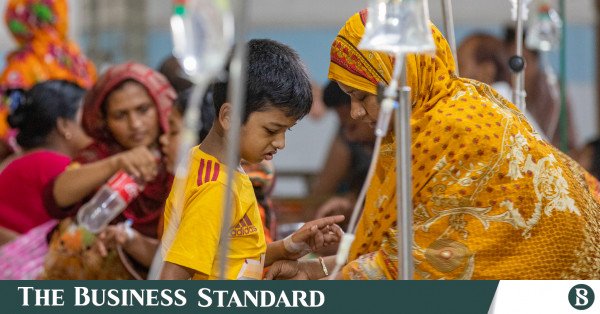
It also advised hospitals in high-risk areas to prepare for a prolonged patient surge.
Dengue deaths surge
Six more people died of dengue and 1,561 were hospitalised in the 24 hours to 8am yesterday (13 September), according to the Directorate General of Health Services (DGHS).
The latest deaths raised this year’s toll to 149, while total cases reached 51,837.
Only five dengue deaths were recorded between January and May. The toll rose to 13 in June, 36 in July and 43 in August. In the first 13 days of September alone, 52 people have died.
DENV-3 dominant this year
Dengue-3 (DENV-3) has emerged as the dominant serotype this year, replacing DENV-2, which was predominant from 2023 to 2025.
According to an IEDCR report, hospital-based surveillance found DENV-3 in 91.5% of 71 samples tested from 1,097 NS1-positive samples collected at nine hospitals. DENV-2 accounted for the remaining 8.5%.
DENV-3 dominates in Dhaka, while DENV-2 has been detected outside the capital. All samples tested in Bandarban and Barguna were positive for DENV-2, the IEDCR said.
Epidemiologists say infection with one dengue serotype provides immunity against that type but leaves people vulnerable to the other three. A subsequent infection with a different serotype can increase the risk of severe complications and death.
Dr Zaki said reinfection with a different serotype can cause complications such as plasma leakage. He advised people to seek medical care within 24 to 48 hours of developing a fever and undergo a NS1 test when necessary.
“Many patients reach the hospital late, by which time they have already progressed to shock,” he said.
‘No longer just disease of urban areas‘
Kabirul Bashar, professor of zoology at Jahangirnagar University, told TBS that dengue is no longer confined to Dhaka or urban areas.
“Aedes mosquitoes have spread to districts, upazilas and even many villages,” he said.
The medical entomologist said the biggest problem in dengue control is the failure to implement evidence-based measures.
“Fogging alone cannot control dengue unless control measures reach the places where Aedes mosquitoes are breeding,” he said.
About The Author