The World Health Organization says there is no known safe level of lead exposure. Even low levels can harm children’s brain development, affecting their learning abilities and behaviour.
YouthNet Global organised the programme with support from Pure Earth Bangladesh, while Volunteer for Bangladesh, Photo: TBS.
“>

YouthNet Global organised the programme with support from Pure Earth Bangladesh, while Volunteer for Bangladesh, Photo: TBS.
Young people and environmental campaigners in Chattogram have called for urgent action to prevent lead poisoning among children, demanding safe battery recycling, safer consumer products and stronger enforcement of environmental laws.
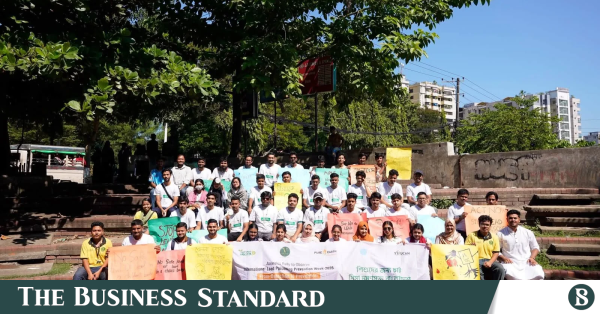
They made the demands at a human chain and rally held at Kazir Dewri Mukto Mancha in the port city on Friday under the theme “Together, We Stand Against Lead Pollution”. Participants also distributed leaflets to raise awareness about lead exposure and its harmful effects.
YouthNet Global organised the programme with support from Pure Earth Bangladesh, while Volunteer for Bangladesh, YOUCAN and Earth Development Foundation joined as co-organisers. Young volunteers, civil society representatives, journalists and local stakeholders took part.

According to the Bangladesh Multiple Indicator Cluster Survey 2025, conducted by the Bangladesh Bureau of Statistics with support from UNICEF, 38.4% of children aged 12-59 months in Bangladesh have elevated blood lead levels.
The World Health Organization says there is no known safe level of lead exposure. Even low levels can harm children’s brain development, affecting their learning abilities and behaviour.
Aymanur Rahman Tanvir, divisional coordinator of YouthNet Global’s Chattogram division, said children and pregnant women were particularly vulnerable to lead exposure.
“Lead pollution is not merely an environmental issue; it is a silent public health crisis. Tackling it requires awareness, responsibility and joint efforts from every one of us,” he said.
Mitali Das, country director of Pure Earth Bangladesh, stressed the need to identify and control sources of lead exposure alongside raising public awareness.
“To protect children from lead poisoning, we need to identify and control sources of lead, ensure safe consumer products, promote environmentally sound battery recycling and raise public awareness,” she said.
Das said Pure Earth was working with the Ministry of Environment, Forest and Climate Change, the Department of Environment and other stakeholders to develop Extended Producer Responsibility (EPR) guidelines for lead-acid batteries.
The proposed guidelines would help ensure proper battery collection, tracking and environmentally sound recycling, she added.
Sohanur Rahman, executive coordinator of YouthNet Global, warned that unplanned and unsafe recycling of lead-acid batteries posed serious risks beyond recycling facilities.
“Unplanned and unsafe recycling of lead-acid batteries endangers not only workers but the health and environment of entire surrounding communities,” he said.
He called for stronger public pressure against harmful industrial practices and effective policy measures to protect communities exposed to lead pollution.
The Chattogram programme was part of a week-long campaign being conducted across all eight administrative divisions by YouthNet Global with support from Pure Earth Bangladesh.
The campaign aims to engage children, young people, teachers, public and private institutions, and local communities in identifying sources of lead pollution and preventing exposure.
Participants called for stronger enforcement of environmental laws, safer consumer products and effective monitoring of used lead-acid battery collection and recycling to protect children, workers and surrounding communities.
About The Author