Highlights:
- Tk214 crore iconic Cox’s Bazar station remains partially operational.
- Promised facilities, including waiting rooms, hotel and restaurants, remain unavailable.
- Poor maintenance has caused rust, moss growth and equipment damage.
- Staffing shortages leave the station operating at roughly one-third capacity.
- Only four train pairs serve the route daily, against 31 planned.
- Bangladesh Railway relaxed tender conditions, extending the contract to 20 years.
Cox’s Bazar’s iconic railway station has yet to become fully operational nearly three years after its inauguration, leaving passengers without many of the promised facilities while poor maintenance has already started damaging parts of the complex.
According to railway data, around Tk11,500 crore was spent on the 101-kilometre Dohazari-Cox’s Bazar railway line, including 38 bridges and nine stations. The project was inaugurated in November 2023, and train services began the following month, connecting the tourist destination to the railway network for the first time.

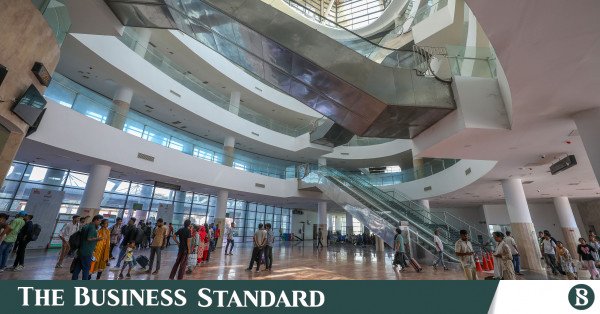
The project included a six-storey, conch-shell-shaped iconic station built on 29 acres at Chander Para in Jhilongja union, near Cox’s Bazar sea beach. Covering 1,87,000 square feet, the station was constructed at a cost of Tk214 crore.
Over the past couple of years, inadequate maintenance has allowed dust to accumulate on the station’s steel structure and fittings, while parts of the structure have begun to rust.
Bangladesh Railway had planned to hand over the station’s operation to a private operator because it lacked approval to recruit the required workforce. Its first tender failed to attract any bids, prompting the railway authorities to issue a second tender with relaxed conditions.
Passengers deprived of services, infrastructure deteriorating
The station was designed to offer modern facilities, including a star-rated hotel, shopping mall, restaurants, childcare centre, and luggage lockers. The air-conditioned complex can accommodate 46,000 people daily and also includes a post office, convention centre, information centre, ATM booths, and prayer facilities.
The ground floor houses ticket counters, reception, lockers, an information centre, a mosque, a children’s recreation area, a passenger lounge, and access to footbridges. The second floor was designed for waiting rooms, shopping facilities, restaurants, and a childcare centre. A 39-room hotel was planned for the third floor, while the fourth floor includes space for restaurants, a conference hall, and a childcare centre. The fifth and sixth floors have office spaces and a multipurpose hall, respectively.
Despite these facilities, even basic services such as waiting rooms and rest areas for passengers remain unavailable. Chairs on the ground floor are currently the only designated seating arrangement.
The lack of regular operation and maintenance has damaged toilets, fittings and other equipment. The escalators have also developed problems, while parts of the steel structure are showing signs of rust and moss growth.
A railway employee told The Business Standard that most basic passenger services remain unavailable.
The station’s decorative structures are also deteriorating, with rust and moss appearing on the pipes forming its signature conch-shell design, he said.
The station currently operates with four stationmasters, four booking assistants, five ticket collectors, three porters, 12 pointsmen, and six gatekeepers. Eight Railway Police personnel and 12 members of the Railway Security Force are deployed for security.
However, the workforce is only about one-third of what the large complex requires, according to railway data.
During a recent visit by railways ministry officials, station staff highlighted shortages of personnel and cleaning workers. They said the station was operating with limited capacity and that uncertainty over the management of its facilities had prevented it from opening fully. They also warned that inadequate cleaning and supervision could leave valuable equipment vulnerable to theft and infrastructure at risk of further damage.
The railway had planned to operate 31 pairs of trains daily on the Dohazari-Cox’s Bazar line. Currently, only four pairs run from Dhaka and Chattogram. Bangladesh Railway is also planning to extend the Dhaka-Chattogram route’s Mahanagar Express to Cox’s Bazar, while the Chattogram-Chandpur Meghna Express is also expected to serve the tourist destination.
Railway relaxes tender conditions
Bangladesh Railway invited bids early this year to appoint a private operator under a tender.
Although eight companies purchased the tender documents, none submitted a bid, citing unfavourable commercial conditions.
According to the office of the Chief Commercial Manager of Bangladesh Railway’s eastern zone, the railway held a meeting with contractors in April to discuss the failed tender.
The companies said the railway had required the operator to recruit 500 people and procure equipment, including cranes, to clean and maintain the entire station. They estimated that the operator would need to invest around Tk100 crore, while the station could take two years to become commercially viable.
They questioned whether the investment could be recovered within the original 12-year contract period. They also objected to the Tk20 crore tied up in the non-refundable advance payment and performance guarantee, arguing that financing the investment through bank loans would leave little profit.
The contractors proposed reducing the Tk5 crore non-refundable advance payment and Tk15 crore performance security, lowering penalties for late utility-bill payments, making contract termination provisions more flexible, and extending the contract period from 12 to 20 years.
Taking their concerns into account, Bangladesh Railway issued a second tender on 30 September. The non-refundable advance payment was reduced from Tk5 crore to Tk1 crore, and the performance security from Tk15 crore to Tk5 crore. The contract period was extended to 20 years.
Mamunul Islam, general manager (east) of Bangladesh Railway, told TBS that the railway could operate the station itself if it had sufficient staff, but recruitment for the new railway line had not received approval from the Ministry of Public Administration.
“That is why we invited tenders to appoint a private operator for the station,” he said, adding that the railway had relaxed the conditions based on companies’ recommendations and hoped to appoint an operator in the second round.
“If infrastructure remains unused for a long time without being put into operation, it naturally deteriorates,” he said.
About The Author