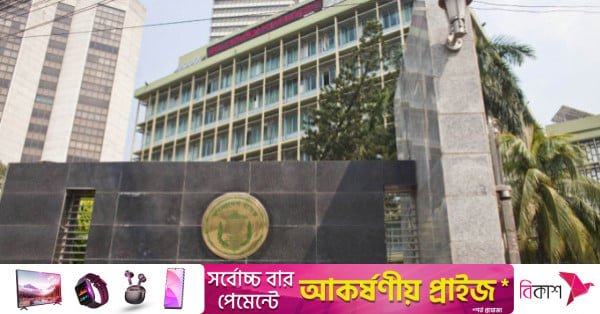
The central bank injected Tk21.68 lakh crore liquidity support into the country’s banking system last year as the sector faced mounting pressure from rising default loans, capital shortages, a crisis in Islamic banks, weak financial institutions, and declining investor confidence.
Bangladesh Bank’s recently released Financial Stability Report stated that the support was extended in 2025 to maintain the stability and functioning of the banking system amid increasing financial strain.
A record Tk30.29 lakh crore in loans and liquidity support was also provided during the fiscal 2023-24 to maintain stability, which was up 131% from the previous year’s Tk13.08 lakh crore.

The 2025 support was extended through various facilities, including repo operations, Assured Liquidity Support (ALS), the Islamic Banks Liquidity Facility (IBLF), and Special Liquidity Support (SLS), according to the report.
Conventional banks and financial institutions received Tk19.75 lakh crore through regular liquidity instruments. Of the total, 59.11% came through repo operations, 36.67% through ALS and 4.22% through the standing liquidity facility (SLF).
Repo is a mechanism through which banks receive short-term loans from the central bank against treasury bills and bonds. Banks can borrow through repo operations, usually for overnight, seven-day, 14-day and 28-day periods.
Through ALS, only primary dealer (PD) banks can borrow funds for up to 90 days. PD banks receive the facility when they are required to purchase government treasury bills and bonds due to insufficient demand at auctions.
During the year, banks deposited Tk5.11 lakh crore with Bangladesh Bank under the standing deposit facility (SDF).
Mutual Trust Bank Managing Director Syed Mahbubur Rahman said the weak interbank market had forced banks to depend on central bank support.
“Our interbank market is not very strong. So banks take repo facilities from the central bank against treasury bills and bonds. However, these funds are returned by banks within a very limited period,” he said.
Banking sector experts said liquidity support could help maintain financial stability in the short term but was not a permanent solution.
They warned that prolonged dependence on such facilities could create a “moral hazard” among banks. In other words, the banks may assume that despite weak management, the central bank will ultimately step in to bail them out.
They said the immediate priorities should be restructuring weak banks, recovering default loans, ensuring professionalism in management and strengthening independent supervision by the central bank.
Islamic banking faces deeper stress
During the year, Islamic banks received Tk1.74 lakh crore in liquidity support from Bangladesh Bank through the IBLF, Mudarabah Liquidity Support (MLS) and SLS.
IBLF accounted for the largest share at 89.93%, while SLS accounted for 9.88%. The contribution of MLS was negligible. Conventional banks were the main users of regular liquidity instruments, accounting for 91.89% of the support, while Islamic banks accounted for 8.11%.
In addition, 11 banks received emergency liquidity assistance (ELA) from Bangladesh Bank in 2025, amounting to Tk18,333 crore.
According to the report, high interest rates, global uncertainty, import costs and slower investment growth had put pressure on the economy, while the banking sector faced a serious capital shortage.
The banking sector’s capital-to-risk-weighted assets ratio (CRAR) fell from 3.08% in 2024 to negative 2.64% in 2025, indicating that many banks were unable to maintain sufficient capital to absorb risks. The capital conservation buffer also fell to zero.
State-owned banks, specialised banks and several private and Islamic banks were identified as the main contributors to the capital weakness. The banking sector’s leverage ratio also turned negative, falling to 3.10%. Returns on assets (ROA) and returns on equity (ROE) declined significantly.
The report expressed the greatest concern over Islamic banking. The combined CRAR of Islamic banks fell to negative 43.18%, while default loans increased by 56.15%.
Although the CRAR stood at 7.71% excluding five banks undergoing restructuring, the overall situation remained concerning. Deposit growth slowed, investment growth declined and shareholders’ equity turned negative.
The report also said several Islamic banks failed to maintain mandatory liquidity indicators, including the liquidity coverage ratio (LCR), net stable funding ratio (NSFR) and investment-deposit ratio (IDR).
As Islamic banks hold a significant share of Bangladesh’s banking system, the central bank warned that problems in the sector could put the entire financial system at risk.
Default loans remain biggest challenge
Non-performing loans remained the biggest challenge for the banking sector, the central bank report further noted.
Stress tests showed that a further rise in default loans could severely affect banks’ capital positions. The risk of large borrowers becoming defaulters also remained high.
Corporate lending was highlighted as a major risk, with around 46% of total loans concentrated in the corporate sector and 67% of risk-weighted assets linked to it.
Non-bank financial institutions also faced difficulties. By the end of 2025, their default loan ratio had risen to 33.32%. Capital adequacy fell to negative 23.19%, deposits declined by 7.03% and profits turned negative due to higher provisioning requirements.
Despite the challenges, the report noted some positive developments, including increased remittance inflows, stable export earnings and improved current account conditions due to controlled import costs.
At the end of 2025, Bangladesh’s foreign exchange reserves stood at $33.19 billion. Under the IMF’s BPM6 calculation method, reserves stood at $28.59 billion.
Digital financial services also expanded, with increased use of NPSB, BEFTN, internet banking, payment cards, BD-RTGS and agent banking. Bangla QR and TakaPay also grew during the period.
Bangladesh Bank said the financial system remained stable overall but warned that risks could not be ignored.
Experts called for stronger action to recover default loans, restructure weak banks, improve governance, address capital shortages and strengthen regulatory oversight.
The report showed that domestic credit through the banking system reached Tk22.84 lakh crore at the end of 2025, rising 7.98% from 2024. Private sector credit increased by 6.49% to Tk17.47 lakh crore, while public sector credit rose by 13.15% to Tk5.36 lakh crore.
After declining between 2018 and 2023, the ratio of private and public sector credit increased slightly to 3.46% at the end of 2024 before falling to 3.26% by the end of 2025. The ratio declined further to 3% in the first half of 2026.
About The Author