In contrast, ordinary consumers experienced unexpected financial relief, reporting that prices had plummeted by as much as Tk20,000 per lakh compared to the preceding evening
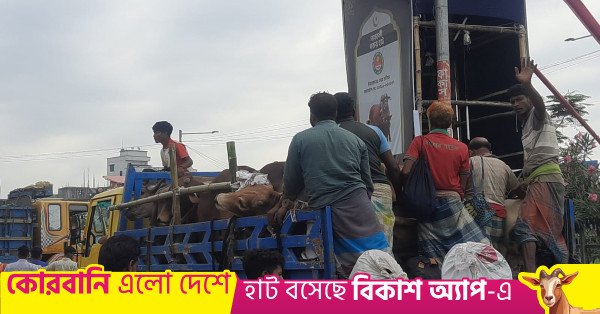
A continuous stream of dejected traders loading unsold cattle onto transport vehicles, while others scrambled across the venue in search of available transport at the Gabtoli Cattle Market on the day of Eid-ul-Adha (28 May 2026). Photo: Jahir Rayhan/TBS
“>

A continuous stream of dejected traders loading unsold cattle onto transport vehicles, while others scrambled across the venue in search of available transport at the Gabtoli Cattle Market on the day of Eid-ul-Adha (28 May 2026). Photo: Jahir Rayhan/TBS
A drastic collapse in cattle prices hit the capital’s premier Gabtoli Cattle Market during the final hours of the trade, driven by a sharp decline in eleventh-hour buyers and an unprecedented oversupply of animals.
The sudden market crash left many farmers and traders facing severe financial losses, forcing many to reload their unsold livestock onto trucks to return to their home districts on Eid morning (28 May).
A survey of the Gabtoli market from 8:30am to 11:30am today, the day of Eid-ul-Adha, revealed a continuous stream of dejected traders loading unsold cattle onto transport vehicles, while others scrambled across the venue in search of available transport.


The financial devastation was echoed by Mohammad Lablu, a trader from Manikganj, who stated that he had brought 44 cows to the capital but managed to sell only 13, lamenting that the traders themselves felt financially sacrificed alongside their livestock this year.
Similarly, Abdus Sattar from Shibganj upazila in Chapainawabganj recounted bringing 38 cattle to Dhaka, 16 of which remained unsold.
Sattar noted that a cow valued at Tk 380,000 just two days prior was ultimately sold for Tk 270,000 on Eid morning, explaining that because he had purchased the livestock using borrowed capital, he was forced to liquidate the animals at a massive loss simply to service his outstanding debts.
Traders and farmers noted that keeping the animals in muddy, rain-soaked conditions over several days posed severe health risks to the livestock, which prompted many to accept losses exceeding Tk 100,000 per animal.
In contrast, ordinary consumers experienced unexpected financial relief, reporting that prices had plummeted by as much as Tk 20,000 per lakh compared to the preceding evening.
A buyer named Mohammad Fardin shared that he successfully purchased a cow for Tk 270,000 after the seller had initially demanded Tk 420,000, while another buyer, Shahed, confirmed that the downward price correction began on the eve of Eid, offering much-needed respite to middle-income families.

Thousands of unsold cattle remained visible on the market grounds well past 11am, with sellers confirming that the market correction had begun in earnest at 6am on Wednesday due to the stark supply-demand imbalance.
This year’s steep price correction stands in stark contrast to previous seasonal trends. According to official data from the Department of Livestock Services (DLS), a total of 9,136,734 animals were sacrificed during the preceding Eid-ul-Adha, consisting of 4,705,106 cattle and buffaloes, 4,430,668 goats and sheep, and 960 other animals. In a press conference held on 3 May, the Minister of Fisheries and Livestock, Mohammad Amin Ur Rashid, had announced that the national stock of sacrificial animals for the current year stood at 12,333,000 against a projected domestic demand of 10,106,334 animals, indicating a significant macro-level surplus that ultimately manifested at retail markets.
Interviews conducted with approximately 100 traders, farmers, and consumers over a three-day period at the venue identified a combination of critical economic and structural factors that caused the low sales volume and subsequent price crash at Gabtoli. A primary driver was diminishing public purchasing power, as soaring commodity prices and macroeconomic pressures forced families to significantly downsize their festival budgets, opt for smaller animals, or engage in joint sacrifices.
This drop in demand was met with an immense domestic supply, as vast numbers of cattle were transported to Dhaka from various districts, creating a massive retail glut when buyers failed to match the influx.
Furthermore, sellers highlighted a sharp drop in the number of high-value buyers. In previous years, affluent political leaders, prominent businessmen, and influential figures regularly purchased ten to fifteen large cattle priced between Tk500,000 and 600,000 each.

However, current socio-political shifts, which left several prominent political figures and influential buyers absent from the market, drastically reduced large-scale purchases.
This structural shift was compounded by the strategic behaviour of ordinary consumers, many of whom deliberately delayed their purchases until Eid morning or the final night in anticipation of a price drop, which placed immense liquidation pressure on the traders.
The situation was further aggravated by allegations from some sellers who claimed that cattle were illegally smuggled into Bangladesh through various border points in Thakurgaon. These animals were reportedly crossed over under the cover of night and rapidly dispatched across the country via trucks, which contributed to the domestic price depression.
Additionally, the growing popularity of digital storefronts and decentralised local neighbourhood markets drew significant consumer traffic away from major traditional hubs, leaving Gabtoli with historically low foot traffic.
Faced with rising transport fares, labour costs, and the accumulating overhead expenses of feeding and housing livestock at the urban venue, desperate traders ultimately chose to absorb massive financial losses on-site rather than incur the double expense of transporting the unsold animals back to their farms.
About The Author