Health ministry officials are scheduled to meet on 24 June to finalise the expansion plans for the three hospitals
Photo: Noor A Alam
“>

Photo: Noor A Alam
Hospital capacity expansion plan:
- National Cancer Institute: From 500 to 1,200 beds
- Dhaka Dental College Hospital: From 200 to 300 beds
- Mohammad Ali Hospital in Bogura: From 250 to 500 beds
- All 427 upazila hospitals: From 50 to 101 beds
- 170 urban healthcare centres in Dhaka and Chattogram Cost: Tk1,157cr
- Capacity must grow alongside bed numbers, experts caution
Following a proposal to nearly double health sector spending in the upcoming fiscal year’s budget, the government is launching a series of initiatives to expand hospital capacity, improve access to cancer treatment, strengthen dental healthcare services and ensure primary healthcare coverage in both urban and rural areas.
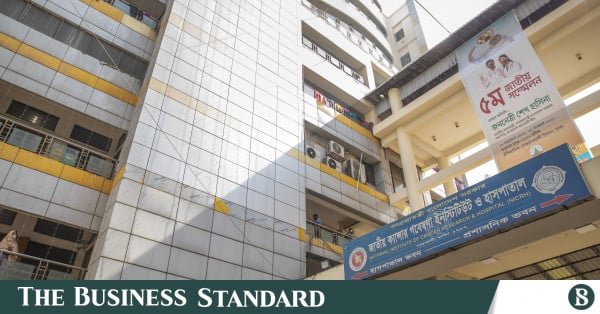
To make treatment for life-threatening cancers more accessible within the country, the government has decided to expand the National Institute of Cancer Research and Hospital from 500 beds to 1,200 beds. It is also moving to accelerate construction and commissioning of eight cancer hospitals currently being built across the country’s eight divisions.

In addition, Dhaka Dental College Hospital will be upgraded from 200 to 300 beds, while the 250-bed Mohammad Ali Hospital in Bogura will be expanded to 500 beds.
Health ministry officials are scheduled to meet on 24 June to finalise the expansion plans for the three hospitals.
Infograph: TBS
“>

Infograph: TBS
Healthcare experts, however, say that unless service quality, modern facilities and patient-friendly care are ensured, the tendency of cancer patients to seek treatment abroad is unlikely to decline.
Improving healthcare services and ensuring access to primary healthcare for all are among the BNP government’s key commitments. Alongside proposing a nearly doubled health budget of Tk69,409 crore for the next fiscal year, the government has announced plans to recruit 5,000 doctors and 1 lakh healthcare workers as part of a broader overhaul of the health sector.
To ensure that budget allocations are effectively utilised, the health ministry has already begun taking implementation measures at the start of the fiscal year.
Earlier, the government decided to upgrade all 427 upazila hospitals with 50 beds into 101-bed facilities to strengthen primary healthcare services at the local level.
The health ministry is also preparing a Tk1,157 crore Urban Health Care Integration Project to improve primary healthcare services for residents of Dhaka and Chattogram city corporation areas. Under the project, 170 healthcare centres will be established in the country’s two largest cities.
Capacity must grow alongside bed numbers
At the National Institute of Cancer Research and Hospital, nearly 200 patients wait for admission every day, but only six or seven beds become available. As a result, most patients who require hospitalisation cannot be admitted despite urgent need. The country’s only specialised 500-bed cancer hospital is struggling to cope with the overwhelming patient load, prompting the government’s decision to expand it to 1,200 beds.
Dr Mostafa Aziz Sumon, Director of the National Institute of Cancer Research and Hospital, told The Business Standard: “Although our official capacity is 500 beds, patient demand is more than double. Even with 1,200 beds, we would still have to turn patients away. What we really need is a comprehensive 2,000-bed cancer hospital.”
Dr Sumon noted that cancer hospitals face unique challenges compared with general hospitals.
“In general hospitals, patients with fever may leave after a few days, freeing up beds. Cancer patients often require long-term treatment. In paediatric cancer cases, children may need to stay in hospital for up to three months as part of the treatment protocol,” he said.
Experts caution, however, that increasing bed numbers alone will not resolve the crisis. They say adequate staffing, modern equipment and sufficient funding must accompany the expansion.
Dr Md Habibullah Talukder Ruskin, former professor at the Cancer Institute and project coordinator of the Gonoshasthaya Community-Based Cancer Hospital, welcomed the expansion plans but stressed that service capacity must also improve.
“It is encouraging that hospital bed numbers are increasing. However, the government must also ensure radiotherapy and all other cancer services meet patient demand,” he said.
He added that upazila health complexes should offer basic cancer screening and diagnostic services, while district hospitals and medical colleges should provide multidisciplinary cancer care.
“If every medical college develops a comprehensive cancer centre offering surgery, chemotherapy, radiotherapy, gynaecological oncology and paediatric oncology, pressure on the Cancer Institute will be significantly reduced,” he said.
He also urged the government to quickly complete and fully operationalise the divisional cancer hospitals currently under construction.
Hospital sources said between 1,200 and 1,500 patients receive outpatient services daily. Many patients requiring admission must wait several months to secure a bed.
Equipment shortages are also worsening the situation. Dr Sumon said that although the hospital has seven radiotherapy bunkers, only two radiotherapy machines are currently operational.
“As a result, patients must wait between one and one-and-a-half years for radiotherapy,” he said.
He added: “We have only one CT scan machine, and it is barely functioning. There is no MRI machine. We do not have enough anaesthesia machines in our operating theatres. Even basic supplies such as gloves, cannulas and saline sets often run short.”
A complete course of radiotherapy costs between Tk12,000 and Tk15,000 at the Cancer Institute, compared with around Tk2 lakh at private hospitals.
Staff shortages remain another major challenge. The hospital is currently operating with manpower originally allocated for a 300-bed facility. Although 210 new positions were recently approved, officials say that is far below actual requirements.
“We requested around 1,200 additional staff, but only 210 positions were approved,” Dr Sumon said.
He stressed that a comprehensive approach is needed.
“Increasing bed numbers alone will not solve the problem. Adequate funding, sufficient manpower and modern equipment must all be ensured simultaneously,” he said.
According to the Bangladesh Cancer Society, an estimated 1.3 million to 1.5 million people in Bangladesh are currently living with cancer. Around 200,000 new cases are diagnosed every year, while approximately 150,000 people die from the disease annually.
Cancer treatment in Bangladesh remains heavily concentrated in Dhaka, with poor patients relying largely on the National Cancer Institute. Of the nine government medical college hospitals providing cancer treatment, radiotherapy machines at five are either malfunctioning or unable to meet demand. Even at Dhaka Medical College Hospital, radiotherapy equipment problems limit oncology services.
At the oncology department of the Bangladesh Medical University, only one radiotherapy machine is operational. The machine can treat around 70 patients a day, while between 200 and 300 patients wait daily for radiotherapy.
Professor Dr Syed Md Akram Hossain, chairman of the Clinical Oncology Department at Bangladesh Medical University, told TBS: “It is extremely difficult to handle the patient load with a single radiotherapy machine. There is no backup. If the machine breaks down, treatment will stop completely. If patients have to wait three or four months for radiotherapy, their cancer may progress significantly during that time.
About The Author