Bangladeshi nurses are seeking opportunities abroad for higher salaries and better living standards. But the global healthcare market demands a more refined skillset
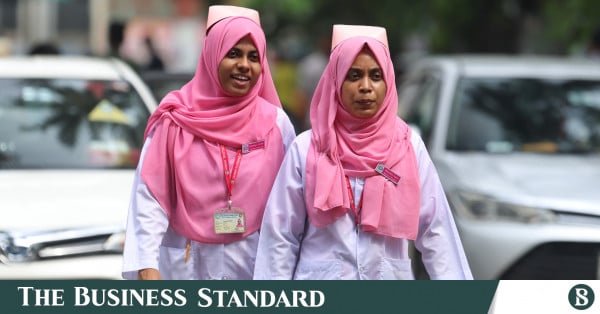
Bangladeshi nurses employed overseas can earn between Tk1 lakh and Tk1.5 lakh a month. Photos: Mehedi Hasan
“>

Bangladeshi nurses employed overseas can earn between Tk1 lakh and Tk1.5 lakh a month. Photos: Mehedi Hasan
In October 2024, Saudi Arabia announced vacancies to recruit 500 qualified nurses from Bangladesh to address the kingdom’s growing demand for healthcare professionals. The offered salary exceeded Tk1 lakh per month.
Candidates were required to have at least three years of experience, proficiency in English and certification through the Saudi Prometric examination.
Only 300 nurses applied for the positions. Ultimately, 215 secured jobs as nurse specialists at hospitals under the Saudi Ministry of Health.

Mili Akter, 30, was one of them.
After completing her BSc in Nursing at Mymensingh Nursing College, she worked at a private hospital in Dhaka before moving to Riyadh. She is now in her second year as a staff nurse at Dallah Hospital, earning about Tk98,000 per month.
“Nurses like us from Bangladesh have to struggle a lot here because we do not have sufficient qualifications and skills,” she said.
As demand for skilled nurses rises in Gulf countries such as Saudi Arabia, Kuwait, the UAE, Qatar and Oman, more Bangladeshi nurses are seeking opportunities abroad for higher salaries and better living standards.
While recent government-led initiatives have focused mainly on Gulf countries, demand in OECD countries — particularly the United States, the United Kingdom, Japan, Canada and Germany — has remained high since 2010.
“Demand for skilled migrant nurses has risen largely because of ageing populations and healthcare worker shortages in developed countries,” explains Syed Abdul Hamid, professor at the Institute of Health Economics, University of Dhaka.
Despite the growing opportunity, Bangladesh remains far behind because of structural, technical, linguistic and institutional barriers.
Only around 5.1% of Bangladesh’s nurses have migrated through government-managed channels and agencies.
“>

Only around 5.1% of Bangladesh’s nurses have migrated through government-managed channels and agencies.
Bangladeshi nurses employed overseas can earn between Tk1 lakh and Tk1.5 lakh per month, while nurses in Bangladesh typically earn less than Tk30,000.
Professor Hamid notes that Bangladesh, through nurses, could earn between $100 million and $150 million annually in remittances by 2030, even if migration remains limited to Gulf markets.
Government-led migration remains limited
Bangladesh is currently sending nurses mainly to Kuwait, which has emerged as one of the largest overseas employers of the former’s nurses in recent years.
In October 2025, Kuwait sought to recruit 100 nurses from Bangladesh through Bangladesh Overseas Employment and Services Limited (BOESL).
Candidates were required to demonstrate English proficiency, at least three years of work experience, relevant technical skills and certification in basic life support.
The offered salaries reached Tk1.27 lakh for BSc nurses and Tk1.11 lakh for diploma nurses.
Although 100 candidates sat for the recruitment examination, only 15 were ultimately selected, according to BOESL.
Noman Chowdhury, assistant general manager of BOESL, said only five nurses have so far completed visa processing.
“Due to the ongoing tensions in the Middle East, the Kuwaiti authorities have not yet granted emigration clearance for the nurses,” he said.
He added that overseas deployment of nurses largely stalled throughout 2025. “Apart from Kuwait, we did not receive offers to send nurses to any other country.”
The first structured deployment of Bangladeshi nurses to Kuwait began in 2022. By the end of 2024, a total of 677 Bangladeshi nurses had been placed in Kuwaiti public hospitals, according to the BOESL Annual Report 2023–24.
Language proficiency remains a major barrier for Bangladeshi nurses seeking employment abroad.
“>

Language proficiency remains a major barrier for Bangladeshi nurses seeking employment abroad.
BOESL also received an initial demand from Saudi Arabia for 150 nurses in 2025 under the first official government-to-government recruitment proposal between the two countries.
However, the proposal was later cancelled because of complications related to Saudi Arabia’s Prometric examination requirement.
Bangladesh and Saudi Arabia signed a bilateral agreement on recruiting health workers in 2022, the first such arrangement in the 50-year diplomatic relationship between the two countries.
Italy also expressed interest in recruiting Bangladeshi nurses, though no formal recruitment proposal materialised.
Chowdhury noted that signing agreements does not necessarily guarantee actual deployment.
Lost ground in overseas nursing markets
Long before the recent wave of overseas recruitment, Bangladeshi nurses migrated to Gulf countries between the mid-1980s and early 2000s, mainly to Saudi Arabia, Kuwait, Libya, Bahrain, Iraq, Iran, Oman and Brunei.
According to the Bureau of Manpower, Employment and Training (BMET), this marked the earliest recorded migration of trained nurses from Bangladesh.
BMET data show that at least 1,200 female nurses migrated between 1991 and 2004.
However, from 2005 onwards, the flow slowed significantly as international demand increasingly outpaced Bangladesh’s supply of qualified nurses.
During this period, Gulf countries increasingly turned to countries such as India, Nepal, the Maldives, the Philippines, and Indonesia for trained nursing professionals.
Overshadowed by regional competitors
Despite growing global demand, Bangladesh remains significantly behind many South and Southeast Asian countries in supplying nurses to international markets.
Countries such as the Philippines and India dominate the global nursing labour market, sending hundreds of thousands of nurses to destinations including the US, the UK, Germany and Gulf countries.
OECD data show that more than 800,000 nurses were working in developed countries in 2023 — a 69% increase since 2010.
Infograph: TBS
“>

Infograph: TBS
The US, the UK and Germany together host more than 60% of them.
The Philippines alone has around 280,000 nurses working in OECD and Gulf countries. India has also expanded rapidly in recent years.
Other countries in the region have built strong overseas nursing sectors as well.
Nepal is estimated to have between 15,000 and 20,000 nurses abroad, while Indonesia has between 20,000 and 30,000, particularly in Japan and the Middle East.
Sri Lanka and Vietnam have also expanded their presence through structured government programmes and bilateral agreements with destination countries in Europe and East Asia.
In contrast, only around 5.1% of Bangladesh’s nurses have migrated through government-managed channels and agencies.
This figure remains far lower than regional competitors that have spent decades building structured migration pathways for healthcare workers.
Structural barriers
A 2023 study published in the Journal of Medical and Clinical Nursing and Health highlighted the sharp gap between aspiration and reality among Bangladeshi nurses.
The study found that 97.2% of Bangladeshi nurses were willing to work abroad.
Among them, 30.9% preferred Canada, while 18.8% hoped to migrate to the United States. Nearly 15% wanted to work in European countries.
Language proficiency remains a major barrier for Bangladeshi nurses seeking employment abroad. While Indian or Filipino nurses can communicate fluently with patients, many Bangladeshi nurses struggle. Nursing colleges must place greater emphasis on language and communication skills alongside academic training.
Salma Akhtar, PhD researcher, Graduate School of Biomedical and Health Sciences, Hiroshima University
Yet many struggle with language and communication skills, limited financial resources to cover migration costs, the absence of internationally standardised nursing curricula and insufficient specialised training.
These challenges are compounded by the lack of a coherent nurse export policy and the absence of internationally recognised licensing examination centres in Bangladesh.
“Language proficiency remains a major barrier for Bangladeshi nurses seeking employment abroad,” says Salma Akhtar, a PhD researcher at Hiroshima University’s Graduate School of Biomedical and Health Sciences.
“While Indian or Filipino nurses can communicate fluently with patients, many Bangladeshi nurses struggle. Nursing colleges must place greater emphasis on language and communication skills alongside academic training,” she adds.
She also notes that many nursing colleges lack adequate clinical training opportunities.
“The absence of modern simulation laboratories, shortages of skilled instructors and limited research-based education are holding back nursing education,” she said.
Lessons from regional competitors
The Philippines is widely considered the world’s most structured exporter of nurses. It follows a policy managed by government agencies that regulate recruitment, provide pre-departure training, and protect migrant workers.
India, on the other hand, manages nurse migration through the ministerial emigration framework. Both countries built institutional systems for nurse migration, including language training, licensing preparation, and government placement channels.
“Bangladesh has institutions like BMET and BOESL. Yet it cannot ensure such a policy framework, which is mandatory for any labour-export,” says Professor Hamid.
Absence of international examination centres
The absence of internationally recognised nursing licensing examination centres also remains a major obstacle.
Licensing examinations such as the National Council Licensure Examination (NCLEX) and the Commission on Graduates of Foreign Nursing Schools (CGFNS) are widely accepted internationally, while some countries require separate examinations such as the Saudi Prometric test.
“Many countries conduct licensing examinations virtually, which creates technical difficulties,” notes Halima Akther, registrar of the Bangladesh Nursing and Midwifery Council.
“If these examinations were conducted directly in Bangladesh, it would reduce technical barriers and help nurses prepare according to international requirements,” she adds.
About The Author