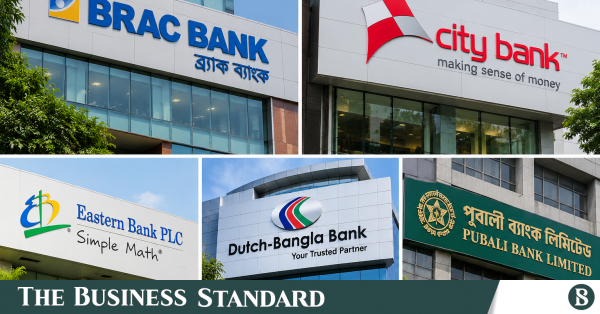
CAL Bangladesh has recommended five listed banks – BRAC Bank, City Bank, Eastern Bank, Dutch-Bangla Bank and Pubali Bank – as its top picks, projecting share price upside of 44% to 81% as banking sector reforms create opportunities for stronger lenders to expand credit and gain market share.
In its research report titled “Banking on the Next Cycle”, the investment research firm identified 14 “Cycle-Ready” banks based on asset quality, capital adequacy, funding strength and lending capacity.
It said these banks are better positioned to withstand the sector’s ongoing balance-sheet adjustments and benefit from a recovery in credit demand.

BRAC Bank leads the recommendations, with a target price of Tk117.45 against its closing price of Tk65 on 5 October 2026, implying potential upside of 80.7%. City Bank has a target price of Tk48.36, suggesting a 62.8% gain from Tk29.70.
Eastern Bank’s target price of Tk34.38 indicates 50.8% upside from Tk22.80, while Dutch-Bangla Bank could gain 47.8% to reach Tk67.25 from Tk45.50. Pubali Bank has a target price of Tk55.88, implying 44% upside from Tk38.80. The projections exclude cash dividend yields.
Stronger banks positioned to capture credit recovery
CAL Bangladesh said stricter loan classification and provisioning requirements have exposed deep weaknesses in the banking system, pushing deposits and future credit expansion towards better-capitalised institutions.
The sector’s gross non-performing loan (NPL) ratio stood at 32.8% in June 2026, while the system-wide provision shortfall reached Tk2.2 trillion. Ten troubled banks held 74% of total NPLs, highlighting the concentration of asset-quality problems.
In contrast, the 14 Cycle-Ready banks maintained a median NPL ratio of 3.8% and a combined capital adequacy ratio of 15.79%, above the 12.5% benchmark used in the study. These banks also held Tk165.5 billion in excess capital above that threshold, providing room to expand lending as demand recovers.
The report projects private sector credit growth to accelerate from 4.3% in FY26 to 12% by FY29, adding Tk6.23 trillion to the country’s private credit stock from June 2026 levels. The 14 banks could account for 55.5% of the expected expansion in credit, it said.
The recovery is expected to begin with retail and small and medium enterprise (SME) lending, including consumer finance and credit cards, before gathering momentum in corporate lending, import financing and trade services.
BRAC Bank’s deposit growth, SME franchise and stake in mobile financial services provider bKash underpin its outlook, according to the report. City Bank is positioned to benefit from a recovery in consumer spending through its cards, payments and retail banking businesses.
Eastern Bank’s well-provisioned loan book and transaction-banking operations support its growth prospects. Pubali Bank’s nationwide network and trade relationships offer scope to expand lending, while Dutch-Bangla Bank’s low-cost deposit base and extensive distribution network provide capacity to turn excess liquidity into loans.
Contagion, spread caps pose risks
Despite the opportunities, CAL Bangladesh flagged risks from financial distress at weaker banks, regulatory limits on lending-deposit spreads and concentrated corporate exposures.
The report said 22 of the country’s 61 banks reported losses, while 19 fell below the statutory minimum capital adequacy ratio. Financial difficulties at troubled lenders could trigger liquidity pressures across the sector.
Regulatory enforcement of a 4% cap on weighted-average lending-deposit spreads could also squeeze net interest margins. As of July 2026, 55 banks, including 13 Cycle-Ready institutions, were operating above the ceiling, according to the report.
Large corporate exposures present another vulnerability, as loan restructuring or classification could trigger substantial provisioning requirements at individual banks.
CAL Bangladesh said the recommended banks offer attractive valuations relative to their returns on equity, but the projected gains depend on the pace of economic recovery, credit demand and banks’ ability to manage regulatory and asset-quality risks.
About The Author