The former central bank governor urges overhaul of taxation framework and breaking of ‘politician-bureaucrat nexus’.
Dr Mohammed Farashuddin. Sketch: TBS
“>

Dr Mohammed Farashuddin. Sketch: TBS
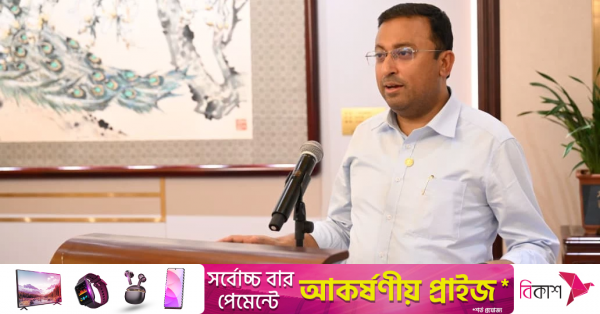
Former Bangladesh Bank governor Mohammed Farashuddin today (25 June) criticised the size and implementation strategy of the national budget for fiscal 2026-27, calling for a major overhaul of the country’s taxation and administrative framework to support economic requirements.
Speaking at a seminar titled “National Budget: Insights and Perspectives” at East West University, Farashuddin, also an economist, argued that the current fiscal blueprint falls short of what the economy needs.
Unless the politician-bureaucrat nexus can be broken – and I don’t see any provision in the budget for that – I don’t see any result.
Mohammed Farashuddin, former governor, Bangladesh Bank

He contended that the budget should have been at least Tk14 lakh crore – equivalent to 20% of gross domestic product (GDP) – instead of its current allocation, which stands at just 13.7% of GDP.
Bureaucratic inertia and waste
The former central bank governor strongly criticised the lack of progress in administrative reforms and automation, asserting that entrenched inefficiencies continue to hinder effective budget execution.
He noted that efforts to automate tax administration began as early as 1983, yet little meaningful progress has been achieved over the last four decades.
“The automation has remained where it was,” Farashuddin said. “Unless the politician-bureaucrat nexus can be broken – and I don’t see any provision in the budget for that – I don’t see any result.”
He also alleged that public resources continue to be wasted through prolonged project timelines and unnecessary administrative expenditures. Alongside these systemic inefficiencies, he expressed deep concern over widening wealth inequality despite the country’s broader economic progress.
Pointing out that the Gini coefficient – a metric used to measure income inequality – has risen from 0.32 in 1972 to 0.5 at present, he remarked that the country is going the other way around from the founding ideals of the 1971 independence.
He stressed that economic growth alone is insufficient unless wealth distribution becomes more equitable.
Radical tax restructuring proposed
Farashuddin directed sharp criticism at the National Board of Revenue, accusing it of failing to broaden the tax base and instead placing additional burdens on existing taxpayers. Citing data from the Boston Consulting Group, he noted that around 25 lakh people in Bangladesh have annual per capita incomes exceeding $5,000, yet a large portion of this affluent population remains outside the tax net.
To encourage greater tax compliance, he proposed a revised, tiered tax structure with lower rates across different income slabs. Under his proposal, a 5% tax would apply to the first Tk5 lakh after the tax-exempt threshold, followed by 10% on the next Tk10 lakh, 15% on the following Tk15 lakh, and 20% on the next Tk20 lakh, with a maximum rate of 22% on all remaining income.
“All finance ministers I have spoken to believe higher tax rates bring higher revenue. This is completely wrong,” he asserted, arguing that lower rates stimulate better compliance.
LDC graduation and competition
Turning to global trade, Farashuddin opposed any move to delay Bangladesh’s graduation from Least Developed Country (LDC) status.
The economist argued that the country should embrace international competition rather than postpone the transition. “We should have gone for the graduation, faced the challenge, and opened the economy to competition.”
The seminar also featured a keynote presentation by Professor Mustafizur Rahman, a distinguished fellow at the Centre for Policy Dialogue (CPD), and AK Enamul Haque, the director general of the Bangladesh Institute of Development Studies (BIDS).
Questioning the revenue assumptions underpinning the budget, Mustafizur said projected revenue growth appeared disconnected from actual collection trends.
He also warned that the government’s plan to borrow Tk1.12 lakh crore from the banking system to finance the budget deficit could place additional pressure on an already stressed financial sector.
“We must stop relying solely on banks and instead look toward the equity market and securitisation of profitable infrastructure assets such as the Metro Rail or Padma Bridge,” he said.
About The Author