Although business leaders and industrialists have described the proposed FY2026–27 budget as broadly satisfactory, they have called for more effective measures to attract new investment.
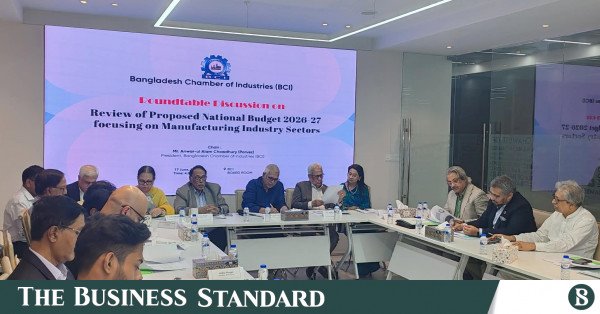
At a roundtable discussion organised at the Bangladesh Chamber of Industries (BCI) office in the capital today (17 June), they said that to advance the manufacturing sector, it is essential to ensure inflation control, uninterrupted energy supply, low-interest loans, improved law and order, logistical support, and political stability.
The experts also urged the government to adopt a long-term strategy for industrial diversification by building international partnerships in promising sectors.

The event was chaired by BCI President Anwar-Ul-Alam Chowdhury (Parvez).
He said that despite some positive steps taken by the interim government and business-friendly dialogue, the expected momentum in private investment has not materialised.
Although the budget identifies key problems and priorities, he said more effective action is needed to improve the business environment.
The BCI president also said the budget contains many positive aspects. However, given the sluggish investment situation and weak private sector performance, achieving 6.5% growth will not be possible.
He added that the government may have to borrow more from banks than targeted, which could create a credit crunch for the private sector.
“Failure to collect revenue properly could also lead to financial sector stress,” Anwar said.
He further noted that the budget provides no clear commitment to resolving the energy crisis.
Anwar also said unless the National Board of Revenue (NBR) is reformed, it could become a threat.
He criticised the state of law and order, saying the country must move beyond “mob culture”.
Anwar also questioned the justification for increasing allocations to salaries and allowances without reducing government expenditure.
Metropolitan Chamber of Commerce & Industry President Kamran T Rahman said the proposed budget is the largest in the country’s history in terms of expenditure, revenue, and deficit.
“However, without reforms in the tax system, the burden of additional revenue collection will fall on existing taxpayers, which is concerning for business and investment,” Kamran said.
He added that external debt repayment pressure will increase in the coming years.
Without sufficient export earnings and foreign currency inflows, debt servicing could become challenging, potentially leading to further currency depreciation, which would raise production costs and inflation.
Research and Policy Integration for Development (RAPID) Chairman Dr Mohammad Abdur Razzaque said Bangladesh’s economy is currently facing three major challenges, which are supply-side constraints, weak demand and import compression.
Due to four years of high inflation, people’s real purchasing power has declined significantly, weakening domestic demand.
He said imports have fallen from around $90 billion in recent years to below $70 billion, which is unusual and concerning for a growing economy. Businesses are facing difficulties importing raw materials and capital machinery.
Razzaque warned that further import restrictions to boost foreign exchange reserves could harm the economy.
Policy Exchange Bangladesh Chairman and Founder Dr M Masrur Reaz said the current budget does not significantly increase the tax burden on ordinary people or businesses.
“Increasing the tax-free income threshold and raising allocations for social protection are positive steps. However, the budget lacks a clear outline of the government’s economic strategy and reform programme,” Masrur said.
He added that the projected targets for growth, investment, and inflation are highly ambitious and not fully aligned with reality.
Masrur also questioned the feasibility of achieving Tk6.04 lakh crore taka in revenue and implementing a heavily debt-dependent budget.
About The Author