Fisheries and Livestock Minister Mohammed Aminur Rashid today (11 August) said vaccines for avian influenza and goat pox developed by the Bangladesh Livestock Research Institute (BLRI) will be commercially produced and made available to farmers across the country.
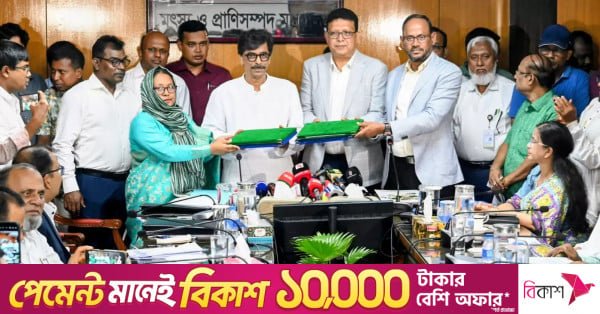
He was speaking as the chief guest at a ceremony held at the ministry’s conference room, where vaccines were formally handed over to the Department of Livestock Services (DLS), paving the way for their commercial production and field-level distribution.
Describing the livestock sector as a vital part of the country’s agricultural economy, the minister said farmers could suffer heavy financial losses if diseases in the poultry and livestock sector are not brought under control, noting that avian influenza in particular can severely disrupt poultry production and farm management.

He said strengthening the capacity to develop and produce effective vaccines domestically is therefore essential. “Today’s event is not merely a formality of handing over a vaccine; rather, it marks an important step in bringing knowledge and innovation from the laboratory to farmers on the ground.”
Aminur added that vaccines developed through indigenous technology and research will play a key role in disease control, reducing production costs, and cutting import dependence in the country’s livestock and poultry sectors.
He said BLRI scientists and researchers developed the vaccines using local technology and materials after years of research, trials, and overcoming various challenges.
The minister observed that an innovation achieved in the laboratory fails to yield its full benefit unless it reaches ordinary people, making it now most important to take research-based innovations to the stage of commercial production and ensure their use at the farmer level.
Highlighting various government initiatives for farmers and agriculture, he said a large section of the population is directly or indirectly linked to agriculture, and that strengthening agriculture and farmers would boost the overall economy.
Aminur said the government is emphasising re-excavation of rivers, increasing water flow, halting the catching of jatka (juvenile hilsa), and completely stopping the use of current nets to preserve the production and taste of hilsa, the national fish.
Alongside this, he said, efforts are underway to bring fishermen under alternative employment opportunities instead of limiting support to food assistance alone.
About The Author