The Bangladesh Investment Development Authority (Bida) is working to create a reliable database to assess the country’s actual investment and industrialisation scenario while identifying and addressing the barriers faced by investors.
The initiative will identify administrative complications, policy inconsistencies, infrastructure constraints and other obstacles to investment and recommend measures to remove them.
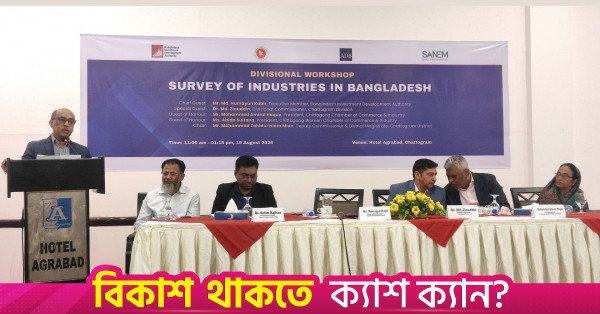
The information was disclosed at a divisional workshop on the “Industrial Survey of Bangladesh” held at Hotel Agrabad in Chattogram today (19 August). It was jointly organised by Bida, the Asian Development Bank (ADB) and the South Asian Network on Economic Modeling (Sanem).

Government officials from different districts of Chattogram division, businesspeople, investors, academics, researchers and chamber representatives attended the workshop which was followed by an open discussion.
Speaking at the workshop, Sanem Executive Director and University of Dhaka Economics Professor Dr Selim Raihan said the lack of accurate, reliable and updated data is one of the major problems facing investment in Bangladesh.
Bida, the Bangladesh Economic Zones Authority (Beza), the Public-Private Partnership (PPP) Authority, Hi-Tech Park authorities and different chambers have investor-related data. But the information is scattered across different organisations and is often outdated, he said.
Multiple registrations of the same investor with different organisations have also created duplicate records, said Raihan.
“Whenever policymakers need to know the actual investment scenario in Bangladesh at a particular point in time, they face difficulties in obtaining accurate and updated information,” he added.
To address the problem, work is underway to combine data from different sources into a unified investment database. Investors are being contacted directly to remove duplicate records and update outdated phone numbers, addresses and other contact information. The database will eventually be linked to Bida’s One Stop Service (OSS) platform, Raihan said.
He said the objective of the survey is not merely to prepare a list of investors but also to identify the problems they face in running their businesses.
The survey covers three categories of investors: foreign investors, domestic investors and joint ventures. As far as possible, comprehensive information will be collected on foreign investors and joint ventures. The ADB-supported project is expected to be completed by November, he added.
Promising industries to be identified across 64 districts
Another key objective of the survey is to identify region-specific industrial and investment potential across the country.
“Chattogram’s potential is not the same as Rangpur’s or Rajshahi’s. So, we need to identify which products, industries or economic sectors have potential in each of the 64 districts and what types of investment opportunities exist there,” Raihan said.
At the Chattogram workshop, businesspeople and other stakeholders provided information on promising products and sectors, investment opportunities and existing challenges in different districts.
Bida Executive Member and Additional Secretary Md Humayun Kabir said bureaucratic delays, harassment and the difficulty of having to visit multiple government offices for investment-related services are major obstacles to industrialisation in Bangladesh.
The SME and startup sectors, in particular, have failed to develop to their full potential because entrepreneurs have not received the necessary support, he said.
An initiative has been taken to bring investment-related agencies under one umbrella, Kabir said. The proposed merger of Bida, Beza and the PPP Authority aims to provide investors with necessary services from a single point and reduce administrative complexities.
He said several ministries and agencies, including the National Board of Revenue (NBR), Ministry of Industries, Ministry of Commerce and Bida, are involved in industrialisation and investment.
However, ministries and agencies often formulate laws, rules or policies without coordinating with the existing policies of other agencies. This creates conflicts between policies and circulars, leaving investors facing practical difficulties, he said.
Sanem has been tasked with reviewing relevant laws, rules, circulars and policies to identify such conflicts, Kabir said. Recommendations will be made to the concerned ministries and agencies for necessary amendments.
The Bida official said the government’s election manifesto has set a target of building a $1 trillion economy by 2034, alongside creating large-scale employment, reducing barriers to industrialisation and investment, and harnessing region-specific economic potential.
He said Chattogram’s port, logistics facilities, infrastructure and industrial base have given the region distinct investment potential compared with many other parts of the country.
“Chattogram’s potential needs to be harnessed separately,” he said.
Skills more important than degrees
Chattogram Divisional Commissioner Dr Md Ziauddin said the difference between “skills” and “knowledge” needs to be properly understood in the country’s labour market.
“Having a higher education degree does not necessarily make a person skilled for a particular job,” he said.
Drawing on his experience as an additional secretary at the Ministry of Health, he said sanitation problems in hospitals cannot be solved simply by increasing the number of cleaners.
Workers need appropriate training and skills for specific jobs, he said. People with the right skills should be recruited for the jobs that require them.
In the future workplace, what a person knows and can actually do will be more important than certificates, he said.
Ziauddin also said development inevitably has some impact on nature. Therefore, a realistic limit needs to be set on how much environmental damage can be accepted in exchange for development.
Such limits should be determined based on research and data rather than emotion, he said.
Call to bring women into economic activities
Chattogram Chamber of Commerce and Industry President Mohammad Amirul Haque said both men and women must be brought into economic activities to realise the country’s full economic potential.
He stressed the need to focus on technology, technical training and practical skills rather than certificate-based education alone.
Technical training could be introduced at schools in the afternoon after regular classes, he said. Existing infrastructure could be used to develop skilled manpower through training in welding, electrical work, technology and manufacturing.
Bangladesh must move away from exporting unskilled workers and develop skilled manpower according to the demands of international markets, Haque said.
He also stressed the need to train women in professions such as nursing and send them to higher-value international labour markets.
Push for renewable energy
The Chattogram Chamber president also questioned the country’s power generation capacity.
According to him, Bangladesh has around 29,000MW of power generation capacity against demand of around 16,000–17,000MW.
Instead of continuing to incur costs by maintaining excess capacity, he called for increased investment in renewable energy.
He also stressed the need to improve the government’s negotiation skills to protect Bangladesh’s interests in foreign investment and international agreements.
Haque said shutting down industries one after another in the name of environmental protection would hurt employment and the economy. At the same time, industrialisation cannot be pursued at the expense of the environment.
He called for practical solutions to advance industrialisation and the energy sector while ensuring environmental protection.
ADB Bangladesh Country Economist Dr Chandan Sapkota, Chattogram Women Chamber of Commerce and Industry President ABida Sultana, Sanem Programme Director Md Zubayer Hossain, Chattogram Deputy Commissioner and District Magistrate Mohammad Zahidul Islam Mia, and Bida officials attended the workshop.
About The Author