The commerce ministry has proposed resolving the matter through bilateral negotiations with the Office of the United States Trade Representative (USTR).
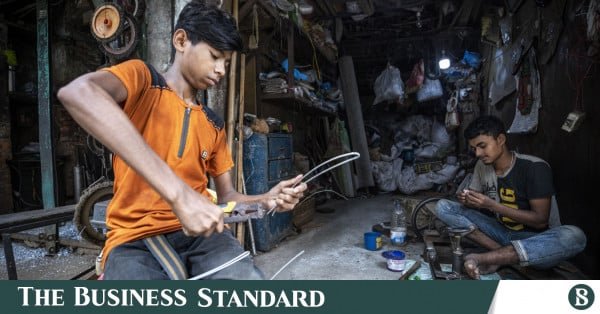
A file photo shows two underage workers performing a hazardous task at a factory in the capital, Dhaka. Photo: TBS
“>

A file photo shows two underage workers performing a hazardous task at a factory in the capital, Dhaka. Photo: TBS
Bangladesh will not participate in a hearing on the United States’ move to impose additional tariffs on the country over allegations that it has failed to take effective measures to eliminate forced labour in the production of goods and has created barriers to US trade.
A commerce ministry official, speaking to TBS yesterday (5 July) on condition of anonymity, confirmed that neither the government nor the private sector had registered or made any submission to present arguments in Bangladesh’s defence at the hearing scheduled for Tuesday. Instead, the commerce ministry has proposed resolving the matter through bilateral negotiations with the Office of the United States Trade Representative (USTR).
In June, following an investigation under Section 301 of the US Trade Act of 1974, the USTR proposed imposing additional tariffs on imports from 60 countries, including Bangladesh. Governments and private-sector representatives from the affected countries will be able to present evidence and arguments in Tuesday’s hearing in an effort to avoid the proposed tariffs.

The commerce ministry official said Bangladesh had learned that, in many cases, governments were not attending the hearing directly and that private-sector representatives were participating instead. However, Bangladesh’s private sector was unwilling to take part because of the high cost involved.
Meanwhile, BGMEA President Mahmud Hasan Khan and BKMEA President Mohammad Hatem told TBS that the government had not asked them to participate in the hearing. They said the commerce ministry had sought their views on the issue, and they had submitted their opinions in writing.
A senior commerce ministry policymaker told TBS that discussions with the United States had made it clear that participating in the hearing would not change the outcome. According to the official, the USTR intends to impose, under Section 301, the same level of tariffs that US President Donald Trump had previously announced under the reciprocal tariff policy.
In April 2025, the United States imposed reciprocal tariffs at varying rates on imports from 60 countries, including Bangladesh. Following the signing of a trade agreement with the United States in February this year, Bangladesh’s reciprocal tariff rate was reduced to 19%. However, after the US Supreme Court struck down the reciprocal tariff regime, Washington imposed a separate 10% tariff under a different legal framework while continuing its Section 301 investigation.
“Following the completion of the Section 301 investigation, Bangladesh could face an additional 19% tariff in line with the bilateral trade agreement signed with the United States. However, the tariff imposed on Bangladesh will not exceed 19%. The United States is also expected to apply tariff rates to other countries in accordance with their respective trade agreements,” the official said.
A former commerce ministry official told TBS that the United States had launched a Section 301 investigation against Bangladesh in 2018 over allegations involving exports of counterfeit goods. Bangladesh participated in a virtual hearing at the time and presented arguments in its defence, after which the United States did not pursue the matter further.
He said the USTR officials conducting the investigation might not necessarily follow the recommendations of the negotiating team. “It would have been better for Bangladesh to fight its case by participating in the hearing. By staying away, Bangladesh has effectively left the entire matter in the hands of the United States.”
About The Author