At the same time, he said tackling malnutrition cannot be the responsibility of the health sector alone.
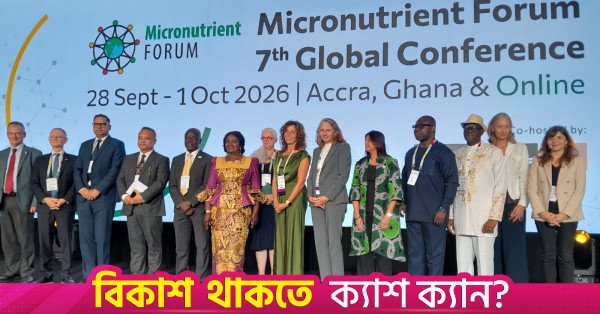
Prime Minister’s Health Affairs Adviser Dr SM Ziauddin Hyder at a global nutrition conference in Ghana on Monday (28 September). Photo: Collected
“>

Prime Minister’s Health Affairs Adviser Dr SM Ziauddin Hyder at a global nutrition conference in Ghana on Monday (28 September). Photo: Collected
Bangladesh is working to make nutrition an integral part of primary healthcare by integrating nutrition services with sexual and reproductive health, maternal, newborn and child health services, said Prime Minister’s Health Affairs Adviser Dr SM Ziauddin Hyder at a global nutrition conference in Ghana.
He made the remarks at the opening panel of the 7th Global Conference of the Micronutrient Forum (MNF), which began in Accra on Monday (28 September).
The four-day conference is being held under the theme “Nutrition in a Changing Environment” and brings together researchers, policymakers, academics and development partners working on nutrition, public health, food systems and development.

Ziauddin joined the opening panel with Dr Francis Aminu, director of Health and Nutrition at the Aliko Dangote Foundation; Rune Skinnebach, ambassador of the European Union to Ghana and head of the EU Delegation; Philip Boahen, lead partnership and coordination manager at the Agriculture and Agro-Industry Department of the African Development Bank; and Nge Brouwer.
At his speech, Ziauddin said, “A girl needs nutrition and reproductive health information and anaemia prevention during adolescence. During her reproductive years, she needs family planning and preconception care. During pregnancy, she needs quality antenatal care along with nutrition assessment, dietary counselling, micronutrient supplementation and prevention and treatment of anaemia.”
“After childbirth, the same woman needs maternal nutrition support, breastfeeding assistance, family planning and newborn care,” he added.
He also said, “These should not be viewed as separate programmes, but as a continuum of integrated primary healthcare services across the life course.”
Ziauddin further said, “The key question now is whether countries have the political commitment and sustainable financing to build a strong primary healthcare system that can deliver nutrition services alongside sexual and reproductive health, maternal, newborn and child health services.”
According to Ziauddin, Bangladesh is taking steps to establish and strengthen primary healthcare facilities in every union and every urban ward.
The government also plans to recruit nearly 100,000 community health workers to strengthen the link between families, communities and the formal healthcare system, while the process of recruiting 25,000 midwives has also begun, he said.
He also stressed the need for research on how integrated services can be implemented at scale, who is receiving services and who is being left behind, and how political commitments can be translated into sustainable domestic financing.
He identified three areas where further evidence is particularly important – implementation evidence on delivering integrated services at scale, equity evidence on reaching underserved populations, and costing and financing evidence to support sustainable government investment.
At the same time, he said tackling malnutrition cannot be the responsibility of the health sector alone.
“Food systems, education, water, sanitation and hygiene (WASH), social protection, women’s empowerment and local government programmes should be coordinated around the same vulnerable populations, families, women and children,” he said.
However, Ziauddin cautioned against using the need for further research as a reason to delay action.
“We already have enough evidence to start acting. The challenge now is to translate evidence into political commitment, political commitment into sustainable financing, financing into a strong primary healthcare system, and that system into integrated services reaching every adolescent girl, woman, mother and child,” he said.
He said Bangladesh wants to move in this direction and that its experience could be relevant to other low- and middle-income countries, including those in South Asia.
“Integrating nutrition into the health system does not require another standalone nutrition project. It requires a strong primary healthcare system in which nutrition is inseparable from sexual and reproductive health and maternal, newborn and child health services,” he added.
About The Author