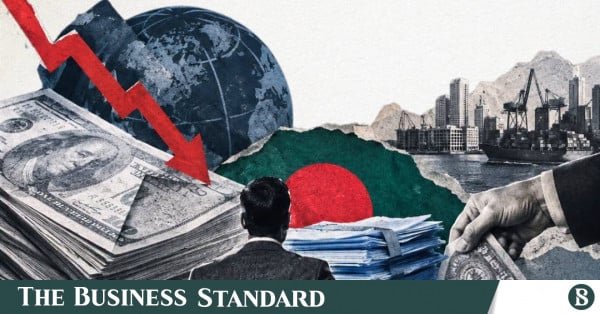
Bangladesh repaid more than twice what it received in foreign loans in the first quarter of FY27, as falling loan disbursements and rising debt-servicing costs put pressure on the country’s external finances.
The country repaid $1.35 billion in principal and interest on foreign loans in the July-September period against $662.31 million foreign loans disbursed, according to provisional data from the Economic Relations Division (ERD) released yesterday (26 October).
This means Bangladesh paid $2.04 in foreign debt servicing for every dollar it received in loans from external sources during the quarter.

Debt servicing rose 5.6% year-on-year from $1.28 billion in the same period of FY26. Principal repayments increased to $858.92 million from $816.99 million, while interest payments climbed to $492.31 million from $462.96 million.
Meanwhile, foreign loan disbursements fell 42.3% from $1.149 billion a year earlier, leaving the government with significantly lower external financing to meet its development obligations.
Of the $662.31 million received during the quarter, $541.74 million came as loans and $110.57 million as grants, according to ERD data.
Economist Mustafa K Mujeri, executive director of the Institute for Inclusive Finance and Development (InM), said the rising repayment burden reflected the volume of loans taken in previous years and the contractual obligations attached to them.
“Loans taken under agreements with various development partners in the past must now be repaid, including principal and interest, in accordance with the terms of those agreements. There is no scope to reduce or increase the repayment obligations,” he told The Business Standard.
He said the repayment burden would increase further over the next two to three years.
The combination of higher debt servicing and lower disbursements is creating significant financial pressure on the government, potentially complicating revenue collection and budget implementation, Mujeri said.
If foreign loans and grants remain insufficient, the government may have to rely more heavily on domestic borrowing, he warned. Increased borrowing from the central bank could fuel inflation, while greater borrowing from commercial banks could squeeze credit for private businesses, hurting investment and employment.
World Bank, ADB lead disbursements
The World Bank’s International Development Association (IDA) and the Asian Development Bank (ADB) were the largest sources of foreign assistance during the quarter, together disbursing $358.62 million, or around 54% of the total.
The IDA disbursed $196.51 million, followed by the ADB with $162.11 million.
India was the third-largest source, providing $104.99 million under bilateral credit arrangements. Japan disbursed $44.66 million, Russia $20.65 million, and China $14.66 million.
The Asian Infrastructure Investment Bank (AIIB) made no disbursements during the period, while other development partners collectively provided $118.73 million.
Commitments rise, but disbursements lag
Despite the decline in actual receipts, foreign loan and grant commitments increased nearly 40% year-on-year to $1.273 billion in July-September, up from $910.67 million in the corresponding period of the previous fiscal year.
Of the total, $1.148 billion was in loans and $125.45 million in grants.
ERD data show that a $1 billion loan commitment was secured from the Islamic Development Bank (IsDB) for the modernisation and expansion of the Eastern Refinery project.
Japan recorded fresh commitments of $3.51 million, while IDA, ADB, China and AIIB reported no new commitments during the quarter.
Mujeri, however, said commitments do not immediately translate into cash disbursements. Development partners have adopted a cautious approach following the formation of the new government, reviewing its policies and plans before proceeding with financing decisions.
He also pointed to gaps in maintaining continuity in agreements and loan arrangements made under the previous government as a factor behind the delays.
The government is currently negotiating a new programme with the International Monetary Fund (IMF). A successful agreement is important because major development partners often consider the outcome of IMF negotiations when making subsequent lending decisions, Mujeri said.
Failure to secure IMF financing could make it harder for Bangladesh to obtain substantial funding from other multilateral lenders, he added.
He urged the government to ensure a timely agreement with the IMF and increase the flow of foreign assistance to ease pressure on public finances and reduce reliance on domestic borrowing.
About The Author