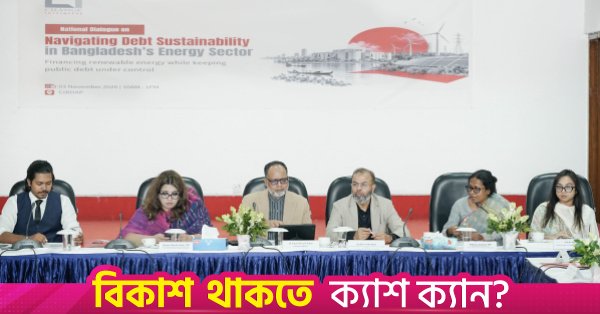
Bangladesh needs to reduce its reliance on loans and secure more grant-based climate financing, particularly for renewable energy, according to a study presented at a national dialogue organised by Change Initiative at Cirdap in Dhaka today (3 November).
The study found that 92% of the $2.54 billion in climate finance received by the country’s energy sector between 2002 and 2023 came as loans. Grants accounted for just 8%.
The dialogue, titled “Navigating Debt Sustainability in Bangladesh’s Energy Sector: Channelling Multilateral Development Bank Finance into Renewable Energy through Public Finance Mechanisms”, brought together policymakers, researchers and private-sector representatives to discuss sustainable financing for Bangladesh’s energy transition.

Research Coordinator Mofazzal Hossain presented the study.
M Zakir Hossain Khan, co-founder and chief executive of Change Initiative, said Bangladesh’s dependence on imported fossil fuels had made its energy system vulnerable to external shocks.
“Accelerating renewable energy is essential to achieving energy sovereignty and securing greater control over our energy future,” he said.
He said the government’s target of generating 10,000MW of solar power would require affordable financing, including grants, concessional loans and responsible investment. This would help households and industries adopt renewable energy without putting further pressure on public finances.
Md Imranul Hoque Chowdhury, deputy director (PIM), Team Asia, International Business Development at Singapore-based ib vogt, said foreign investors look for predictable policies and clear contractual terms before investing in Bangladesh.
Sudden policy changes and uncertainty over contracts could undermine investor confidence, he said.
He called for more private investment and equity financing in renewable energy to reduce reliance on government borrowing. Local banks should also play a bigger role in financing renewable energy projects, while smaller rooftop solar projects could be combined to make them more financially viable.
He also suggested allowing private investors to install solar systems on factory rooftops and sell electricity to factories under contractual agreements.
Dr Dilruba Bedana, chief operating officer of GREENFINITY, said financing opportunities should also be made available to smaller renewable energy service providers. Bangladesh currently has around 8,500 such providers, she noted.
She called for greater involvement from commercial banks and stronger government support to ensure access to finance, maintain quality standards and strengthen monitoring.
Chief guest Shama Obaed Islam, state minister for foreign affairs, said Bangladesh needed an energy sector that reduced dependence on imported fossil fuels without creating excessive debt.
She said the government aimed to generate 20% of electricity from renewable sources by 2030 and 30% by 2040. Achieving these targets would require transparency, coordinated investment and stronger climate diplomacy.
She also called for a unified national position at international climate negotiations, drawing on the expertise of researchers, civil society, the private sector and young innovators.
The study found that renewable energy accounts for only around 1% of grid electricity generation, while more than 60% of power generation depends on imported fuels.
It recommended increasing grant-based financing, expanding affordable local-currency loans, and securing stronger support from development banks to boost renewable energy without significantly increasing the government’s debt burden.
The study covered all energy-sector projects, including coal and gas projects such as Matarbari and Bheramara.
Khondkar Morshed Millat, former director of Bangladesh Bank’s Sustainable Finance Department, proposed allocating at least 1.5% of total lending to renewable energy. He also recommended gradually raising the overall green finance target to 15-20% by 2030.
Programme chair Sheikh Faridul Islam, state minister for environment, forest and climate change, said Bangladesh should highlight the scale of climate-related loss and damage at COP31.
He also called for greater cooperation with other Global South countries to advance climate justice.
About The Author