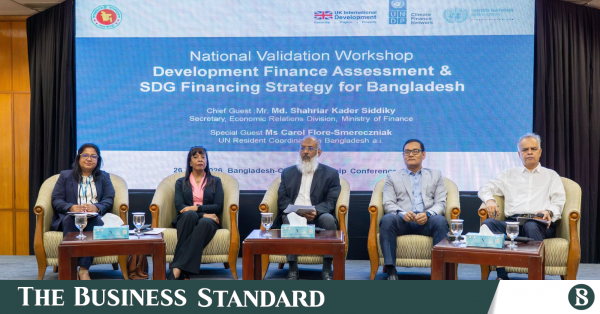
Bangladesh will require about $421 billion in additional financing over the next five years to achieve the Sustainable Development Goals (SDGs), according to a new government assessment presented at a national workshop in Dhaka yesterday (25 July).
The findings were presented by Selim Raihan, professor of Economics at the University of Dhaka, at the “National Validation Workshop on the Development Finance Assessment and SDG Financing,” organised by the ERD with support from the UNDP and the UN Resident Coordinator’s Office in Bangladesh, according to a press release.
Raihan said most of the estimated financing requirements would need to be met through domestic public and private finance, climate finance and international partnerships.
He also outlined Bangladesh’s evolving financing landscape and options for mobilising additional resources from both public and private sources.

The workshop reviewed the findings of the Development Finance Assessment, a global tool designed to align financing policies, institutions and financial flows with national development priorities. Participants also discussed Bangladesh’s updated SDG Financing Strategy.
Addressing the event as chief guest, ERD Secretary Md Shahriar Kader Siddiky said the remaining period to achieve the SDGs by 2030 would be challenging because of a large financing gap, limited time and an uncertain global environment.
“What we now need is a clear set of priorities, coordinated action, better governance and effective implementation,” he said.
UN Resident Coordinator Carol Flore-Smereczniak stressed the importance of strengthening domestic resource mobilisation as Bangladesh advances along its development path.
“In today’s world, opportunities for development financing are diminishing. This is an opportunity for Bangladesh to increase its domestic investment in the SDGs by increasing the tax-to-GDP ratio and by encouraging the private sector to make SDG-aligned investments,” she said.
Additional Secretary of the ERD and chair of the event, AHM Jahangir, highlighted the need for an integrated financing plan as Bangladesh prepares to graduate from least developed country status.
Speaking on behalf of the UNDP, Sonali Dayaratne, deputy resident representative, underscored the need for stronger financing policies and partnerships to close the funding gap.
“The financing gap to meet national development targets has further widened. The government can deploy public resources to leverage and derisk private investments. The challenge is of economic governance. Getting it right requires building a financial ecosystem that is grounded in the application of transparent rules and regulations for all.” she said.
About The Author