The Bangladesh factory currently produces about 206,000 seat-trim cover units a year, and the company plans to maintain roughly the same level of production next year
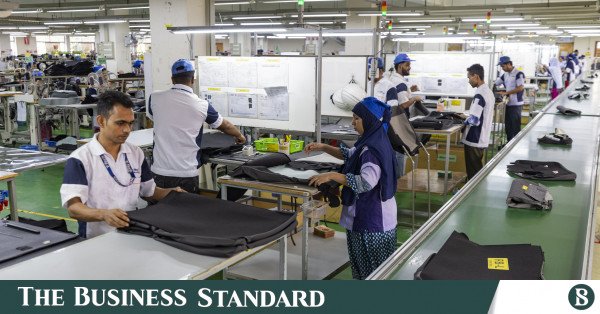
Workers stitch seat‑trim covers at Japanese‑owned TS Tech Bangladesh in Adamjee EPZ, Narayanganj. The locally made covers are exported to Japan for use in seats of Honda, Suzuki, Yamaha and Kawasaki vehicles. Photo: Rajib Dhar
“>

Workers stitch seat‑trim covers at Japanese‑owned TS Tech Bangladesh in Adamjee EPZ, Narayanganj. The locally made covers are exported to Japan for use in seats of Honda, Suzuki, Yamaha and Kawasaki vehicles. Photo: Rajib Dhar
Highlights:
- TS Tech Bangladesh exports seat-trim covers to Japanese vehicle manufacturers
- The factory employs 375 people and invested $4.67 million
- Honda, Yamaha, Suzuki and Kawasaki are among its customers
- Bangladesh factory produces about 206,000 seat-trim covers annually
- TS Tech is expanding automation, conveyors and 3D printing technology
- Company supports workers through daycare and pregnancy-friendly workplace facilities
Seat-trim covers made at a Japanese-owned factory in Bangladesh are shipped to Japan, where they are assembled into complete seats and fitted into vehicles made by manufacturers including Honda and Suzuki.
TS Tech Bangladesh Limited, located at Adamjee Export Processing Zone (EPZ), began operations in Bangladesh in January 2017. The company has invested $4.67 million in the country, employs 375 people and exported products worth $14.75 million in the last fiscal year, mainly supplying seat-trim covers to Japanese vehicle manufacturers.

The company operates from a six-storey Standard Factory Building (SFB) rented from the Bangladesh Export Processing Zones Authority (Bepza).
Infograph: TBS
“>

Infograph: TBS
At the factory, workers cut leather and other materials, sew different components and prepare seat-trim covers according to specific designs. Most of the raw materials are sourced from Japan and China.
The finished covers are then sent to different TS Tech facilities in Japan, where they are assembled into complete seats before being supplied to the respective vehicle manufacturers.
“Among our major customers are Honda, Yamaha, Suzuki and Kawasaki in Japan. At our facility, we mainly produce car seat-trim covers, motorcycle seat-trim covers and various plastic parts like door trims and roof trims,” Satoru Onishi, managing director of TS Tech Bangladesh, told TBS.
“Cutting and sewing of raw materials are mainly done at the Bangladesh factory. Complete seats are then prepared in Japan and later installed in vehicles at the manufacturers’ end,” he said.
The Bangladesh factory currently produces about 206,000 seat-trim cover units a year, and the company plans to maintain roughly the same level of production next year.
Automation and 3D printing
During a visit to the factory recently, the production floor was found busy across a large area. Leather materials were being cut in some sections, while workers used sewing machines to stitch different parts. Others were carefully joining sections of the covers, while workers elsewhere inspected and measured finished products.
Onishi said TS Tech is increasingly focusing on productivity and automation while using modern technologies such as 3D printing for internal production work. The company’s production capacity has been expanded gradually since it began operations.
The company began several initiatives in August 2023 to improve its production system. These included installing conveyor belts, automation systems and auto-lay machines.
It also manufactures various jigs and production-support equipment in-house for use in its manufacturing process. Some of these tools are designed and produced using 3D printers.
TS Tech is a global company with 73 plants operated under 13 establishments around the world. The group has about 141,000 employees in total, including around 16,000 in Japan.
“In the Japanese market, we make products for various companies. Outside Japan, TS Tech also does business with various international vehicle manufacturers,” Onishi said.
Day-care centre
Alongside its manufacturing operations, TS Tech Bangladesh has introduced workplace facilities aimed at supporting its employees, around 60% being women.
The company opened an in-house day-care centre in 2025. Onishi said 19 children were currently staying there under the care of five babysitters.
Asma, a Japanese-language interpreter at the company who has a child at the day-care centre, said, “It is very helpful for me. I can leave my child at the day-care centre and concentrate on my work without worry.”
The company also provides special facilities for pregnant employees, who wear separate green ribbons so they can be easily identified and given the necessary support.
A worker wearing a green ribbon said, “Pregnant employees receive special care.”
About The Author