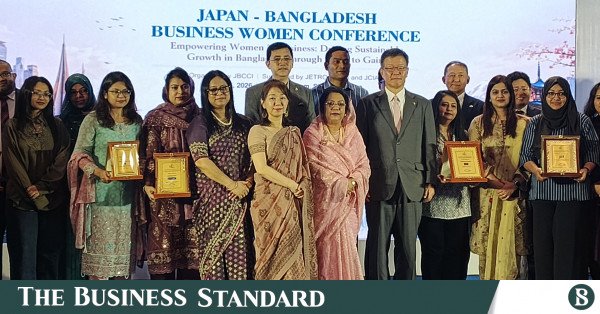
Bangladesh and Japan have unveiled a new roadmap aimed at strengthening women’s economic leadership, with a focus on expanding women’s roles in corporate leadership, entrepreneurship and global business networks.
The roadmap was presented at the Japan–Bangladesh Business Women Conference 2026 today (26 July) under the theme “Empowering Women in Business: Driving Sustainable Growth through Give to Gain.”
The conference was jointly organised by the Japan-Bangladesh Chamber of Commerce and Industry (JBCCI), the Japan Center for International Affairs and Development (JCIAD), and the Japan External Trade Organization (JETRO).

JBCCI Secretary General Maria Howlader FCA, managing partner of Howlader Maria & Co Chartered Accountants, presented the keynote on the “Give to Gain” model.
The model calls on the government, financial institutions, private sector and development partners to provide women entrepreneurs with training, mentorship, easier financing, supply chain access, safe workplaces and opportunities to join corporate boards.
Participation rising, leadership gap remains
Bangladesh ranked 24th among 148 countries in the Global Gender Gap Index 2025, with a gender parity score of 77.5%.
While women’s participation has increased significantly in education, healthcare, agriculture, banking, public administration and the garment sector, their representation in corporate leadership remains limited.
Women hold only 6.17% of independent director positions on corporate boards in Bangladesh. In Japan, women account for 20.5% of independent directors and 16.3% of management positions, although both figures remain below OECD and global averages.
The keynote highlighted that Bangladesh’s women empowerment journey has progressed from social inclusion to economic participation and professional advancement.
The next challenge, speakers said, is ensuring stronger representation of women in corporate leadership, investment, exports and international business networks.
Speakers identified limited access to finance, lack of collateral, weak financial documentation, inadequate business networks and family responsibilities as major barriers for women entrepreneurs.
They called for supporting women-led businesses to move from “micro to small” and “local to global”.
Seven recommendations placed before government
The conference proposed seven recommendations, including developing a national roadmap for women’s economic empowerment until 2030, ensuring 20–30% representation of women on corporate boards, improving access to finance, expanding skills development programmes and establishing a Bangladesh-Japan Women Entrepreneurs Accelerator.
Shiori Onishi, Co-CEO of Euglena CG Ltd, suggested creating a cross-border mentorship network connecting women leaders and professionals from Bangladesh and Japan under the Give to Gain model.
She also proposed a regular platform for women entrepreneurs from both countries to exchange experiences and encouraged families to promote gender equality by ensuring equal opportunities for sons and daughters.
Bangladesh-Japan ties based on trust: Minister
Aviation and Tourism Minister Afroza Khanam, who attended the conference as chief guest, said Bangladesh and Japan are not only development partners but also partners built on trust.
“Bangladesh-Japan relations have entered a new era today. We are sincerely grateful for Japan’s continued cooperation,” she said, highlighting Japan’s contributions to infrastructure, industrialisation and human resource development.
Speaking about women’s empowerment, the minister said various initiatives have been taken to improve women’s education and economic participation.
JBCCI announces five commitments
JBCCI announced five commitments, including creating a verified directory of women entrepreneurs and board-ready professionals, launching an accelerator programme for women entrepreneurs, expanding business links with Japanese companies, recognising women-inclusive organisations and providing training on governance, financing, digitalisation and export capacity.
The conference also announced plans to establish the “JBCCI Japan-Bangladesh Women in Business Platform” and develop a policy recommendation paper for the government.
Participants said the objective of the initiative was not limited to discussion but aimed at creating a measurable action plan through cooperation among government agencies, private sector stakeholders, development partners and women entrepreneurs.
About The Author