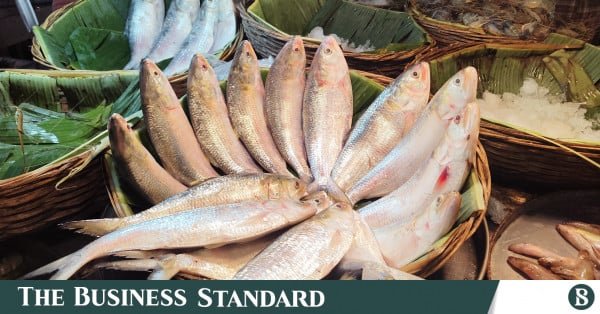
Imported hilsa brought in at around Tk500 per kilogram has allegedly been sold in local markets as Padma hilsa for Tk2,000-Tk3,000 per kilogram.
Representational Image. File Photo: TBS
“>

Representational Image. File Photo: TBS
Bangladesh has halted hilsa imports from India after the Department of Fisheries cancelled 103 no-objection certificates (NOCs) issued for importing the fish.
The decision took effect today (23 September), with hilsa imports from India being suspended following the cancellation of the NOCs.
The Department of Fisheries cancelled the 103 NOCs through a letter signed by its acting Director General, Dr Md Khaled Konok, yesterday (22 September).

The department has not specified a reason for the sudden suspension of hilsa imports. However, industry insiders believe the decision may have been taken to prevent imported Indian hilsa from being sold as local or Padma hilsa, curb potential money laundering through under-invoicing and encourage greater interest in domestic hilsa production.
Importers, meanwhile, have claimed that the sudden suspension has exposed them to significant financial losses. Port officials said hilsa imports from India had increased recently as traders sought higher profits.
According to them, the declared import price ranged from 48 cents to $2 per kilogram. Imported hilsa brought in at around Tk500 per kilogram has allegedly been sold in local markets as Padma hilsa for Tk2,000-Tk3,000 per kilogram.
Rafiqul Islam, a consumer from Bejpara in Jashore city, said imported Indian hilsa looks similar to Padma hilsa, creating confusion among buyers.
“Although there is a difference in taste, consumers may buy Indian hilsa thinking it is local because of the similar appearance,” he said.
He added that the imported fish, despite being bought at a lower price, was being sold for around Tk2,500-Tk3,000 per kilogram. The district administration recently fined several sellers during market monitoring over allegations of selling Indian hilsa at high prices.
Stakeholders also fear that an increased supply of imported hilsa could discourage fishermen from catching domestic hilsa. Some also believe that declaring hilsa imports at prices lower than their actual market value could create opportunities for money laundering through under-invoicing.
Against this backdrop, stakeholders believe the government decided to restrict hilsa imports.
Hilsa importer Syed Mahidul Haque Rubai said importers were facing significant losses due to the sudden suspension.
“The hilsa we purchased in India for import had been kept there. Now we will have to return it at a lower price. On top of that, we are also facing losses from the import costs,” he said.
Asawadul Islam, an inspector at the Fish and Quality Control Office in Benapole, said hilsa imports had been suspended following instructions from the Department of Fisheries.
“The supply of Indian hilsa to the Benapole market has also stopped due to the suspension,” he said, adding that 535 metric tonnes of hilsa had been imported this year.
According to Department of Fisheries data, Bangladesh had permitted the import of 1,739.50 tonnes of hilsa from India in the current fiscal year.
Of this, 535 metric tonnes had been imported through Benapole land port as of Tuesday.
Following the cancellation of the 103 NOCs, traders are now waiting for further instructions from the authorities on whether hilsa imports will be allowed under the remaining approvals.
About The Author