Highlights
- Raw materials can be imported into FTZs without paying duties
- Companies to be able to store, process, assemble, repackage, re-export products
- Goods may be supplied to domestic market after payment of duties, taxes
- FTZs to reduce lead times, industry leaders say
Bangladesh is set to introduce free trade zones (FTZs) for the first time under a proposed customs framework, marking a major shift in its export strategy, industrial development and investment facilitation efforts.
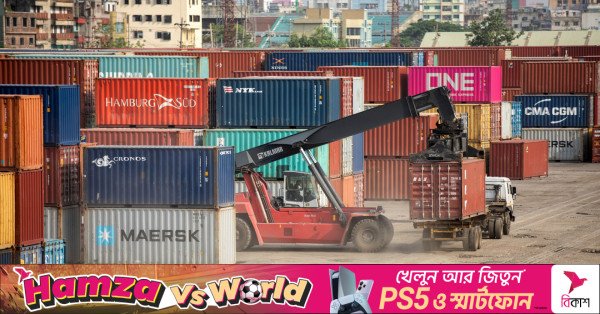
Under the proposed framework, businesses will be allowed to import raw materials, components and goods into designated FTZs without paying duties. Companies will be able to store, process, assemble, repackage, relabel and re-export products from these zones. Goods may also be supplied to the domestic market after payment of applicable duties and taxes.

The initiative is expected to help reduce supply chain delays, lower production costs and strengthen Bangladesh’s position as a regional trade and logistics hub as the country prepares for graduation from least developed country (LDC) status.
The Cabinet Committee on Economic Affairs (CCEA), chaired by Finance Minister Amir Khosru Mahmud Chowdhury, yesterday approved a proposal to establish the country’s first free trade zone in Anwara, Chattogram, aimed at boosting trade, investment, and export capacity.
Industry leaders say the move could address one of the biggest challenges facing Bangladesh’s manufacturing sector: long lead times in sourcing imported inputs.
Currently, export-oriented manufacturers often require 20 to 30 days to receive imported raw materials due to procedures involving letters of credit, shipping, customs clearance, and inland transportation.
Businesses believe FTZs will allow companies to maintain inventories closer to production facilities, enabling manufacturers to access imported inputs quickly when export orders arrive.
MA Jabbar, managing director of DBL Group and President of Bangladesh Economic Zone Investor Association, said the introduction of FTZs would mark a major shift in Bangladesh’s trade and investment landscape.
“Bangladesh’s export basket is still highly concentrated. Free trade zones can create opportunities for new sectors to integrate into global supply chains and help generate momentum beyond the RMG industry. This initiative can play a significant role in attracting new investment and diversifying our export base,” he said.
SMEs likely to be major beneficiaries
Small and medium enterprises (SMEs) are expected to gain significantly from the proposed system as many currently struggle to import raw materials due to limited access to trade finance, import facilities, and economies of scale.
Under the FTZ model, large operators could import materials in bulk and store them in designated zones, while smaller manufacturers would be able to purchase supplies according to their requirements.
Taskin Ahmed, president of the Dhaka Chamber of Commerce and Industry, said reducing lead time is one of the biggest priorities for Bangladesh’s industrial sector.
“Even large manufacturers face losses because of delays in opening LCs and transporting goods. SMEs are even more disadvantaged as many cannot directly import raw materials,” he said.
He added that global buyers are increasingly demanding faster delivery, and Bangladesh often loses business opportunities to competing countries because manufacturers cannot arrange inputs quickly enough.
“An FTZ system can substantially reduce that disadvantage,” he said.
Anwara in Chattogram to host first FTZ
The Bangladesh Economic Zones Authority (Beza) has been working towards establishing a modern free trade zone in Chatogram’s Anwara, in line with international standards.
The establishment of Bangladesh’s first Free Trade Zone is being regarded as a landmark step towards the country’s economic transformation, enhanced global trade connectivity, and improved regional competitiveness. It is expected to position Bangladesh as a key trade and logistics hub in South and Southeast Asia, said the press release issued by the Cabinet Committee on Economic Affairs.
To that end, a high-level committee comprising 10 relevant agencies including the commerce, industries, and shipping ministries, Finance Division, and National Board of Revenue (NBR), conducted a comprehensive review of FTZ management systems, laws, policies, incentive frameworks, and operational models from countries around the world, culminating in a detailed report.
Based on the committee’s recommendations, the Anwara area along the banks of the Karnaphuli river in Chattogram was selected as the most suitable location for the country’s first FTZ, taking into account its infrastructure advantages, international trade connectivity, logistics capacity, and potential for future expansion.
Learning from global models
FTZs and free trade warehousing zones have become important tools for trade facilitation and investment attraction in several economies, including the Shanghai Free Trade Zone, India’s Free Trade Warehousing Zone (FTWZ) model, the industrial and trade zones of Vietnam, the Jebel Ali Free Zone in the UAE and Singapore’s globally recognised trade hub model.
Experts believe Bangladesh could use a similar model to attract investment in sectors beyond garments, including electronics, automotive components, medical devices, agro-processing and light engineering.
“This is a transformative initiative,” said Snehasish Barua, director of SMAC Advisory Services and partner at Snehasish Mahmud & Co.
“Currently, companies often wait weeks to receive imported raw materials. FTZs will allow manufacturers to source inputs much faster,” he said.
He added that larger companies could import materials in bulk and distribute them among smaller businesses, reducing procurement and logistics costs.
However, Snehasish warned that effective monitoring would be critical.
“If duty-free goods enter the domestic market without proper controls, local industries could face unfair competition,” he said.
More than a warehouse system
NBR officials insist that the initiative should not be viewed merely as another warehousing arrangement.
“Bangladesh already has a bonded warehouse system, but it primarily serves specific export-oriented industries,” a senior NBR official told TBS on condition of anonymity.
“Free trade zones will be a broader and more modern customs framework that can accommodate a wider range of businesses,” he added.
According to the official, the initiative presents an opportunity to position Bangladesh as a regional trade and logistics hub.
To prevent misuse, the government is planning to introduce digital tracking systems, inventory monitoring and regular customs audits.
NBR officials said the FTZ concept should not be viewed simply as an extension of the existing bonded warehouse system.
Economists believe FTZs could help diversify exports, improve manufacturing competitiveness and attract both domestic and foreign investment.
“Logistics inefficiencies and complicated import-export procedures account for a significant share of business costs in Bangladesh,” said Dr Masrur Reaz, chairman of Policy Exchange Bangladesh.
“If managed properly, free trade zones can play an important role in reducing those costs,” he said.
He added that port efficiency, customs automation, transport infrastructure and policy stability must improve alongside the FTZ initiative.
About The Author