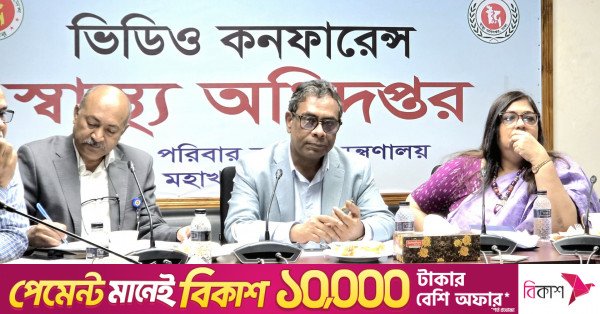
The government plans to establish specialised rehabilitation centres in every district.
State Minister for Health MA Muhit speaks at a stakeholder consultation on the pilot project titled ‘Shishuswarga Model’ at the Directorate General of Health Services (DGHS) today, 13 July 2026. Photo: Collected
“>

State Minister for Health MA Muhit speaks at a stakeholder consultation on the pilot project titled ‘Shishuswarga Model’ at the Directorate General of Health Services (DGHS) today, 13 July 2026. Photo: Collected
Highlights:
- Services to reach an estimated one crore people
- Govt shifts from charity to rights-based approach
- High-level committees formed to strengthen coordination
Bangladesh has the potential to become a global role model for building a disability-inclusive society if government agencies work in a coordinated manner, State Minister for Health MA Muhit said today (13 July).
Speaking at a stakeholder consultation on the pilot project titled ‘Shishuswarga Model’ at the Directorate General of Health Services (DGHS), Muhit said the government is planning to establish specialised Shishuswarga centres in every district under the Ministry of Social Welfare.

The centres will provide long-term rehabilitation, vocational training and employment support for persons with disabilities, forming part of a broader effort to expand disability-inclusive public services nationwide.
Muhit said the Ministry of Health’s extensive grassroots workforce will identify persons with disabilities, facilitate early diagnosis and treatment, ensure access to therapy and connect beneficiaries with Shishuswarga centres and educational institutions.
He said around 46 lakh persons with disabilities are currently registered in the government’s database, although the actual number is estimated at at least one crore.
“Our target is to ensure every person with a disability receives the services and rights guaranteed by the state,” he said.
The state minister said the government is moving away from a charity-based model towards a rights-based approach that guarantees equal opportunities for persons with disabilities.
“The prime minister does not want people to think the state is showing charity. She wants persons with disabilities to enjoy the same rights as every other citizen,” he said.
To strengthen inter-ministerial coordination, Muhit said two high-level committees have been formed under the prime minister’s leadership. He serves as vice-chair of the policy steering committee and chair of the implementation committee.
He added that several ministries have already introduced disability-inclusive initiatives. The Road Transport and Bridges Ministry and the Railways Ministry have announced half-fare or free travel facilities for persons with disabilities on metro rail services, while other ministries are integrating disability inclusion into their development programmes.
Describing disability support as a “conveyor belt”, Muhit said assistance should continue throughout every stage of life—from birth and early medical intervention to education, rehabilitation and employment.
“At every stage of life, the state will stand beside persons with disabilities, with different ministries working together to meet their changing needs,” he said.
About The Author