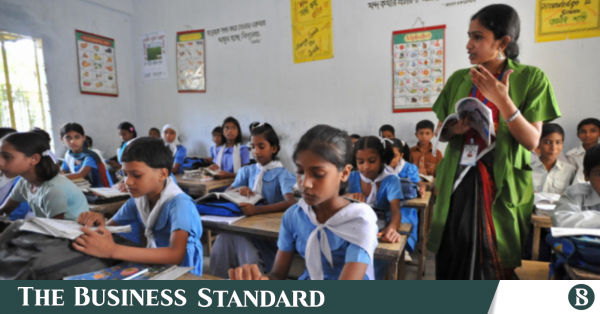
Since students are not allowed to be charged examination fees, teachers say they are struggling to pay for stationery expenses and even minor repairs.
Representational Image. Photo: TBS
“>

Representational Image. Photo: TBS
Teachers at government primary schools are now being forced to pay out of their own pockets to cover routine school expenses as allocations under the School Level Improvement Plan (SLIP) fund have fallen sharply.
Since students are not allowed to be charged examination fees, teachers say they are struggling to pay for stationery expenses and even minor repairs. The funding squeeze has left some schools unable to meet basic needs, with teachers having to use their salaries to keep schools running.
From Tk1 lakh to barely Tk10,000

The Awami League government stopped formal examination fees after 2010 to promote free and compulsory primary education, later introducing SLIP funds, or annual grants, to cover school needs, including examinations. But allocations have since fallen sharply.
Infographics: TBS
“>

Infographics: TBS
According to a 23 February Directorate of Primary Education directive, schools received less than their requested SLIP allocation for FY26.
Schools with up to 50 students will receive Tk7,500; those with 51-300 students Tk15,000; 301-600 students Tk22,500; 601-1,000 students Tk30,000; and those with more than 1,000 students Tk37,500.
Teachers said many schools received Tk60,000-Tk120,000 annually even two years ago for development, stationery, examinations and repairs.
At Jodda Government Primary School in Nangalkot, Cumilla, headteacher Nizam Uddin Majumder said its allocation fell from Tk1 lakh to Tk12,500 this year, leaving about Tk10,000 after Vat. “This amount is not enough to pay for even regular stationery expenses,” he said.
Andharmanik Government Primary School headteacher Md Jamal Uddin Shihab said Tk15,000 last year fell to about Tk12,000 after deductions, insufficient for annual exam papers, question papers, answer scripts, pens and dusters.
Each exam requires Tk1,500-Tk2,000 for question papers through the upazila education office, forcing him to pay from his salary.
Md Shah Alam, headteacher of Char Ubhuti Government Primary School in the same upazila, said each term examination costs Tk2,000-Tk3,000, leaving little for other necessities.
Abdul Aziz, an assistant teacher at Dathia Koyrapara Government Primary School in Chatmohar, Pabna, said the current allocation itself is barely enough for three examinations. Teachers often have to cover the gap themselves.
At Bhimpur Government Primary School in Naogaon Sadar, assistant teacher Firoz Karim said the fund once allowed schools to repair fans and other equipment. Now, they sometimes cannot afford to replace even a faulty bulb.
No exam fees, no money for exams
The funding crisis deepened after the Primary and Mass Education Ministry, citing inadequate SLIP funds, set examination fees of Tk20-Tk50 by class in early June.
The decision drew criticism and was withdrawn on 16 June. Government primary schools therefore currently have no provision to collect examination fees from students.
A DPE official said SLIP funds are now on hold because the Fourth Primary Education Development Programme (PEDP4) has ended. Schools have been instructed to preserve expenditure records and vouchers.
The official said plans are in place to streamline SLIP management when the new PEDP5 programme begins.
Rasheda K Chowdhury, executive director of Campaign for Popular Education, said SLIP spending must be monitored and irregularities investigated, but honest teachers should not be made to suffer because of them.
Educationist Prof Manzoor Ahmed said school-level decentralised financial management must be accompanied by proper oversight. “Good teachers should not suffer for corruption and irregularities,” he said, stressing that decentralised management must be made effective through proper accountability.
About The Author