The strong quarterly performance prompted the company to raise its full-year 2026 financial guidance.
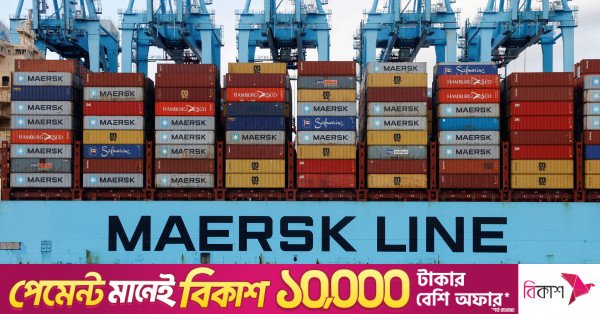
Containers are seen on the Maersk’s Triple-E giant container ship Majestic Maersk, one of the world’s largest container ships, next to cranes at the APM Terminals in the port of Algeciras, Spain on 20 January 2023. File Photo: Jon Nazca/Reuters
“>

Containers are seen on the Maersk’s Triple-E giant container ship Majestic Maersk, one of the world’s largest container ships, next to cranes at the APM Terminals in the port of Algeciras, Spain on 20 January 2023. File Photo: Jon Nazca/Reuters
Danish shipping giant AP Moller-Maersk reported a 20% year-on-year increase in revenue to $15.8 billion in the second quarter of 2026, up from $13.1 billion a year earlier, driven by strong global demand, higher ocean freight rates and growth across all its business segments.
The strong quarterly performance prompted the company to raise its full-year 2026 financial guidance.
Maersk now expects underlying EBITDA of $10.5 billion to $12.5 billion, compared with its previous forecast of $8 billion to $10 billion.

Its underlying EBIT guidance has also been raised to $4.5 billion to $6.5 billion from $2 billion to $4 billion, according to a press release.
The company also revised its free cash flow outlook to more than zero from at least negative $1.5 billion previously.
For the group, EBITDA rose to $3 billion in Q2 from $2.3 billion a year earlier, while EBIT increased to $1.6 billion from $845 million. The EBIT margin reached 10%.
Ocean was the main contributor to the revenue growth, adding around $2 billion to group revenue.
Global demand for transport and logistics remained resilient during the quarter, with particularly strong growth in imports into Africa, North America and Latin America.
Continued export momentum from the Far East, especially China, also supported the increase in volumes.
Maersk said Ocean spot rates increased significantly during the quarter amid stronger demand, increasingly imbalanced trade flows, tight capacity and rising port congestion across Europe, the Middle East, East Coast of South America and West Africa.
Ocean loaded volumes increased 4.1%, while the average loaded freight rate rose 22%. Vessel utilisation remained high at 96%.
Ocean revenue increased 23%, while EBIT jumped to $935 million, compared with $229 million in the same quarter last year. The segment had posted an EBIT loss of $192 million in Q1 2026.
Maersk CEO Vincent Clerc said the second quarter was another indication of the heightened volatility in global trade.
“Strong, broad-based demand from the Far East since 2024 has resulted in significantly more unbalanced trade flows,” he said.
He said higher volumes were putting pressure on landside infrastructure, with congestion and disruption affecting ports and inland transportation networks across several geographies.
“With bottlenecks remaining deeply entrenched, we must continue to invest in critical trade infrastructure and scale,” Clerc said.
Logistics and Services segment posts strong growth
Maersk’s Logistics & Services business reported a 15% year-on-year increase in revenue, while revenue also grew 11% sequentially.
EBIT increased to $217 million, from $175 million a year earlier and $173 million in Q1 2026.
The EBIT margin improved to 5.1%, up 0.5 percentage points from the previous quarter.
Landside operations led the growth, supported by landbridge solutions connecting ports across the Gulf region.
Forwarding benefited from higher volumes in Air and Project Logistics, while Solutions also contributed positively.
Terminals maintain strong earnings
Maersk’s Terminals business increased revenue by 11%, supported by higher rates, increased storage revenue and a 2.2% increase in volumes.
Revenue per move increased 7.1%.
EBIT stood at $458 million, compared with $461 million in the same quarter last year and $436 million in Q1 2026.
The company said strong underlying performance more than offset the impact of the Middle East conflict.
Maersk steps up investment in ports, logistics
Maersk continued to invest in trade infrastructure and supply chain capabilities during the quarter.
In Brazil, APM Terminals inaugurated a $350 million terminal in Suape, which the company described as the first fully electrified container terminal on the continent.
In Vietnam, APM Terminals and Hateco Group signed an agreement with Da Nang City to build and operate the Lien Chieu Container Terminal. The project represents an investment of more than $1.7 billion.
$550m Laldia terminal project in Chattogram
The strong performance comes as APM Terminals advances its $550 million Laldia Container Terminal project in Chattogram.
APM Terminals has unveiled the proposed layout and operational blueprint for the facility and plans to begin construction by the end of 2026.
Once completed, the terminal is expected to handle more than 800,000 TEUs annually, increasing Chattogram Port’s container handling capacity by nearly 23%.
The project is expected to ease congestion, improve operational efficiency and help reduce logistics costs for Bangladesh’s trade.
APM Terminals BV signed a 30-year concession agreement with the Chittagong Port Authority on 17 November 2025 to design, finance, build and operate the terminal under a public-private partnership model.
Maersk expects global container market volume growth of around 4% in 2026 and said its revised guidance reflects its second-quarter performance and improved visibility for the remainder of the year.
The company also continued execution of its $1 billion share buyback programme.
About The Author