Speakers call for a comprehensive cost-benefit assessment, national consensus and stronger domestic defence capabilities before any decision.
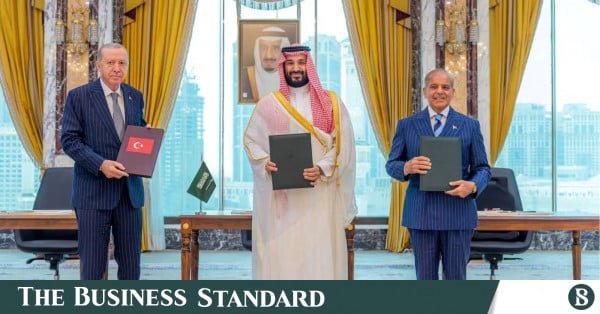
Turkish President Tayyip Erdogan, Saudi Crown Prince Mohammed bin Salman, and Pakistan’s Prime Minister Shehbaz Sharif pose after signing a joint defence agreement in Mecca, Saudi Arabia,7 August, 2026. Photo: Reuters
“>

Turkish President Tayyip Erdogan, Saudi Crown Prince Mohammed bin Salman, and Pakistan’s Prime Minister Shehbaz Sharif pose after signing a joint defence agreement in Mecca, Saudi Arabia,7 August, 2026. Photo: Reuters
Bangladesh should undertake thorough diplomatic preparations, build national consensus and conduct a comprehensive assessment of the potential benefits and risks before deciding whether to join the Mecca Pact, security and international relations analysts said today (31 August).
They also stressed the need to strengthen Bangladesh’s own military capabilities, defence technology, intelligence gathering and capacity for independent diplomatic decision-making.
They made the remarks at a roundtable titled “Bangladesh’s Potential Joining of the Mecca Defence Pact: Strategic National Security Calculations”, organised by Voice for Reform in Dhaka’s Kawran Bazar.

Major General (retd) Fazle Elahi Akbar said Bangladesh needs greater autonomy in security and diplomatic decision-making.
He said rapidly expanding the country’s military capabilities would be difficult and suggested greater defence cooperation, joint training, military technology transfers and intelligence sharing with friendly countries such as Saudi Arabia and Türkiye.
Bangladesh could benefit from Türkiye’s defence technology while developing its own defence manufacturing capacity, he said. Membership of the pact could also create opportunities for greater economic cooperation and support on the Rohingya issue, he added.
Former diplomat Sakib Ali called for a full cost-benefit analysis before any decision, cautioning against treating the pact as a “shortcut solution” to Bangladesh’s security challenges based solely on public sentiment.
He said the terms and obligations of the pact must be clearly understood and Bangladesh’s experience with neighbouring countries should be considered when assessing potential risks and reactions.
Brigadier General (retd) Hasan Nasir said Bangladesh has limited scope to expand its military capabilities rapidly and therefore needs security partnerships with friendly countries that could provide support during a crisis.
He said Saudi Arabia could offer strategic support, while Türkiye could provide opportunities for military technology, training and joint exercises. At the same time, Bangladesh should develop its own defence manufacturing capabilities, he added.
Professor Shahab Enam Khan of Jahangirnagar University said the pact could offer both military and diplomatic opportunities.
Bangladesh could contribute its human resources and technical expertise while exploring joint defence technology development with Saudi Arabia, Türkiye and Pakistan, including in air defence and electronic warfare, he said.
However, the success of such cooperation would largely depend on Bangladesh’s diplomatic capacity, he added.
Former US diplomat John F Danilovich described the Mecca Pact as a defensive alliance intended to prevent conflict and promote collective security.
He said member states would retain their sovereign decision-making powers, drawing a comparison with NATO’s Article 5, under which an attack on one member does not automatically mean every member must go to war.
Political activist Hasib Hossain said Bangladesh should assess the pact in light of regional security threats and national sovereignty.
Rather than depending on a single “big brother”, Bangladesh should develop its own capabilities amid an emerging multipolar world order, he said.
He called for strengthening air defence, missile capabilities, electronic warfare, satellite surveillance and intelligence-sharing alongside conventional military capabilities.
The speakers stressed that any decision on joining the Mecca Pact should not be based solely on military considerations, but should also take into account diplomacy, economic interests, regional dynamics, national capabilities and long-term sovereignty.
About The Author