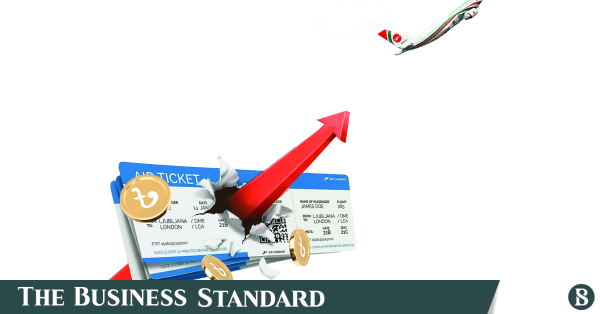
A proposed revision document obtained by TBS recommends raising fees for aircraft landing, passenger boarding bridges, route navigation, and out-of-hours airport operations. It also proposes increases to international and domestic embarkation fees.
Illustration: TBS
“>

Illustration: TBS
Highlights:
- Caab considers hiking aviation charges by up to 33%, potentially pushing airfares higher
- Proposed increases cover landing, navigation, boarding bridges and airport operations
- Domestic embarkation fees could quadruple from Tk25 to Tk100 per passenger
- Airlines warn higher operating costs could undermine affordable fares and expansion plans
- Caab cites rising expenses, infrastructure investments and Tk1,250 crore annual debt servicing
Airfares in Bangladesh, already among the highest in the region, could rise further as the Civil Aviation Authority of Bangladesh (Caab) considers hiking several aeronautical charges by up to 33%.
A proposed revision document obtained by The Business Standard recommends raising fees for aircraft landing, passenger boarding bridges, route navigation, and out-of-hours airport operations. It also proposes increases to international and domestic embarkation fees.

If approved and implemented, the higher fees will drive up operating costs for airlines, creating significant hurdles for carriers trying to keep airfares competitive, industry officials warned.
Caab, however, has defended the potential increases, citing mounting operational expenses, major infrastructure investments, and the high cost of maintaining modern navigation and surveillance systems.
Infograph: TBS
“>

Infograph: TBS
Speaking to TBS, Mohammad Nazmul Hoque, Caab member (Finance) and a joint secretary to the government, clarified that a formal proposal has not yet been submitted to the Ministry of Civil Aviation and Tourism.
“We have our regular groundwork in place and conduct preliminary assessments for adjustments,” Nazmul said. “We will take initiatives on the matter if necessary, but no formal proposal has been submitted so far.”
Aeronautical charges were last revised in 2013 and are typically reviewed every 7 to 10 years. A previous revision proposed by Caab in 2021 was not implemented by the ministry.
Airlines warn of impact on already high fares
Airfares doubled or tripled following the Covid-19 pandemic and have shown little sign of returning to pre-pandemic levels, despite recent policy interventions by the interim government. Overseas migrant workers remain among the worst affected by the sustained price pressures.
Kamrul Islam, spokesperson for US-Bangla Airlines, cautioned that higher aviation charges could stifle passenger growth and disrupt airline fleet and network expansion plans.
He highlighted that carriers operating in Bangladesh already face higher landing, parking, security, and air navigation charges compared to rival markets across the Middle East and Southeast Asia, including Singapore, Kuala Lumpur, Bangkok, and Guangzhou.
“To keep airfares competitive, there must be scope to control major cost components, particularly aviation charges and jet fuel prices,” Kamrul said, adding that further fee hikes combined with volatile jet fuel prices would make affordable air travel increasingly unsustainable.
What Caab plans to increase
Under the prepared plan, landing charges for both international and domestic flights would rise by 25%, with rates determined by aircraft weight.
For international flights, the charge for aircraft weighing up to 10 tonnes would increase from $5.25 to $6.56 per 1,000kg. For those weighing over 100 tonnes but not more than 300 tonnes, it would rise from $12 to $15 per 1,000kg.
For domestic flights, the charge for aircraft in the latter weight category would increase from Tk188 to Tk235 per 1,000kg.
Caab has also proposed a 25% increase in passenger boarding bridge charges, except at Dhaka airport’s Third Terminal. The hourly charge for the first two hours would rise from $100 to $125 for aircraft weighing under 100 tonnes and from $250 to $312.50 for those weighing 300 tonnes or more.
Charges for flights operating beyond notified airport hours would also increase. The hourly airport facility charge for international flights would rise 27% from $225 to $285. For domestic flights, it would increase 33% from Tk4,500 to Tk6,000 per hour.
The charge for using air navigation facilities beyond designated operating hours would go up from $90 to $115 per hour.
Separately, Caab has proposed a 10% increase in route navigation charges. For international aircraft weighing over 100 tonnes but not more than 200 tonnes, the charge would rise from $420 to $462. For those weighing over 200 tonnes, it would increase from $450 to $495.
It also recommends transferring overflight charges – fees airlines pay for flying through a country’s airspace without landing – from Dhaka airport’s account to Caab headquarters.
Direct costs to passengers and helicopter operators
Passengers will feel the direct impact through higher embarkation fees added to ticket costs.
For terminals other than HSIA’s Third Terminal, the existing international embarkation fee of Tk500 (around $4) would be replaced by a charge of $6 per departing passenger. The domestic embarkation fee, currently Tk25, would increase to Tk100. For HSIA’s Third Terminal, Caab has proposed an embarkation fee of $12.50 per passenger.
These charges would be added to ticket prices and other applicable taxes and fees, increasing the overall cost of air travel.
Helicopter operators will also face a substantial cost jump. Currently, combined landing, navigation, and security fees range between Tk450 and Tk800 depending on weight. The new plan proposes a flat rate of Tk3,000 per domestic operation and $50 per international operation.
Caab defends hikes amid escalating costs
Caab’s internal presentation emphasises that its operating expenditure grew dramatically from Tk1,186 crore in FY16 to Tk3,242 crore in FY26. Aeronautical charges provide 60% to 65% of its total revenue.
The regulator noted that existing fee structures cannot cover upcoming development and operational outlays, including an estimated annual debt servicing payment of Tk1,250 crore for the newly built Third Terminal at Dhaka airport, alongside investments in taxiways, aprons, cargo facilities, and ICAO-standard communication systems.
Ticket syndicates compound fare pressures
Adding to passenger frustration, travel agents report that ticket syndicates continue to artificially inflate airfares on key labour routes to the Middle East and Malaysia.
Despite a civil aviation ministry directive issued in February last year requiring transparent pricing, mandatory passenger details for group bookings, and public disclosure of ticket pricing, market distortion remains widespread.
Mahmudul Haque Piaru, a Dhaka-based travel agent, noted that one-way economy fares currently range from Tk65,000 to Tk70,000 to Jeddah, Tk45,000 to Tk50,000 to Doha, and Tk25,000 to Tk35,000 to Malaysia.
“Landing, parking, and operational charges, combined with fuel costs, form the backbone of airline expenses,” Piaru said. “With fares already high, the government must strike a balance between airlines’ operational costs and public affordability before revising these rates.”
About The Author