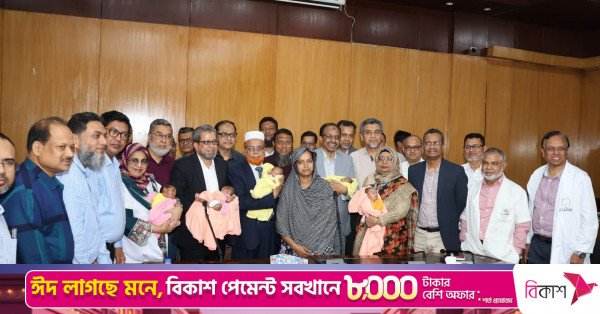
The babies were delivered through a caesarean section on 5 April 2026
Doctors pose with five premature babies and their parents at Bangladesh Medical University after the newborns were discharged from the NICU following weeks of intensive care. Photo taken on 14 May 2026. Photo: Courtesy
“>

Doctors pose with five premature babies and their parents at Bangladesh Medical University after the newborns were discharged from the NICU following weeks of intensive care. Photo taken on 14 May 2026. Photo: Courtesy
In a rare medical success that doctors are calling close to a miracle, five premature and critically underweight babies born together at Bangladesh Medical University have returned home healthy after weeks of intensive treatment at the university’s Neonatal Intensive Care Unit (NICU).
The five newborns – two girls and three boys – were handed over to their parents today (14 May) at a ceremony held at Shaheed Dr Milton Hall, marking the end of an extraordinary battle for survival that began moments after their birth.
Physicians involved in the case said the chances of successfully managing five premature babies born simultaneously remain extremely rare and medically challenging in Bangladesh.

The babies were delivered through a caesarean section on 5 April 2026, at just 33 weeks of gestation, to a 30-year-old mother whose pregnancy had been classified as high-risk from the outset because of the multiple fetuses.
Within minutes of birth, all five infants developed serious complications, including respiratory distress, rapid breathing and chest retraction, and were rushed to the NICU for emergency care.
Their fragile condition was reflected in their birth weights – 1,420 grams, 1,250 grams, 1,410 grams, 985 grams and 1,625 grams, respectively – far below the average weight of a healthy full-term newborn.
Doctors said a carefully coordinated treatment plan was launched immediately. Breastfeeding was initiated within the first hour after birth, while the babies received CPAP respiratory support, round-the-clock monitoring and strict infection-control care.
As the days passed, gradual feeding support, temperature regulation and continuous observation began to show results. Physicians said the early introduction of breast milk played a crucial role in strengthening the babies and helping them recover faster.
Once their condition stabilised, doctors introduced Kangaroo Mother Care (KMC), allowing close skin-to-skin contact between the mother and the newborns – a method known to improve temperature control, weight gain and emotional bonding in premature infants.
Family members were also trained in infection-prevention practices, including strict handwashing protocols, helping minimise the risk of complications during the babies’ recovery.
Among those present at the ceremony were Vice-Chancellor Prof Dr FM Siddiqui, Pro-Vice-Chancellor Prof Dr Md Mujibur Rahman, Treasurer Prof Dr Nahreen Akhtar, Chairman of the Neonatology Department Prof Dr Md Abdul Mannan, and Chairman of the Fetomaternal Medicine Department Prof Dr Tabassum Parveen.
Vice-Chancellor Prof Dr FM Siddiqui described the successful treatment of the five premature newborns as a landmark achievement for the university. He praised the coordinated efforts of the neonatology, fetomaternal medicine and nursing teams, saying the recovery of all five babies demonstrated both medical expertise and dedicated neonatal care
About The Author