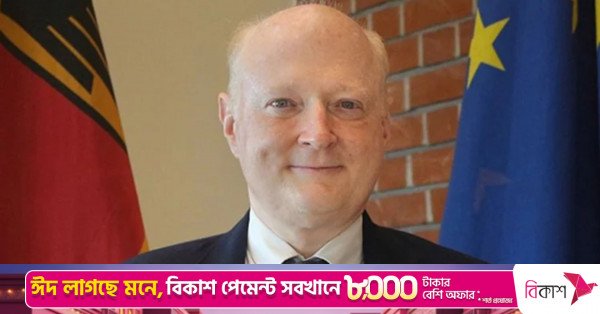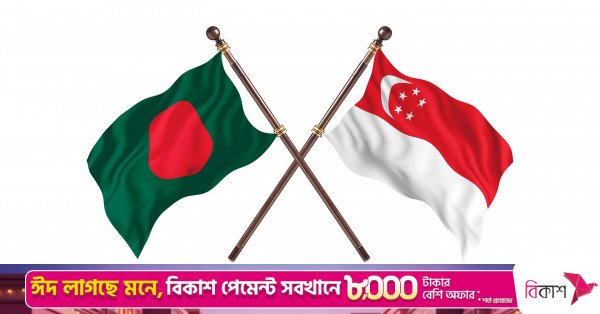
Terming bilateral relations between Bangladesh and Singapore “warm and longstanding”, Singapore Chargé d’affaires in Dhaka Mitchel Lee said the relationship is expected to strengthen and deepen in the coming years, and that Singapore is interested in increasing engagement with Bangladesh’s new political leadership.
“In 2004, Singapore’s then Prime Minister Mr Goh Chok Tong made an official visit to Bangladesh. Subsequently, then Prime Minister Khaleda Zia made an official visit to Singapore in March 2005. We hope to build our linkages with this new BNP leadership in time to come,” said Mitchel Lee in an interview with a group of local journalists.
Bangladesh has a new government under the leadership of Prime Minister Mr Tarique Rahman. How do you see the relations between Bangladesh and Singapore in the coming years?

Singapore’s bilateral relations with Bangladesh are warm and longstanding. Singapore was one of the first Southeast Asian countries to establish ties with Bangladesh in February 1972. We have strong people-to-people linkages and are also linked by trade and investment.
Singapore is optimistic that the relationship will strengthen and deepen in the coming years. We are keen to engage the new political leadership of Bangladesh. We had good linkages at the leaders’ level when Bangladesh Nationalist Party was previously in power.
In 2004, Singapore’s then Prime Minister Mr Goh Chok Tong made an official visit to Bangladesh. Subsequently, then Prime Minister Khaleda Zia made an official visit to Singapore in March 2005. We hope to build our linkages with this new BNP leadership in time to come.
Bilateral trade hovers at around $3 billion. What is the target that both sides are trying to reach in terms of bilateral trade in the next five years?
We do not have a hard target of how much trade will grow for the next five years. But Singapore strongly believes that bilateral trade can increase rapidly if both sides can focus on concluding the bilateral free trade agreement (FTA) which has been in the works since 2022.
Singapore is also keen on updating our Double Taxation Agreement with Bangladesh. If these two agreements can be concluded quickly, it would certainly create the conditions for much greater trade.
FDI flow into Bangladesh declined in 2024 and 2025 according to a UNCTAD report. Has there been any new investment from Singapore particularly in the energy sector? How do you see the investment climate in Bangladesh?
The investment climate for Bangladesh certainly needs to improve. Prior to the general elections of February 2026, the interim government of Bangladesh embarked on efforts to reduce friction and pain points for potential investors such as digitalising the approval processes for new businesses.
If the newly elected government continues to make progress in reducing impediments for businesses, then the investment climate will improve. Consistent trade and investment policies are also important for businesses.
Bangladesh has become a middle-income country according to one World Bank report. How do you view Bangladesh’s progress in terms of economic development?
Bangladesh has certainly made great strides in terms of its development. Its per capita GDP currently of around $2,500 certainly makes it qualify as a middle-income country by World Bank’s estimate.
Bangladesh has also improved in some health indicators like life expectancy and low infant mortality. That said, there is some way to go for Bangladesh in terms of climbing up the human development index.
Bangladesh can do more to improve the quality of its education, housing and urban infrastructure development. The economy also needs to be diversified and not overly rely on the garment and textile sectors.
How many Bangladeshis are living in your country? What are your thoughts on their contributions to your country?
There are more than a hundred thousand Bangladeshi workers working and living in Singapore. They are mainly in the construction and marine sectors and have over the years contributed positively to Singapore’s development.
Singapore has a world-class healthcare system. How can Singapore help Bangladesh in setting up a world-class healthcare system?
Singapore’s public hospitals that are run by the government are focussed on supporting Singapore’s healthcare needs. As public institutions run on taxes paid by Singaporeans and Singapore residents, these hospitals do not have the mandate to venture abroad to set up branches.
Their sole responsibility is to serve Singaporeans and Singapore residents.
There are however privately run hospitals that have ventured overseas. Thus far, they have not considered venturing into the healthcare sector in Bangladesh. Bangladeshis have tried to approach such hospitals in the past, but they have not been keen.
More work needs to be done to create the conditions for such private hospitals to be willing to invest in such a high-capital venture.
For now, Singapore could support Bangladesh through capacity-building and sharing of experiences. SingHealth, which includes Singapore General Hospital, has previously established an MoU with Bangladesh’s Ministry of Health and Family Welfare to support training and capacity-building of healthcare professionals in Bangladesh.
They have been regularly providing capacity-building for a number of years now. In fact, a team came to Bangladesh in July last year to support a local hospital to treat burn victims from the air crash which occurred in July 2025 in Uttara.
The situation in the Strait of Hormuz has pushed energy prices up globally. Can Singapore play a role in ensuring energy security in Bangladesh?
Singapore does not have oil wells and we are a small island state. But Singapore has been faring relatively well during this period due to our long-term planning, including positioning ourselves as a major oil refining centre for the region.
Singapore has been a major LNG trading hub and Bangladesh can tie up with global energy companies operating in Singapore to secure short or long-term LNG procurement contracts.
Singapore companies are also interested in the energy sector in Bangladesh. Sembcorp for example has a 412 megawatt power plant in Sirajganj that is fully operational and supplies electricity to the grid. In fact it is the single largest Singaporean investment in Bangladesh.
Bangladesh could transition into renewables and work with companies like Sembcorp to reduce its dependence on oil and gas. This would help enhance Bangladesh’s energy security in the long term.
Bangladesh is one of the most climate vulnerable countries in the world. How can Singapore support Bangladesh’s efforts to mitigate and adapt to climate change?
Bangladesh could work faster on building up its regulatory framework on carbon capture market. A more structured and well-regulated carbon market will mean that countries like Singapore could feel more assured in buying carbon credits or supporting other mitigation projects.
Singapore has already completed several bilateral agreements on carbon credits including with Papua New Guinea, Ghana, Bhutan, Peru, Chile, Rwanda, Paraguay and Thailand.
Singapore’s education system is world class. Can Singapore help support Bangladesh in building up its education system?
Singapore could share our experience in curriculum development and train-the-trainer programmes. Our education system tries to equip students with skills that they can use to get good jobs. We also emphasise life-long learning.
We welcome Bangladeshi officials to come to Singapore to better understand our education system.
Singapore is a clean and green city-state. Can Singapore help Bangladesh on environmental issues?
Singapore’s clean and green movement started almost the same time as we gained our independence. Mr Lee Kuan Yew understood that a clean and green environment was not just important for our health and wellbeing but also creates a positive impression for the country with foreign investors and tourists.
Singapore can help share our experience in environmental protection and creating more liveable cities. Singapore hosts the World Cities Summit biennially to bring together government leaders and industry experts from around the world to discuss sustainable urban solutions.
The next edition of the World Cities Summit will be held from 14 to 16 June 2026 in Singapore. I hope Bangladesh sends a delegation to learn best practices and has the authority to implement similar solutions in Bangladesh.
About The Author