AOAB secretary general Mofizur said Bangladesh has enormous tourism potential, but the sector requires proper planning and conservation-focused development to achieve sustainable growth.
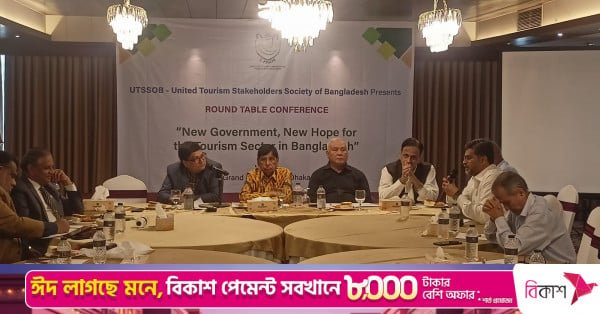
Stakeholders discuss challenges and opportunities in Bangladesh’s tourism sector at a roundtable conference titled “New Government, New Hope for the Tourism Sector in Bangladesh” organised by the United Tourism Stakeholders Society of Bangladesh (UTSSOB) at a city hotel in Dhaka on 14 May 2026. Photo: TBS
“>

Stakeholders discuss challenges and opportunities in Bangladesh’s tourism sector at a roundtable conference titled “New Government, New Hope for the Tourism Sector in Bangladesh” organised by the United Tourism Stakeholders Society of Bangladesh (UTSSOB) at a city hotel in Dhaka on 14 May 2026. Photo: TBS
Bangladesh’s tourism sector is struggling to reach its full potential due to the absence of research-driven planning, reliable statistics, and coordinated policy support, industry stakeholders said at a roundtable discussion held in Dhaka today (14 May).
“We are significantly lagging behind in research-based planning for tourism development. Without credible data and proper research, it is impossible to formulate sustainable policies,” said Mofizur Rahman, secretary general of the Aviation Operators Association of Bangladesh (AOAB), at a roundtable conference titled “New Government, New Hope for the Tourism Sector in Bangladesh” organised by the United Tourism Stakeholders Society of Bangladesh (UTSSOB) at a city hotel in Dhaka.
Mofizur said Bangladesh has enormous tourism potential, but the sector requires proper planning and conservation-focused development to achieve sustainable growth.

He also stressed the need for a “united voice” among tourism stakeholders instead of fragmented approaches.
“If all stakeholders can jointly present the sector’s challenges and opportunities to the government, meaningful changes will become possible,” he added.
Highlighting the close relationship between aviation and tourism, he said policy inconsistency and lack of coordination among government agencies have slowed the sector’s growth. He urged policymakers to include industry stakeholders in decision-making processes and formulate policies based on practical experience and professional expertise.
Tanzim Anwar, president of the Aviation and Tourism Journalists Forum of Bangladesh (ATJFB), said Bangladesh has failed to develop innovative tourism products due to inadequate research and the lack of reliable statistics.
“Despite having huge potential and numerous attractions capable of drawing foreign tourists, the country has not been able to fully capitalise on its tourism resources,” he said.
Civil Aviation and Tourism Minister Afroza Khanam told Parliament on 29 April that under a proposed “Tourism Mega Plan (2026–2040)”, the government aims to attract 5.57 crore tourists and create 2.19 crore jobs by 2040.
According to official data presented in Parliament, the tourism sector currently employs around 51.9 lakh people, a figure projected to rise to 72.8 lakh by 2030.
Former CEO of the Bangladesh Tourism Board, Jabed Ahmed, said the government would become more proactive if policymakers could better understand tourism as a major growth engine for the economy.
Meanwhile, Burhan Uddin, deputy director of the Bangladesh Tourism Board, said tourism product development could be strengthened if the prime minister’s official tours included visits to iconic tourist destinations and festivals across the country.
“Our honourable prime minister travels across the country for official duties. If significant tourism destinations and cultural festivals are included in those visits, they will gain greater global exposure,” he said.
The speakers also emphasised the need for skilled manpower in both the tourism and aviation sectors. They said engaging young people through training and professional development could create new employment opportunities and contribute positively to the national economy.
They stressed the importance of branding not only Cox’s Bazar but also other tourism destinations such as the hill tracts, Sylhet, Barishal, Gazipur, and coastal regions to international audiences.
The discussants further warned against unplanned development and environmental destruction, saying such practices could seriously threaten the long-term sustainability of Bangladesh’s tourism industry.
The roundtable discussion was chaired by H M Hakim Ali, president of UTSSOB. Opening remarks were delivered by the organisation’s general secretary Rezaul Ekram, while vice-president Toufiq Rahman moderated the session. Industry leaders and tourism stakeholders also spoke at the event.
About The Author