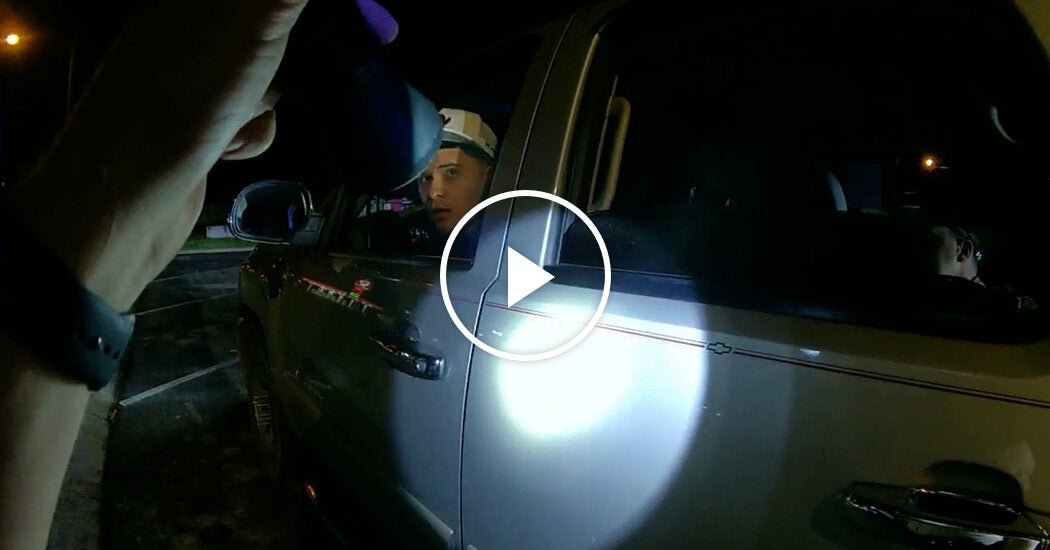
I was literally at work. “Don’t be an idiot.” All of a sudden, I see the lights behind me. “[Expletive] God.” I see them with guns and everything drawn, and I’m like, all of a sudden they just — somebody just grabs me, from my shirt. The first question they asked me was, where was I born? One of them tells him: Just get him, he’s Mexican. He points me out. It was a matter of seconds. “Oh my [expletive] God.” My daughter was passing by. “That’s my mom. What the [expletive]!” She got her phone and she started recording. “Hey, what are you doing? She has her green card. That’s my mom.” And they pulled me out of the car. And —— [SCREAM] I started screaming because I — because I panicked. They never asked my name or ID anything. “You guys don’t listen to what somebody says.” “Because they lie all the time.” I’m a U.S. citizen, and I was detained —— “You’re touching a U.S.A. citizen right there. You can’t do that.” for five days. Immigration agents appear to have had no clear reason to approach Juanita Avila and Javier Ramirez other than, it seems, the color of their skin. That’s because Chief Justice John Roberts’s Supreme Court has given ICE the rubber stamp to racially profile. This is the opinion of the New York Times editorial board. It’s happening across the country. “Where were you born?” “You were born here?” “Yeah.” “Really?” “Yeah.” “OK.” “You speak English?” “Yes.” “I don’t understand why y’all are here because this is a traffic stop.” “Your buddy’s takin’ a ride. He’s going with ICE.” This is body camera footage from just one night of traffic stops in Nashville, Tenn. “You got your driver’s license?” In May 2025, state troopers and federal immigration agents teamed up. “Does he speak English?” “Broken.” “I’m going to run it real quick.” We rarely get to watch ICE in action like this. “He looks like a [expletive] terrorist.” “She might be wet. When we say ‘wet,’ it just means illegal.” A nonprofit had to sue to get this footage, which was first made public by Lighthouse Reports. “Might have two.” “Are you here illegally?” “We’re creeping up on 20 stops already.” “That’s my record.” What it shows is troubling. “Do the passengers look like anything?” “Were you born here? You were born in Nashville? OK, I got you.” “Do you have yours on you, boss?” “Ma’am, do you have your ID on you as well?” “Step out of the vehicle for me, OK?” “Where were you born at?” Take these two stops. “Evening, folks.” “Is it my brake light?” “Yes, ma’am.” “I have an appointment for it to get fixed.” In the first, a driver is pulled over for a broken brake light. Before the officer even runs her license, he tells the ICE agent waiting nearby —— “Nah. Striking out.” She’s let go without any further questions. “You are good to go.” “Thank you so much.” “No problem.” Now, compare that to these stops. “What about you, amigo, identification?” “Do you have your license?” “Do you have an ID as well, buddy?” “Hey, how are you doing?” “Hola.” “You don’t have, uh, got a licensia on you? Ma’am, do you have a, you have a driver’s license?” In most cases, when a driver looks Latino or speaks with an accent —— “Hey, do you want to check the other occupants?” officers ask everyone in the car for identification. “I’m asking you, do you have a licensia?” “I’m not driving.” But when the driver looks white — “Cool, man. Did you just buy this thing?” “I’ll be right back with you, OK?” “He’s going to be good.” “You got your license, registration, insurance?” “Can I reach for it?” “Yeah, yeah. You got any weapons in the car?” “Yeah, under my seat, that’s why I was stickin’ my hands out the thing.” “OK, well, you don’t reach for it, I won’t reach for mine.” The footage also shows officers stopping Black and brown drivers for minor issues — “I have a problem?” “Yeah, the window tint.” like a tinted window, a license plate without a light, “You got to have the lights illuminate your license plate.” even a bent plate that’s still clearly readable. “It’s like bent in half.” Then come the questions. “Are you from Nashville?” “Yeah, I’m from Nashville.” “You are? You born here?” “How long have you been in the country?” “Were you born here?” This is what racial profiling looks like. “Were you born here, in the United States?” What’s even more troubling, the Supreme Court has effectively signed off on all of this. In a recent ruling, the court said immigration agents can weigh factors like race, language and accent when deciding who to stop and question. “Hopefully they roll up in a big truck, a bunch of them, and it’s like, well there’s 9, 10, 11 and 12.” Juanita and Javier carried documents with them proving their citizenship or legal status. But when stopped, they say they weren’t even given the opportunity to show those documents. My passport was in my wallet that day. I pulled out my green card from my pocket. And I said, “I have my ID. You guys didn’t even ask for it.” I was moving a lot because they put their knee, put it on my neck. So I remember the video of George Floyd. I’m like, I don’t want to die. So I was trying to move from it. I just didn’t want them to take me for no reason. I actually called 911. I just hear the officers just laughing. They took the picture of me with the face recognition. You hear them laughing, high-fiving themselves, like, hey, how many did you get, how many did you get? You know, oh, I got 18, I got five, I got six. Yeah! You know, high-fiving. And all of a sudden, it got alerted again, who I was, and they seen that I was a U.S. citizen. So that’s when, you know, it was like awkward silence. So why is this happening? “I’m a U.S. citizen!” “I literally have my passport!” “I’m a citizen, I’m a citizen.” “Get on the [expletive] ground.” “I got rights to talk, bro.” “You got no rights here.” “I do!” It’s long been the case that law enforcement can use physical factors like race, gender and height to identify an individual suspect. But for years, the Supreme Court has been very clear that you can’t use race in broad, blanket ways in many parts of American life. Take education. In 2023, the Supreme Court ruled against Harvard, saying colleges could no longer consider race in admissions decisions. Also in 2007, Chief Justice John Roberts argued that if you sort people by race, it’s discrimination. He put it simply: “The way to stop discrimination on the basis of race is to stop discriminating on the basis of race.” But when it comes to immigration, the court has taken the opposite approach. It has allowed ICE to consider race during immigration stops. This is a double standard, and communities of color are left living with the consequences. “I was born and raised here.” I was traumatized. I couldn’t even — I didn’t even want to get up. Just by seeing cars pass by, you know, with tinted windows, you know, or plates from a different state, you don’t know if they’re ICE or not. I thought they were coming for criminals. To me, that was fine, but not this. They had no reason for them to pull me over, or to stop me and to do all the things that they did. “OK, we’re going to let you go.” “I have my ID. You guys didn’t even ask for it.” I told my daughter: If anybody asks you where are you from, tell them, “I am a U.S. citizen,” and you were born in L.A. So remember those words. And she said, ”OK, Daddy.” The Supreme Court and the Trump administration must uphold the promise of the Constitution. All persons, regardless of race, must be treated equally under the law. The Supreme Court needs to address its contradictory rulings. Otherwise, millions of people will continue to live in fear of their own government. “Oh, hold on, man. Let me, let me turn this…” “We’ll be on the news tomorrow.” “Yeah.” “We’re 100 percent going to be on the news tomorrow. No doubt in my mind.”
About The Author