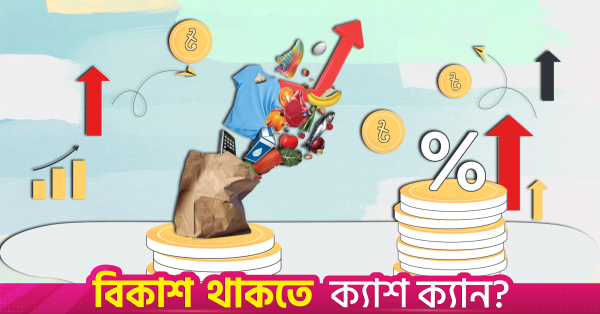
However, economists note that the narrowing gap offers only limited relief as it reflects a slowdown in price increases rather than any meaningful improvement in purchasing power.
InfographicsL TBS
“>

InfographicsL TBS
Bangladesh’s workers continue to face a prolonged cost-of-living squeeze as inflation has persistently outpaced wage growth for more than four years, steadily eroding real incomes and weakening purchasing power across low-income households.
The economy has remained trapped in an inflationary cycle triggered by the Russia-Ukraine war in 2022, compounded by the July 2024 political transition, and the ongoing Middle East conflicts, while wage growth has consistently lagged behind price increases.
In March, average wages for low-paid skilled and unskilled labourers rose slightly to 8.09%, up from 8.06% in February, according to the latest Bangladesh Bureau of Statistics (BBS) data. However, inflation rose faster, reaching 8.71% in March. This left workers behind once again, extending a streak of declining real incomes to 50 consecutive months since February 2022.
A year earlier, in March 2025, inflation had surged to 9.35%, while wage growth remained at 8.15%, creating a gap of 1.20 percentage points. The gap has now narrowed to 0.62 percentage points, mainly due to easing inflation rather than stronger wage growth.

However, economists note that the narrowing gap offers only limited relief as it reflects a slowdown in price increases rather than any meaningful improvement in purchasing power.
Sector-wise data shows only marginal movement in wage growth. Agriculture rose slightly to 8.11% in March from 8.10% in February, while services increased to 8.23% from 8.20%. Industry also edged up from 7.99% to 8.02%, indicating no significant shift in earnings momentum.

The BBS tracks these trends through its Wage Rate Index (WRI), which monitors wages across 63 occupations in agriculture, industry and services.
At the divisional level, wage growth declined only in Rangpur, while other divisions recorded marginal increases.
Joly Talukder, vice president of Garment Workers Trade Union Centre, said workers are unable to benefit from nominal wage increases due to persistent inflation.
“Although workers’ wages have increased, they are unable to benefit from the rise due to inflation. On the other hand, after a wage hike, there is usually a long gap – around five years – during which inflation reduces their real wages,” he said.
He demanded annual dearness allowance adjustments to offset inflation and called for the rapid formation and implementation of a new wage board for formal sector workers, particularly garment workers.
About The Author