Highlights:
- 58% paddy harvested so far
- Labour shortage halts harvesting
- Harvesters unusable due to waterlogging
- Paddy drying disrupted amid continuous rain
- Farmers face losses from low prices
- Harvest may extend until mid-May
In Kadirpur haor of Khaliajuri upazila in Netrokona, farmer Palash Sarkar has managed to harvest only a small portion of his Boro crop, while most of his roughly two and a half acres now lie under waist-deep water.
“If it rains like this for another one or two days, the land will be fully submerged and harvesting will not be possible. We cannot dry the paddy we have already cut. If this continues for three to four more days, even the harvested paddy will be damaged,” he told The Business Standard.

He said he could have started harvesting four to five days earlier, but labour shortages prevented it.
“Despite frequent lightning, we are taking risks to harvest paddy. We have no alternative. We have only one crop a year. We depend on this for the whole year. If it is damaged, we will have nothing left,” he said.
His situation reflects a wider crisis across haor areas, where persistent rain and rising water levels are disrupting the Boro harvest, leaving nearly half the crop still in the fields and putting 17% of the standing paddy at risk of flooding, according to the Department of Agricultural Extension (DAE).
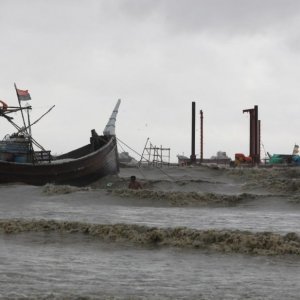
The Bangladesh Water Development Board (BWDB) said water levels in rivers may rise further over the next three to four days, potentially triggering flooding in low-lying areas. Heavy rainfall over the past few days has already submerged low-lying land in many haor regions, creating uncertainty over harvesting the only crop for farmers in these areas.
Heavy rain, rising rivers heighten flood threat
In a bulletin issued yesterday evening (28 April), the Bangladesh Water Development Board’s (BWDB) Flood Forecasting and Warning Centre said the Manu River at the Moulvibazar point is flowing 110cm above the pre-monsoon danger level (a seasonal threshold set to protect Boro crops), while the Bhugai-Kangsa River at the Jariajanjail point in Netrokona is flowing 28cm above the same level.
The BWDB warned that heavy to very heavy rainfall may cause flooding in low-lying areas of Sylhet, Habiganj, Netrokona, and Moulvibazar districts.
Water levels in major rivers in the haor basin have risen over the past 24 hours, with heavy rainfall recorded in the Sylhet-Sunamganj, Moulvibazar-Habiganj, and Netrokona-Kishoreganj regions. Similar rainfall may continue over the next three days.
Water levels in the Surma-Kushiyara basin in Sylhet and Sunamganj may rise significantly over the next three days, with rivers likely to cross the danger level on the second and third days.
The Manu, Khowai, and Juri rivers may cross the danger level within 24 hours, raising flood risks in low-lying areas of Moulvibazar and Habiganj.
Water levels are also rising in the Sarigoyain-Jadukata basin, where the Jadukata River may cross the danger level within three days and the Sarigoyain River may reach the warning level.
Similarly, water levels in the Bhugai-Kangsa and Someshwari rivers in Netrokona are expected to continue rising. A similar trend is observed in the Dhanu-Baulai basin in Netrokona and Kishoreganj.
Overall, continued heavy rainfall may create short-term flooding in low-lying river-adjacent areas of Sylhet, Sunamganj, Moulvibazar, Habiganj, and Netrokona.
The Bangladesh Meteorological Department (BMD) said rainfall may continue across the country, including Sylhet, over the next three to four days, with heavy rainfall expected in the region over the next one to two days.
Meteorologist Bazlur Rashid said heavy rainfall will continue across the country for the next few days, including in upstream areas such as Assam and Meghalaya, which may further increase river water levels.
17% crop at risk as harvest remains unfinished
According to the DAE, farmers have already harvested 58% of paddy in haor areas. However, due to labour shortages and waterlogging, farmers are unable to harvest even mature paddy, leaving 17% of the standing crop at risk of flooding.
Most of the country’s rice is produced during the Boro season, with around 20% coming from seven haor districts.
DAE data shows that Boro paddy has been cultivated on 9.63 lakh hectares of land in these districts this year, including 4.55 lakh hectares in haor areas and 5.08 lakh hectares outside haor zones.
Low prices, high costs deepen farmers’ losses
Farmer Prasanna Kumar from Bausi village in Derai upazila of Sunamganj said that continuous rainfall since Falgun has caused waterlogging in many haor areas.
“As a result, the cost of harvesting and bringing paddy home has doubled. We cannot dry paddy due to lack of sunlight. It is getting damaged in the drying yards. At the same time, paddy prices are very low. Farmers will face severe losses,” he said.
Another farmer from the same area, Abdul Kayum, said mill owners are buying paddy at Tk800 per maund, while labour costs Tk1,000-1,200 per worker.
Due to waterlogged fields and poor road conditions, at least eight workers are required to harvest and store paddy from one kiar (28 decimals of land).
“The yield will be at most 20 maunds per kiar. This means we will incur losses,” he said.
Farmer Md Renu Mia from Gobindapur village under Laxmansree union in Sunamganj Sadar upazila said only a quarter of the paddy in Pagna haor has been harvested.
“Machines cannot be used due to water, and labour is scarce. Cut paddy is lying in the drying yards and starting to rot,” he said.
Farmer Ziaur Rahman from Shahaganj village in Tahirpur upazila said more than half of the paddy in Shanir haor is still unharvested.
“Out of 20-22 kiars, I have harvested only eight. Without sunlight, we cannot dry paddy. With knee- to thigh-deep water, it is difficult to even enter the fields,” he said.
Farmer Shamsul Alam from Nalia near Sylhet Sadar said continuous rainfall has caused waterlogging and rotting of paddy.
“We cannot harvest due to labour shortages,” he said.
Farmers in various haor areas of Sunamganj and Sylhet said that due to excessive rainfall and related difficulties, the expected yield will not even cover half of their costs.
Authorities step up support as harvest faces delays
Sunamganj DAE Deputy Director Mohammad Omar Faruk said it may take until mid-May to complete harvesting, but continuous rainfall is preventing both farmers and labourers from working properly in the fields.
BWDB Executive Engineer Md Mamun Howlader said river water levels may rise further due to heavy rainfall in upstream areas such as Cherrapunji, increasing pressure on haor regions.
Sylhet DAE Deputy Director Md Shamsuzzaman said that if weather conditions improve, harvesting could be completed within eight to 10 days. He added that the government procurement price stands at Tk1,440 per maund, with procurement expected to begin in the first week of May.
DAE Additional Director (Monitoring and Implementation) Dr Md Jamal Uddin said labour is being supplied from different districts to areas at risk of flooding, and support is also being provided through harvesters.
About The Author