We asked our honorees what spurs their writing. They talked about instruments, notebooks and even a pet.
How does a song begin? For some songwriters, an idea can spring from glimpsing a billboard or overhearing a conversation. Others need to be in a particular kind of musical space to do their work. And some musicians have come to see their creativity as being tied to a specific instrument. To get a feel for how they go about it, we asked some of our 30 greatest living American songwriters to tell us about something that sparks their process.
Lucinda Williams
James Trussart guitar
Lucinda Williams picked up her first guitar when she was about 12 years old. It was the height of the folk movement, and she’d fallen in love with the fingerpicking styles of Bob Dylan, Joan Baez and Peter, Paul and Mary, among so many others. “That’s a big part of how I learned, just listening to those recordings,” Williams says. Acoustic guitar remained the foundation of Williams’s songwriting, even as her music became grittier and more electrified. “It’s the basis of me,” she says. When she bought this custom guitar in the early 2000s, from the luthier James Trussart, she noticed that it felt familiar: Unlike most electric guitars, the neck is wide — a more natural fit for the hands of a musician who is used to playing unplugged. “He made me an electric that feels like an acoustic,” Williams says.
Stephin Merritt
Autoharp
Stephin Merritt calls this his “smallest, most portable autoharp.” He purchased it from Music Inn in Greenwich Village three or four years ago to replace an even tinier instrument that he gave to his Magnetic Fields bandmate Shirley Simms, after recording the band’s most recent album. “Autoharps are a bear to tune,” Merritt says. “So the smaller the better.” Though Merritt loves to experiment with obscure instruments, he says his songwriting always begins in coffee shops and bars with a pen and notebook. He’ll sit for a few hours and write down anything that comes to mind. “It’s very easy to dismiss an idea as derivative or stupid before it’s written down,” he says. “If I had dismissed the title ‘The Book of Love’ as derivative, I wouldn’t have a house.”
Valerie Simpson
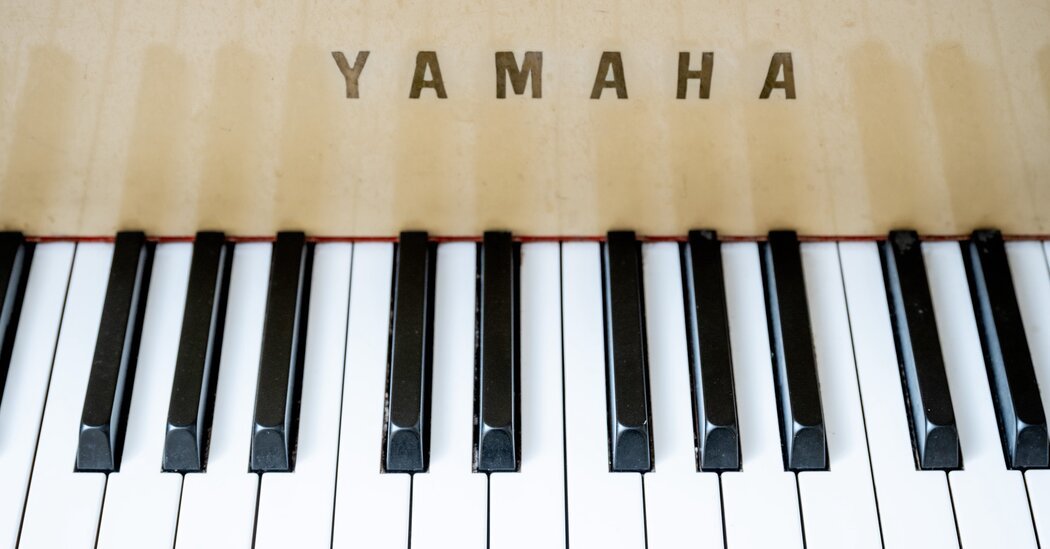
Yamaha baby grand piano
“My beige Yamaha baby grand piano is like my third child,” Valerie Simpson says. She bought it more than 30 years ago with her husband and songwriting partner, Nickolas Ashford, who died in 2011. It is positioned by a large picture window in her apartment “so inspiration can flow through.” She and Ashford wrote innumerable hits on it, including their 1984 single “Solid.” She recalled a time that Nina Simone came to visit in the late ’80s. “I remember her sitting down at the piano, setting the metronome at a ridiculously fast tempo and beating out something wild and wonderful,” Simpson says. “It left an indelible mark on me.”
Mariah Carey
Recording booth
When Mariah Carey had this vocal booth made about 15 years ago, the idea was for it to be mobile. That way it could follow her, whether she was in New York, Los Angeles, the Bahamas or Aspen. It turned out that a soundproof pod was quite difficult to move, though, despite its wheels and mobile design. So she had another created. Now they’re ready whenever and wherever inspiration hits.
Nile Rodgers
Fender guitar, ‘The Hitmaker’
Nile Rodgers got his signature white Fender in 1973. After playing a show in Miami with a Gibson Barney Kessel — a jazz guitar that would feed back whenever he cranked up the volume — Rodgers headed to a local pawnshop to trade it in for a Stratocaster. He came out with the cheapest one they had and $300. It changed everything. “Reliability and versatility are this guitar’s magic sauce,” he says. “A slight tone-knob adjustment allows me to imitate a jazz guitar, R&B smooth to a heavy rocker.” The guitar would later be dubbed the Hitmaker. “There is no song — from ‘Let’s Dance’ to ‘Get Lucky’ to ‘Le Freak’ to ‘We Are Family’ — that would have sounded the same without it,” Rodgers says.
Listen to the 30 Greatest American Songwriters playlist:
Diane Warren
Office
For Diane Warren, the secret to songwriting is solitude. “I can write anywhere,” she says. “Anywhere I can be alone.” Warren is unusual among professional songwriters, creating nearly all of her songs by herself — no collaborators or lyricists. “When I see eight or 10 writers on a song, I think, What exactly are you guys all doing?” She’s reluctant to call anything she does a “process,” but she does believe in repetition and routine. Every morning she goes to one of her offices and writes for a few hours. “You’ve got to work your muscles,” Warren says. “I’m always moving ahead and thinking about what better songs I can write.”
Lionel Richie
Bösendorfer grand piano
For most of his young life, Lionel Richie played and wrote songs on whatever piano he could find. It wasn’t until the early 1970s that he purchased one of his own: a Kawai, for $1,200. Writing music on it felt “like a mystical experience.” On the best days, songs would come out almost fully formed. “I go to the keyboard with no idea of what I’m going to play, and then I start playing,” Richie said. “Believe it or not, the chords come, the melody comes on top of the chords, and then if I’m really lucky, the lyrics will come right behind it as well.” In the years since, he’s acquired a few more instruments — including this custom, one-of-a-kind Bösendorfer that now sits in his living room, gifted to him by the company. It’s the “Rolls-Royce of pianos,” he says, and represents how far he’s come since the early days. “It’s a full circle moment to have a piano like this as a centerpiece.”
Brandy Clark
Martin guitar
A few years after Brandy Clark moved to Nashville to pursue music, she was signed by a music publisher and was honing her writing every day. But it wasn’t paying the bills. “I was just trying to cobble together a living,” she says. She took a gig teaching guitar. When the hours of playing started wearing on her shoulder and a doctor recommended she look for a smaller guitar, she spotted the Martin OMJM John Mayer model pictured here. “I knew it was my guitar probably before I even played it,” she says. It was more expensive than any car she had ever owned, but Clark was planning to save up. Then came a break: Her publisher handed her a check and told her to buy it. “She believed in me enough to fork out several thousand dollars for that guitar,” Clark says. In the years since, almost every song she has written has been on that Martin. “It’s never let me down,” she says. “If I could only ever play one guitar again, that would be the one.”
Jimmy Jam
Electric keytar
“I’ve been keytar-obsessed since I was little,” Jimmy Jam says. His first wasn’t actually a keytar at all — it was a Roland SH-1000 synthesizer that he souped up himself, when he was a teenager. “I basically put guitar pegs on it, just so I could make it into a keytar,” he says. In the years since, he’s had several (real) models: a Moog Liberation he played with the Time (which can be heard on the solo of the song “The Stick”); a purple Roland AX-Edge that’s displayed in the Rock & Roll Hall of Fame; and this black-and-red Roland AX-Edge, which he got while recording “Jam & Lewis: Volume 1,” his 2021 artist album with his co-writer, Terry Lewis. The instrument is more suited for live performance than the studio, Jimmy Jam says, and the idea of performing motivated a lot of his recent work. “The dream was to go and play the songs on our album live,” he said. He got to do just that — with his signature black-and-red keytar — in April, during a residency in Las Vegas.
Terry Lewis
Lyric notebook
For Terry Lewis, the first rule of songwriting is to write everything down. “My mother always said, ‘A short pencil is better than a long memory,’” he says. Over the years he’s scribbled ideas onto napkins, hotel room stationery and other scraps (and lost a few gems along the way). Eventually, those ideas would make their way into notebooks like this one. “Every time you got an idea for a concept, you would write in the Book of Titles,” he says. “And then we would go back and work on them.” The one pictured here dates back to 1999, and contains lyrics to “The Best Man I Can Be” and “Thank God I Found You.” “I probably got it from one of my kids,” he says. “They would buy notebooks and wouldn’t use every page, so I’d just take them.” He estimates that he has 50 to 100 more like it, which contain both crossed-out and slashed-through drafts and more neatly written final lyrics sheets. He’s since moved on to digital notes, which are easier to edit and keep track of across devices. But the format matters less than the act of writing itself. “You could think something is a good idea, but when you see it physically, it changes the dynamics of whether it makes sense or not,” he says. “Writing stuff down is paramount.”
Young Thug
Itsy Bitsy Tootie, his pet tarantula
Young Thug got his pet tarantula, Itsy Bitsy Tootie, last year while working on his most recent album, “UY Scuti.” As a self-described animal lover, he found the spider (a Caribena versicolor, to be precise) inspiring and even brought her out of her terrarium when he was recording so she could see the studio and walk around. “She was around a lot when I was creating music in L.A.,” Young Thug says. “She made me be quieter and more focused, because they can’t be around loud noise.” He felt so inspired by Tootie that he sent spiders to a few friends and family when the album launched, “so that they could have their own connections.”
About The Author