Speaking during the discussion on the motion of thanks to the president’s address, government and opposition lawmakers also clash over claims of distortion, campus unrest
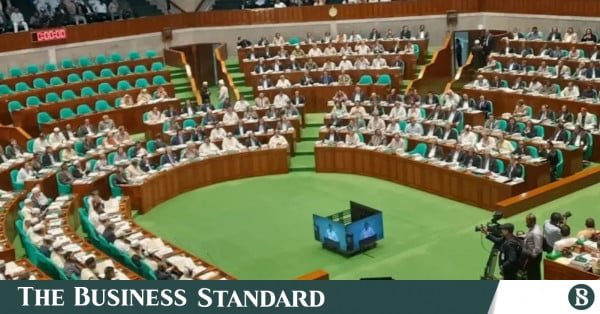
13th National Parliament. File Photo: UNB
“>

13th National Parliament. File Photo: UNB
Jatiya Sangsad witnessed a tense debate today (26 April) as government and opposition lawmakers traded accusations over political repression, rising intolerance and a return to divisive political practices despite the formation of the current House through significant struggle and sacrifice.
Speaking during the discussion on the motion of thanks to the president’s address, opposition lawmakers raised concerns over a perceived return to suppression of dissent and growing instability on university campuses, including allegations of detentions linked to social media activity and political criticism.
Treasury bench lawmakers also alleged that obscene remarks, personal defamation and misinformation were being spread in the name of political movements, while emphasising that freedom of expression did not include abuse of individuals or their families.

Disputes over the July uprising intensified as lawmakers cited conflicting casualty figures and alleged historical distortion. These included accusations that Jamaat-e-Islami was “profiteering from martyrdom” and politicising sensitive events.
NCP lawmaker Hasnat Abdullah said it was disappointing that the cycle of blame, political labelling, and suppression of dissent appeared to be re-emerging.
He warned that university campuses were again becoming unstable, marked by an atmosphere of unrest and the filing of legal cases to stifle opposition voices.
He further alleged that individuals had been picked up from their homes for Facebook posts and that criticism was once again being met with intimidation.
State Minister for Shipping Md Rajib Hasan said that the interim government, which held office for 18 months, had functioned effectively with the support of current opposition leaders, including those aligned with Bangladesh Jamaat-e-Islami and the NCP.
He asserted that those who remained close to power during that period and enjoyed special privileges were now exhibiting instability and discomfort due to the loss of those advantages.
Furthermore, the state minister strongly criticised the opposition leader’s statement concerning the number of martyrs in the July uprising.
Raising a point of order in response, Leader of the Opposition Shafiqur Rahman said that he had not made any unauthenticated claims and that his side possessed a complete profile on the matter.
He asserted that the figure he referred to was not based on any domestic agency but on the United Nations Human Rights fact-finding committee, which had reported the number of deaths as 1,451.
Jamaat lawmaker Md Abdul Aleem said that they no longer wanted to hear the negative rhetoric that had sustained authoritarianism in the name of pro- and anti-independence forces.
“In the new Bangladesh, we do not want to hear calls for eliminating any political party,” he said.
Referring to a comment by opposition leader Shafiqur Rahman, State Minister for Civil Aviation Md Rashiduzzaman Millat said that the opposition leader had stated that “July would come every year.”
Millat described the comment as a warning, implying that, just as the political change in July led to the fall of the Awami League on 5 August 2024, similar pressure could be applied to the current government.
He asserted that the July movement should not be portrayed as the work of a single group, noting that around 1,400 people had lost their lives, and that more than 1,000 of them were from organisations affiliated with the BNP, including Chhatra Dal, Jubo Dal, Swechchhasebak Dal, and Sramik Dal.
State Minister for Fisheries and Livestock Sultan Salahuddin Tuku questioned the roles of various groups in the July movement, alleging that current narratives resembled the behaviour of the Awami League, which often acted as though it alone had led the 1971 Liberation War.
He asserted that a similar mindset had now entered Jamaat-e-Islami, with claims that they were the sole leaders of the July movement. Tuku further criticised allegations that fascist tendencies similar to those of the previous administration had entered the present government, noting that the administration had been in office for only two months but was being judged as though it had governed for five years.
Referring to a Jamaat rally held in Dhaka on Saturday, he stated that threats had been issued to the government. However, he stressed that the current administration is not like those formed after the elections of 2008, 2014, or 2018, but is instead a government of 2026, elected through the direct vote of the people.
Jamaat lawmaker Mohammad Abdul Baten said the law and order situation had deteriorated to such an extent that even elected Ducsu members had been attacked by a mob inside a police station.
About The Author