The coming decade is expected to be the era of biotechnology, bringing transformative changes across agriculture, healthcare, environment, industry, and the economy. With growing challenges such as climate change, food security, health risks, vaccine dependence and reliance on imported technologies, biotechnology is no longer optional – it has become essential.
However, despite significant potential, Bangladesh faces major hurdles including policy gaps, weak research-industry linkages, inability to retain skilled human resources, and a lack of internationally standard regulatory capacity.
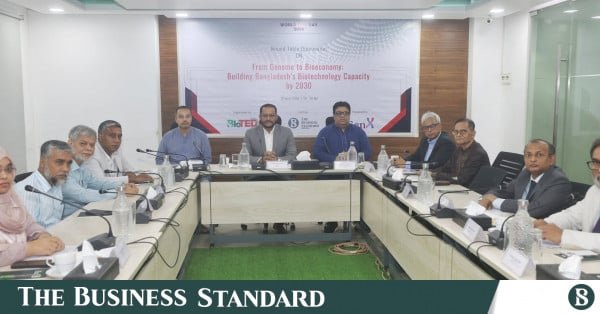
These observations were made at a roundtable titled “From Genome to Bioeconomy: Building Bangladesh’s Biotechnology Capacity by 2030,” held today (25 April) at The Business Standard office to mark World DNA Day 2026. The event was organised by BioTED in collaboration with TBS.

The discussion was moderated by Dr Muhammad Sougatul Islam, Founder and Executive Director of BioTED, while the keynote was delivered by Dr Munia Amin, Director and Senior Research Fellow at the organisation.
Dr Mahdi Amin, adviser to the Prime Minister for multiple ministries including education and labour, said Bangladesh already has some basic practical implementations in biotechnology, particularly in vaccination. He stressed the need to enhance self-reliance in vaccine development. Referring to the government’s mid-day meal programme for nearly 20 million primary school students, he highlighted the challenge of food spoilage during transport and emphasised the need for research and development to ensure affordable, nutritious, and durable food supply.
He also identified brain drain as a major concern, noting that many talented youths leave the country. He suggested transforming this into “brain circulation,” enabling expatriate researchers to stay connected and contribute. Coordinated efforts between the government and universities could make this possible.
Engineer Rehan Asif Asad, adviser to the Prime Minister on science, technology, and ICT, said, “Emerging technologies like bioengineering, gene sequencing, and biohacking will determine global competitiveness. Countries investing in biotech innovation now will lead in the future.”
He noted that while Bangladesh’s pharmaceutical industry has made significant progress, it is time to gradually move into high-value, technology-driven biotech sectors. He added that neighbouring India earns billions annually from innovation and technology, and Bangladesh could aim to build at least a $10 billion market.
He also pointed out that starting a business in Bangladesh requires multiple approvals, making the process time-consuming and discouraging for investors. A “one-stop service” is being planned to simplify procedures, and improvements in banking and financial transactions are expected within 30-60 days.
Professor Dr Mamun Ahmed, Chairman of the University Grants Commission, said, “Although the number of science and technology universities has increased over the past 20-25 years, employment opportunities for graduates remain limited. Many students seek opportunities abroad due to a lack of suitable jobs at home.”
He added that biotechnology curricula are still overly theoretical and not aligned with industry needs, and emphasised the importance of a “tri-partite model” involving education, industry, and financing institutions to foster entrepreneurship.
Md Anwar Hossain, Secretary of the Ministry of Science and Technology, said the government has already developed a strategic roadmap targeting 2030, built on four pillars: talent development, research-to-market, innovation ecosystem, and frontier technology. He noted that while a “research-to-market” platform has been launched, intellectual property protection remains weak and job opportunities in biotech are limited. Strengthening collaboration between academia and industry is crucial.
Professor Dr Md Anwarul Azim Akhand, Vice Chancellor of Mawlana Bhasani Science and Technology University, said biotechnology can drive major changes across multiple sectors. However, brain drain remains a serious issue, with over 80% of students going abroad. He stressed the need to develop a science-minded and innovative youth population and called for government initiatives such as dedicated biotechnology cells to support researchers.
Professor Dr SM Abdul-Awal, Principal Coordinator for SDG Affairs at the Prime Minister’s Office, said biotechnology will dominate the next century and is essential for achieving Sustainable Development Goals, including poverty reduction, food security, and climate action. He emphasised integrating practical labs, programming, and data analysis into education and strengthening industry-academia collaboration.
Professor Dr Sagir Ahmed, Director General of the National Institute of Biotechnology, said the institute now operates with 127 scientists across seven departments. Over the past year, institutional discipline has been restored, ineffective projects scrapped, and new “research-to-market” initiatives adopted. A five-year strategic action plan focusing on integrity, innovation, collaboration, and sustainability has been introduced. Progress is also being made in vaccine development, particularly in livestock, with results expected within a year.
Dr Masih Ul Alam, Founder of Immundnz Ltd in the UK, joined virtually and said Bangladesh has vast biotech potential but lacks adequate investment structures, policy support, and research infrastructure. Drawing from his experience in Europe, he said Bangladesh could become a global biotech hub if supported by strong “de-risking” incentives and infrastructure. He also stressed engaging expatriate scientists through a brain circulation model.
Mohammed Moinul Islam of SOMRU Biosciences, Canada, noted that global biopharma is evolving rapidly, but Bangladesh lags due to weak policies and data systems. Without adopting international regulatory standards, entry into global markets will remain difficult. He also highlighted the importance of public-private partnerships and simplifying business and financial processes to attract investment.
Other speakers included Professor Dr Nazmul Ahsan of the University of Dhaka, Abdus Samad Mridha of Essential Drugs Company Limited, Professor Md Tajul Islam Chowdhury of Sher-e-Bangla Agricultural University, and Md Salahuddin of Incepta Pharmaceuticals Ltd.
About The Author