The lender suggests a new loan programme
Infographics: TBS
“>

Infographics: TBS
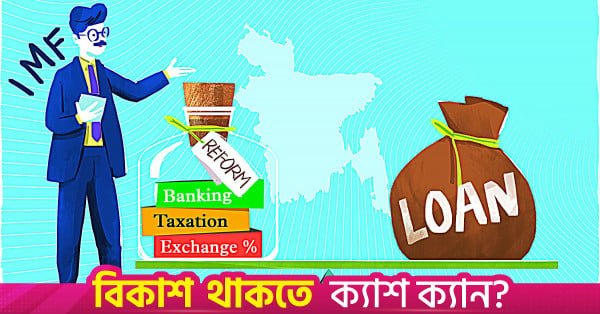
The International Monetary Fund has declined to release the next tranche of Bangladesh’s existing loan programme by June, citing that the country has failed to implement agreed reforms in the revenue and banking sectors, and has instead proposed negotiating a new lending arrangement with additional conditions.
A member of the Bangladesh delegation attending the ongoing Spring Meetings of the IMF and the World Bank in Washington, DC, led by Finance Minister Amir Khosru Mahmud Chowdhury, confirmed the development to The Business Standard.
According to the official, the IMF informed Bangladesh during meetings over the past two days that the country would not receive the expected $1.3 billion tranche under the current $5.5 billion loan programme by June this year.
Bangladesh is still due to receive a total of $1.86 billion under the programme, which expires next January.

“The IMF told us that Bangladesh has not implemented the agreed conditions relating to revenue reform, banking reform, withdrawal of electricity and fuel subsidies and a market-based exchange rate. In these circumstances, the lender is not interested in releasing the next tranche without reviewing implementation of the programme,” the official said.
The official added that it was assumed that the IMF is likely to take considerable time to complete such a review.
“Even if Bangladesh commits to meeting all the conditions and seeks to continue under the existing programme, any disbursement may be delayed until September. The IMF appeared more interested in providing a new loan under revised conditions than continuing with the current arrangement,” he said.
The IMF also expressed concern over the inclusion of Section 18A in the recently passed Bank Resolution Bill, which would allow former owners of banks placed under resolution to regain control.
The lender also criticised the government’s plan to use budgetary resources to compensate depositors of troubled banks. It said depositors should instead be reimbursed through a deposit insurance scheme or another mechanism, without any allocation from the state budget.
Bangladesh has sought additional financial assistance from the IMF, the World Bank and other development partners to help finance rising fuel import costs following higher international oil prices triggered by the US-Israel war on Iran that started on 28 February.
Because of the IMF’s stricter position on the current programme, the Bangladesh delegation in Washington is also holding talks with the World Bank over the possibility of obtaining additional financing on comparatively easier terms.
Bangladesh signed a $4.7-billion loan agreement with the IMF in 2023 during the tenure of ousted prime minister Sheikh Hasina. The size of the programme was later increased by $800 million during the interim government period, taking the total to $5.5 billion.
Of that amount, the IMF has already disbursed $3.64 billion.
Another tranche had been due in December last year, but the IMF withheld the payment because it did not want to release further funds without first holding discussions with an elected government.
Bangladesh had hoped to receive $1.3 billion in June by combining the unpaid December tranche with another tranche due this June.
An IMF delegation visiting Bangladesh last month met Prime Minister Tarique Rahman and the finance minister, but gave no assurance that the June disbursement would go ahead.
At a press conference in Washington, DC yesterday (16 April), Krishna Srinivasan, director of the IMF’s Asia and Pacific Department, said he had discussed the need for major reforms during recent meetings with PM Tarique and Finance Minister Khosru.
“We had a good discussion about the challenges the country faces and we made the point that, with a new government holding a significant majority, this is the right time to undertake ambitious reforms,” he said. “They heard us, and now we will wait to see how they respond.”
Srinivasan said Bangladesh’s revenue performance had deteriorated in recent years and remained well below the level required to support the country’s economic needs.
“In terms of revenue collection, Bangladesh has not performed well. It is low and has declined over the past three years,” he said. “Significant reforms are needed in Bangladesh on the fiscal side, in revenue collection, in rehabilitating the financial sector and in exchange rate reform.”
He added that all three pillars of the IMF-supported programme still required substantial work.
Srinivasan said the IMF team remained engaged in negotiations with the Bangladeshi authorities and would provide an update later.
Economists said the IMF had required Bangladesh to raise revenue collection as a share of gross domestic product by removing tax exemptions and implementing broader revenue reforms when the programme was agreed. Instead, Bangladesh’s tax-to-GDP ratio has fallen.
They also noted that, while some measures had been announced in the banking sector, meaningful reform had not taken place.
Similarly, although Bangladesh had committed to introducing a market-based exchange rate, the IMF does not believe the current exchange rate system is genuinely market-driven.
Under the programme, Bangladesh also pledged to remove subsidies on gas and electricity entirely by 2026.
The previous government, led by the Awami League, increased gas and electricity prices several times and later decided to adjust them every three months in an effort to meet that commitment.
However, gas and electricity prices were not increased during the 18-month tenure of the interim government.
Fahmida Khatun, executive director of the Centre for Policy Dialogue, told this newspaper that steps to implement IMF conditions had stalled completely during the interim administration.
She said: “Although some banking sector reforms were initiated, the interim government left implementation to the elected government. No revenue sector reforms were carried out, and there was no gradual attempt to reduce subsidies. That is why the IMF is dissatisfied with the current programme and is now stepping back.”
According to Fahmida, the government now has two choices before the IMF reviews the final tranches of the programme.
“Either it accepts all the IMF conditions and continues with the programme, or it rejects them and withdraws from the agreement,” she said.
Fahmida added that the government urgently needed money to finance higher fuel import costs and to fulfil its electoral commitments, but that meeting all IMF conditions before January would be difficult.
She said the government could instead begin implementing the main conditions and negotiate for the release of the remaining funds based on a commitment to continue reforms in the future.
Mahbub Ahmed, former senior secretary of the Finance Division, said failure to draw the full amount under the programme would damage Bangladesh’s credibility.
However, he added that the present global economic and energy environment would make it difficult for the government to meet all the IMF’s conditions.
According to Mahbub, Bangladesh had previously failed to receive final tranches under several loan agreements with international lenders because it did not meet the required conditions.
He noted that Bangladesh had fully drawn down only one IMF programme in the past – a $1 billion arrangement signed in 2012.
About The Author